
Russian teen Mirra Andreeva says she had to overcome so many demons inside to win the French Open
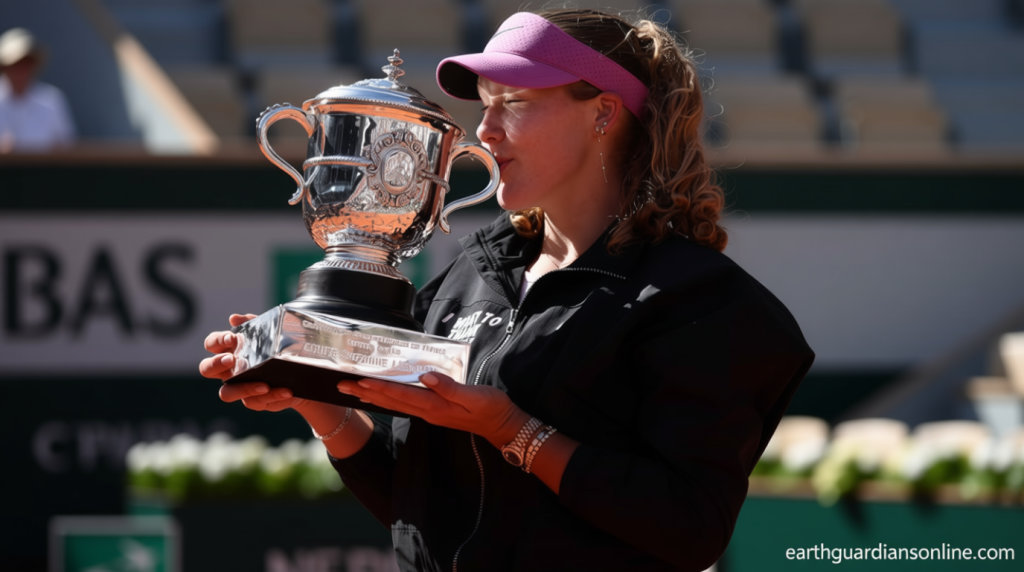
Russian Teen Mirra Andreeva Overcomes Inner Struggles to Claim French Open Victory
Russian teen Mirra Andreeva says she had – At 19, Mirra Andreeva, the Russian tennis prodigy, stood on the red clay of Roland Garros, her hands pressed against her face as she exhaled in a mix of relief and exhilaration. The young athlete, who had long battled internal challenges, finally achieved a milestone that had eluded her for years: her first Grand Slam title. This win, a 6-3, 6-2 triumph over Maja Chwalinska, a Polish qualifier ranked 114th, marked a significant moment in her career, ending a tournament that tested her mental resilience and determination.
Andreeva’s journey to this victory was anything but straightforward. Despite her technical prowess—particularly her aggressive baseline play—her greatest battles were fought within. “It wasn’t just the physical demands of the game,” said Conchita Martinez, her coach and former Wimbledon champion. “It was the constant push to stay focused, to trust my instincts, and to keep pushing forward even when the odds seemed stacked against me.” Martinez highlighted Andreeva’s unique blend of stubbornness and focus, traits that defined her performance in the final. “Her attitude is difficult,” Martinez explained, “because she doesn’t always take advice at face value. But when she listens and applies herself, there’s no ceiling to what she can achieve.”
A Triumph Beyond the Court
The emotional weight of the victory was palpable. Andreeva, who had dreamed of this moment for years, described the reality of winning as surpassing her wildest expectations. “I’ve imagined this scenario countless times,” she said during the trophy ceremony, her voice trembling slightly. “But nothing prepares you for the joy of holding that title in your hands.” Her words echoed the sentiment of many who had followed her meteoric rise, from her debut at 15 in Madrid to her current status as one of the sport’s most promising talents.
“The feeling in real life is so much better than in your dreams,” Andreeva admitted. “You can’t fully grasp the significance until it’s actually yours.”
Her triumph also carried symbolic weight. Chwalinska, the qualifier, had aimed to become the first player from outside the top 100 to win Roland Garros since 1992. But Andreeva’s victory solidified her place among the elite. The 19-year-old’s achievement surpassed even the legacy of Monica Seles, who was 18 when she won her third consecutive French Open. “You’re so young and talented. It’s so annoying,” Chwalinska remarked, a sentiment that reflected the pressure of competing against a player who seemed to embody the perfect blend of grace and grit.
Andreeva’s road to the final was fraught with obstacles. From her early days in Siberia, where she first showed promise, to her move to France to refine her game, her path was marked by perseverance. “I’ve always believed in myself,” she said, her voice steady despite the nerves that had plagued her throughout the two-week tournament. “Even when the world doubted me, I kept working.” This belief was further reinforced by her psychologist, who had supported her from Florida, offering guidance during her most challenging moments.
“Everything that you’ve told me, I’ve been trying to use these two weeks,” Andreeva said, thanking her mental health team. “It’s been a journey of constant self-reflection and growth.”
Her success also came at a time of personal and global tension. As a Russian player, Andreeva had to navigate the complexities of her identity amid the war in Ukraine. The tournament’s backdrop of geopolitical shifts added an extra layer to her emotions. “Every person doesn’t want to have a war in the world,” she said, reflecting on the pressure she felt as a representative of her country. “But when you step on the court, it’s just about the game.”
The Weight of Expectations
Chwalinska’s journey to the final was equally compelling. The Polish qualifier had once been a junior sensation, rivaling four-time Roland Garros champion Iga Swiatek. But her path was disrupted by depression, which she began to grapple with in 2019. “Tennis is such a tough sport. It’s so individual,” Chwalinska said. “We start so early, and people expect us to act like adults even when we’re just kids. The pressure is enormous.”
Andreeva’s win was not only a personal triumph but also a testament to her ability to thrive under scrutiny. As she stood on the podium, the crowd’s cheers echoing around her, she expressed gratitude for the unwavering support she received. “Thanks for your support today and over these past two marvelous weeks here in Paris,” she said in French, a gesture that underscored her connection to the French Open’s rich history and the international community that had rallied behind her.
From Siberia to the Spotlight
Andreeva’s story is one of transformation. Born in Siberia, she moved to Sochi and later to France, where she honed her skills under the watchful eyes of coaches and the rigorous demands of professional tennis. Her early achievements, including a historic performance at the 2023 Madrid Open where she became the third-youngest player to win a main draw match at a WTA 1000 tournament, hinted at her potential. But it was her resilience in the face of doubt that ultimately defined her success.
During the final, Andreeva faced a grueling test. The match was played under a mostly sunny sky, though wind conditions added an unpredictable element. Chwalinska, who began with a shaky first point due to a double fault, managed to secure an early lead, holding serve in the fifth game to take a 3-2 advantage. But Andreeva’s ability to adapt to the conditions proved critical. She moved forward to intercept rising balls, countering Chwalinska’s spin and drop shots with precision and confidence.
“She definitely has the mind of a champion,” remarked a commentator during the match. “When the pressure is on, she doesn’t back down. That’s what makes her special.”
The final moments of the match were a masterclass in mental fortitude. After Chwalinska retreated to handle high balls in the wind, Andreeva capitalized on the opportunity, seizing nine consecutive games to take control. “I never thought I’d be here,” she said, her voice filled with awe. “But I kept pushing, even when it felt impossible.” Her victory was not just a testament to her talent but also to her ability to overcome the emotional and psychological hurdles that come with being a teenage phenom.
A New Era for Women’s Tennis
Andreeva’s win has already sparked conversations about the future of the sport. At just 19, she joins an elite group of players who have redefined what it means to be a Grand Slam champion at a young age. Her triumph is also a reminder of the evolving landscape of tennis, where players from diverse backgrounds and ages are challenging the status quo. “This victory is a milestone for women’s tennis,” said a sports analyst. “It shows that talent, combined with mental strength, can defy expectations.”
As she celebrates her first major title, Andreeva remains grounded in her roots. “I remember the days when I was training in Siberia, dreaming of this moment,” she said. “Now, I’m here, and I
