
Tricycle ambulances are saving lives in Ghana
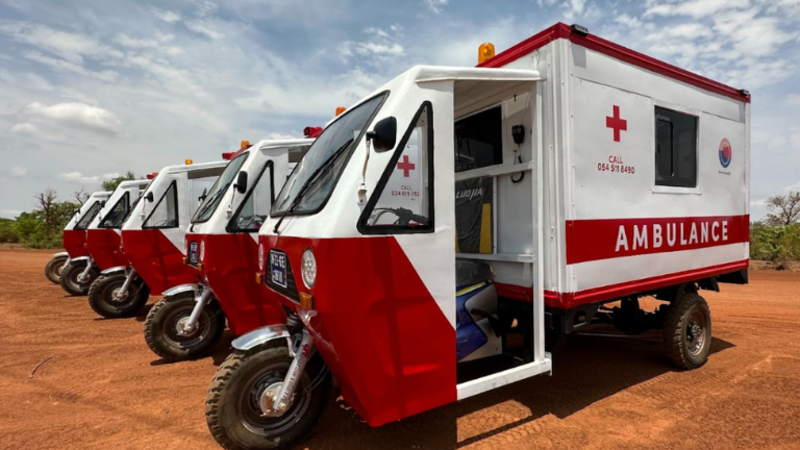
Tricycle Ambulances Are Saving Lives in Ghana
Tricycle ambulances are saving lives in Ghana – For Billeh Rosemount, a 24-year-old woman from a remote farming community in Northern Ghana, the journey to life-saving care began with a mix of fear and urgency. She was suffering a miscarriage, her blood loss uncontrolled by the midwife at her local clinic. With conventional ambulances scarce and impractical for the region’s rugged terrain, the challenge of reaching a hospital loomed large. Rosemount’s fate, however, changed when she was transported by a tricycle ambulance—a mobile medical solution engineered to navigate the difficult roads of rural Ghana.
Engineered for Rural Realities
Developed by Moving Health, a nonprofit organization focused on reducing maternal mortality in Ghana, these tricycle ambulances are designed to operate in areas where traditional vehicles struggle. Powered by a motorcycle engine, they are compact, robust, and tailored to the region’s infrastructure. The vehicles feature a full-length stretcher, space for a family member or community health worker, essential life-support equipment, and emergency birthing kits. Their ability to traverse narrow, unpaved paths ensures that even the most isolated communities can access critical care within a reasonable timeframe.
“I was bleeding and the midwife could not control the blood,” Rosemount recalled. “The midwife at her community clinic had to move her to a larger health center, but a standard ambulance would have taken hours, if it had arrived at all. Instead, Rosemount was transported using a tricycle ambulance.”
Transportation in rural Ghana often means waiting for hours or days, but the tricycle ambulance reduces this delay dramatically. For these communities, the average travel time to a hospital is two hours, yet without such vehicles, the journey could be far longer. Rosemount emphasized the difficulty of relying on motorbikes for transport, noting that neighbors might not always be willing to lend one. “You have to go and beg for somebody to get the vehicle,” she said. “It was very, very, very difficult for us.”
The importance of timely medical care cannot be overstated. In areas where hospitals are far away, even a delay of a few hours can mean the difference between life and death. Rosemount’s story is not unique—many women in rural regions face similar challenges. “Due to that, you have to just sit in the house and give birth,” she added. “You can lose one of the lives, the mother or the child.”
Global Context and Local Impact
Ghana’s maternal mortality rate remains significantly higher than many other regions, with 234 deaths per 100,000 live births recorded in 2023. While this is lower than the regional average, it is still 14 times higher than in the United States. Sub-Saharan Africa accounts for approximately 70% of global maternal deaths, according to the World Health Organization. Rural areas are particularly vulnerable, as distance and unreliable transportation contribute to critical delays in receiving care.
Maternal mortality is often exacerbated by poverty and limited infrastructure. In 2020, a Ghanian news outlet highlighted that only 55 ambulances served the entire country, underscoring the severe shortage of emergency transport. By 2024, the National Ambulance Service had grown to 356 ambulances, but this still leaves gaps in coverage, especially in remote districts. Moving Health has addressed these gaps by introducing tricycle ambulances, which are manufactured in the Upper West Region of Northern Ghana at a cost one-tenth that of traditional vehicles.
“Sometimes the biggest barrier to surviving a medical emergency isn’t the lack of hospitals,” said Emily Young, CEO and co-founder of Moving Health. “It’s being able to get there in time.”
The initiative began as a student project at MIT in 2016, conceived by Young and a group of mechanical engineering students. Its success led to permanent operations in Ghana by 2019. Today, Moving Health operates a fleet of 31 tricycle ambulances across five districts, serving over 230,000 people in regions without access to the National Ambulance Service. These vehicles are stationed at community clinics and can be reached via a hotline or by bike messengers if needed, ensuring proximity is maintained even in areas with unreliable cellular networks.
Isaac Quansah, Moving Health’s chief technology officer and country director, experienced the ambulance crisis firsthand. After his wife gave birth to their first child, postnatal complications left her immobile, and the lack of available transport forced Quansah to drive her to the hospital in a small car. “When I design an ambulance, I know that I have a reason,” he told CNN. “A life-fulfilling purpose for me to help other mothers not go through what my wife went through.”
Quansah oversees local manufacturing, employing and training engineers in Northern Ghana. The organization continuously upgrades its vehicles based on community feedback, ensuring they meet evolving needs. Health workers have shared insights that shaped the design: women often give birth during the journey to the hospital, especially at night. “Can you imagine trying to (deliver a baby,” Quansah mused, highlighting the urgency of the problem.
By combining affordability, accessibility, and adaptability, Moving Health has transformed emergency care in rural Ghana. The tricycle ambulances not only cut transport time by 64% but also provide a sense of security for families who once relied on hope rather than a reliable system. “This isn’t just about moving patients; it’s about moving hope,” Young explained. “When a woman knows she can reach a hospital quickly, she’s more likely to survive.”
The impact of such innovations is profound. In a country where maternal deaths are a persistent concern, these vehicles have become lifelines. They are particularly vital in regions where the nearest hospital may be 50 to 100 kilometers away. By bridging the gap between remote communities and critical healthcare, Moving Health is redefining what is possible in rural emergency medicine. As the organization expands its reach, it aims to make sure no woman is left behind when a medical emergency strikes.
Maternal mortality is a global issue, but in places like Ghana, it is deeply rooted in local challenges. The tricycle ambulance represents a creative solution that acknowledges the unique obstacles of rural healthcare. With ongoing support and community involvement, Moving Health continues to innovate, proving that even the most difficult conditions can be overcome with ingenuity and determination. Their work serves as a reminder that access to care is not just about the availability of medical facilities but also about the ability to reach them in time.
