
Murder or self-defense? Jury swiftly decides verdict in Texas track meet stabbing trial
Texas Track Meet Stabbing Trial: Jury Decides Murder or Self-Defense Verdict
Murder or self defense Jury swiftly – At the heart of a recent Texas trial stands the question: murder or self-defense? A jury swiftly reached a conclusion in the case of Karmelo Anthony, a 19-year-old accused of fatally stabbing Austin Metcalf during a high school track meet in Frisco, a Dallas suburb, in 2025. Prosecutors argued the attack was an intentional act of murder, while defense lawyers contended it was a legitimate case of self-defense. The jury’s rapid decision led to Anthony’s conviction and a 35-year prison sentence, marking a pivotal moment in the community’s ongoing discussion about race, bullying, and the use of force in school settings.
The Fatal Incident at the Track Meet
The confrontation took place on April 2, 2025, at Kuykendall Stadium during a local track competition. Karmelo Anthony, a student at Frisco Centennial High School, and Austin Metcalf, from Frisco Memorial High School, were both 17 years old at the time. According to the Frisco police report, the altercation began when Anthony sought shelter under a Memorial High tent. Metcalf and others reportedly demanded he leave, prompting Anthony to challenge Metcalf with a verbal taunt. The report claims Metcalf approached Anthony, who then pulled a knife and stabbed him once in the chest before fleeing the scene. This sequence of events remains central to the “murder or self-defense” debate.
A witness testified to police that Anthony reached into his bag and said, “Touch me and see what happens” before Metcalf made contact. The victim’s twin brother, Hunter Metcalf, tried to intervene after the stabbing, according to the report. Anthony, clad in Centennial gear, initially admitted to the act at the scene, telling Officer Eduardo Cortez, “He put his hands on me.” However, this statement was later contradicted when he told the officer, “I’m not alleged, I did it.” The conflicting accounts highlight the complexity of the “murder or self-defense” narrative.
Racial Dynamics and Trial Perspectives
The trial has intensified conversations about race, bullying, and the role of weapons in school environments. Anthony, a Black student, and Metcalf, a White student, have become symbols of the broader “murder or self-defense” discourse. Collin County District Attorney Greg Willis emphasized the emotional toll of the event, stating, “When something like this happens at a school event, it shakes people to the core.” His remarks underscore the community’s anxiety over the circumstances that led to the killing. Meanwhile, defense attorney Mike Howard framed Anthony’s actions as a reaction to fear, arguing that Metcalf had initiated the conflict.
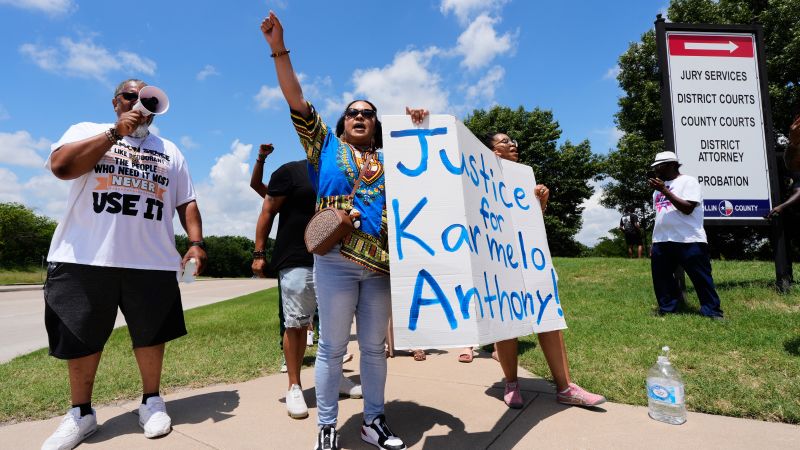
Prosecutor Bill Wirskye dismissed the self-defense claims, insisting the stabbing was an “unprovoked, unjustified murder.” The trial’s outcome has also drawn comparisons to Kyle Rittenhouse’s 2021 acquittal in Kenosha, Wisconsin. Supporters of Anthony, including the Next Generation Action Network, see the case as a test of how “murder or self-defense” verdicts are applied in racially charged situations. The public’s divided opinions are reflected in two major fundraisers: one for Anthony’s family raised over $625,000, while another for Metcalf’s family collected nearly $600,000, showing the emotional weight of the “murder or self-defense” question.
Legal Proceedings and Jury Composition
The trial’s proceedings were closely watched, with a particular focus on jury selection. WFAA reported that no Black jurors were chosen, sparking concerns about potential bias in the “murder or self-defense” case. The courtroom was also tightly controlled, as cameras were barred and public seating was limited, creating a tense atmosphere. The prosecution presented its case late last week, while the defense delivered arguments on Monday, leaving Anthony without an opportunity to testify in his own defense. Closing arguments on Tuesday morning concluded the trial, leading to a swift jury decision.
Public sentiment was polarized, with activists like Jake Lang engaging in heated exchanges outside the courthouse. The trial has become a flashpoint for debates about justice, racial dynamics, and the interpretation of self-defense. As the “murder or self-defense” verdict was announced, the case will continue to shape discussions about how school violence is judged in a society increasingly divided by race and circumstance.
