
Tear your eyes away from the ballroom. This courthouse is the real face of Trump-era architecture
Tear your eyes away from the ballroom. This courthouse is the real face of Trump-era architecture
A New Symbol of Presidential Influence
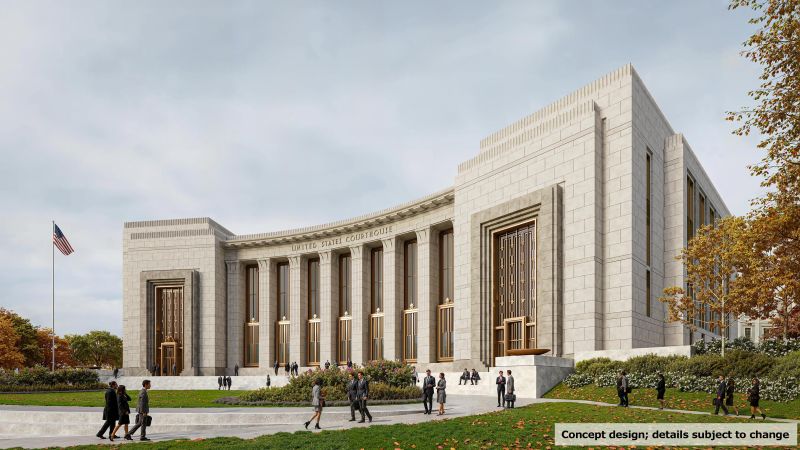
Tear your eyes away from the ballroom – Last week, in a city nestled 500 miles south of Washington, DC, officials quietly revealed a project that could redefine the visual identity of federal architecture in the United States. While President Donald Trump’s opulent White House ballroom and ambitious triumphal arch project have consistently drawn the spotlight, the Chattanooga courthouse stands as a more tangible testament to his executive directive: “Making Federal Architecture Beautiful Again.” Set to open in 2030, this structure is not merely a building but a bold statement of aesthetic philosophy, blending Art Deco motifs with classical Greek elements to create a design that exudes authority and permanence.
The Fusion of Styles in a Modern Context
The courthouse, designed by the otherwise contemporary firm HOK, features a robust, muscular form that nods to ancient temples while embracing the geometric precision of Art Deco. Its design includes a series of square columns flanked by two substantial, mausoleum-like volumes, evoking a sense of armored grandeur. This combination, dubbed “Greco-Deco” by its creators, reflects a deliberate attempt to merge traditional motifs with modern materials and construction techniques. Unlike the White House’s flamboyant spaces, the Chattanooga courthouse aims to communicate stability and tradition through its imposing yet elegant silhouette.
Political and Architectural Significance
The project is the first major federal design announced under Trump’s 2025 executive order, which mandated a shift toward “classical and traditional” styles for public buildings. While the order has sparked debate within the architectural community, the Chattanooga courthouse serves as a concrete example of its implementation. The National Civic Art Society (NCAS), which helped draft the directive, praised the design as a “showpiece” of the president’s vision. NCAS president Justin Shubow, a staunch proponent of classical architecture, argued that the project demonstrates how tradition can remain relevant and innovative. “Classicism is still alive, can be done well, and can be both traditional and original,” he stated in a video call, emphasizing the balance between heritage and contemporary creativity.
Critics See a Deeper Message
Despite the praise from some quarters, not all observers are convinced. Kevin D. Murphy, a professor and chair of the history of art at Vanderbilt University, questioned whether the design aligns with the ideals of transparency and democracy. “To me it isn’t at all transparent,” he said over the phone. “It is very formidable and very solid, in a very conventional way.” Murphy suggested that the courthouse’s resemblance to 1930s classicism might evoke associations with fascist regimes, a critique that highlights the political undertones of Trump’s aesthetic choices. “Is that the message you want to send about the judiciary? That it’s intimidating?” he asked, challenging the notion that such a design serves as an emblem of judicial integrity.
A Handsome Design, But with a Purpose
Christopher Hawthorne, a former architecture critic for the Los Angeles Times and current contributor to the Punch List newsletter, offered a slightly more measured perspective. He called the Chattanooga courthouse a “handsome design” with “the potential to be perfectly competent.” However, he argued that architecture should transcend mere appearance and reflect broader societal values. “I don’t think that this courthouse design has anything to say, except reflecting the current occupant of the White House,” he noted, suggesting that the building’s style is less about function and more about reinforcing the president’s cultural agenda.
Public Reception and Long-Term Impact
The debate over Trump’s architectural influence has extended beyond professional circles. A Harris Poll conducted in 2020 for the National Civic Art Society found that 70% of Americans prefer traditional designs over modern or postmodern alternatives for public buildings. This statistic underscores a potential shift in public sentiment, even as critics warn of a broader culture war. The American public may not yet be fully divided, but the design of the Chattanooga courthouse has become a focal point for discussions about the role of architecture in shaping national identity.
Legacy and Future Directions
While the project is a direct result of Trump’s executive order, its success may depend on how it is perceived in the long run. The building replaces the 1930s Joel W. Solomon Federal Building and US Courthouse, which already bore classical influences. However, the updated design is more assertive in its use of symbolic elements, such as the monumental columns and solid massing. This approach has led to speculation about its impact on future federal projects. “Architecture has a responsibility to say something fundamental about contemporary society,” Hawthorne pointed out, raising the question of whether the courthouse’s grandeur accurately represents the values it aims to uphold.
Broader Implications for Federal Projects
The slow pace of major federal projects has meant that the Chattanooga courthouse is one of the first to clearly demonstrate the practical application of Trump’s design philosophy. HOK, the firm responsible for the project, has not commented on the criticism, leaving room for further debate. As the building nears completion, its legacy will likely be judged not just on its visual appeal but on its ability to embody the principles of the new era in American architecture.
Reflections on Tradition and Innovation
For many in the field, the design represents a tension between the desire for historical continuity and the need for innovation. Shubow acknowledged this duality, noting that while the courthouse reflects a traditional aesthetic, it also incorporates modern materials and techniques. “I think architecture firms should be very wary of having their work enlisted in this sort of culture war,” he said, highlighting the political dimension of the project. Yet, he remained optimistic about the potential for classical styles to inspire rather than constrain.
Conclusion: A Test of Architectural Ideals
As the Chattanooga courthouse prepares to open, it stands as a symbol of both opportunity and controversy. Its design captures the essence of Trump’s vision for federal architecture, blending historical references with a contemporary context. Whether it is viewed as a triumph of tradition or a reinforcement of authoritarian aesthetics will depend on how its features are interpreted. For now, the building serves as a powerful reminder of the influence of presidential leadership on the built environment. Its fate may well shape the future of American architecture for years to come.
“Classicism is still alive, can be done well, and can be both traditional and original.” — Justin Shubow, NCAS president
“To me it isn’t at all transparent. It is very formidable and very solid, in a very conventional way.” — Kevin D. Murphy, Vanderbilt University professor
“I don’t think that this courthouse design has anything to say, except reflecting the current occupant of the White House.” — Christopher Hawthorne, former Los Angeles Times architecture critic
