How smartphones and the New York Knicks created Brooklyn’s biggest block party

How Smartphones and the New York Knicks Transformed Brooklyn’s Block Party Scene
The Spectacle of Spectatorship
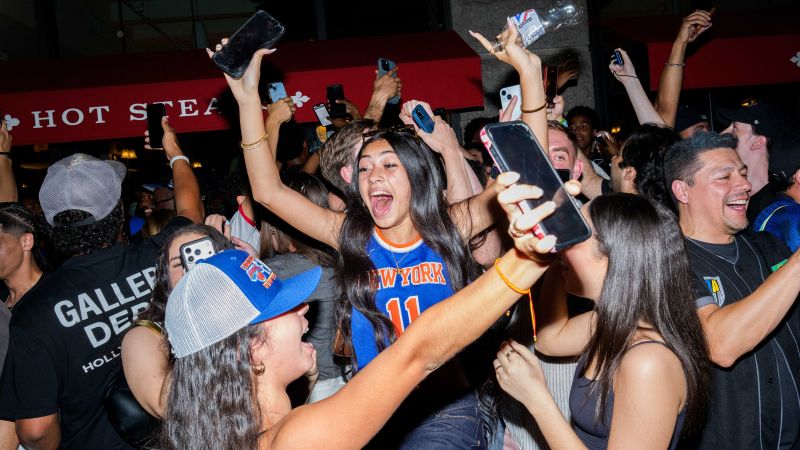
How smartphones and the New York – As the New York Knicks advanced through the Eastern Conference Finals, their improbable victories and dominance over rivals created a unique phenomenon in Brooklyn. The city’s watch parties, traditionally centered around Madison Square Garden, evolved into a mosaic of digital engagement. Fans gathered not just to cheer, but to curate their own experiences, their phones acting as both tools and stages for participation. The atmosphere outside the arena became a microcosm of modern fandom, where semi-professional streamers manipulated the environment for viral appeal, drawing crowds to join in the spectacle.
“Anyone doing anything worth noticing made sure it was caught on cameras, lest they forgo the possibility of viral stardom which can be parlayed into a partnership with a savvy, if unsavory, prediction market.”
These gatherings, fueled by the ubiquity of smartphones, blurred the lines between passive observation and active performance. The presence of gimbals and selfie sticks turned even mundane moments into dramatic scenes, as fans reenacted the excitement of the game in real-time. Yet, this digital layer of engagement only deepened the divide between the audience and the action, creating a cycle where the act of watching was inseparable from the need to be seen watching.
The Evolution of a Fanbase
The Knicks’ journey to the finals was more than a sports story—it was a cultural renaissance for their followers. After decades of mediocrity, the team’s resurgence sparked a frenzy of devotion. Brooklyn, once a secondary market for Knicks fans, became the epicenter of this new era. The city’s fans, now a generation older than the last time the Knicks celebrated a championship in 1973, found themselves rekindling the same passion that defined their childhoods.
This revival was not just about the game itself. It was about the collective experience of being part of something greater than individual ambition. Every win was a reminder of the shared history, the long wait for glory, and the communal joy of victory. The block parties that erupted across the borough mirrored this sentiment, with crowds gathering in neighborhoods far from the arena to relive the triumphs of the team that had become a symbol of resilience.
Time, Memory, and the Digital Mirror
One of the most striking aspects of the Knicks’ playoff run was how it juxtaposed past and present. The team’s historic return to the NBA finals after a 53-year drought forced fans to confront the passage of time. Those who had followed the Knicks as children now stood alongside their own kids, watching the same basketball magic unfold. The connection across generations was palpable, yet the digital age had altered the way this connection was experienced.
Smartphones became the bridge between eras, capturing the moment in real-time while also preserving it for future reflection. The ability to share victories instantly created a sense of immediacy, but it also detached the experience from its original context. As the playoffs progressed, the city’s collective memory seemed to be rewired by the constant stream of highlights, polls, and social media reactions. The Knicks’ journey was no longer just a series of games—it was a living narrative, one that was constantly being reshaped by the lens of technology.
The Block Party in Full Bloom
In the heart of Brooklyn’s Fort Greene neighborhood, the block party reached its zenith. Streets were filled with fans who had arrived hours in advance, equipped with picnic blankets, beach chairs, and drinks to keep the energy high. The Cuban restaurant’s outdoor projection screen became a makeshift arena, drawing thousands to witness the Knicks’ final push for glory. Yet, the sheer size of the crowd led to logistical challenges, with police temporarily halting the broadcast to manage traffic and ensure safety.
Despite the interruption, the spirit of the event remained unshaken. Even when the game was paused, fans clung to their phones, streaming the action from nearby bodegas or communal TVs. The ability to watch from anywhere, at any time, transformed the block party into a distributed phenomenon. While some sought the immersive experience of a projected game, others preferred the intimacy of their own screens, creating a hybrid of celebration that spanned both physical and digital spaces.
The Duality of Connection and Isolation
As the Knicks clinched their long-awaited victory, the city’s blocks became a stage for both unity and fragmentation. The shared excitement of the moment was undeniable, yet the reliance on smartphones introduced a new layer of individualism. Fans cheered in unison, yet their eyes were often fixed on their devices, capturing the moment for later playback. This duality—of collective joy and personal documentation—highlighted the paradox of modern fandom: the more connected we are through technology, the more isolated our experiences feel.
The Knicks’ journey had become a testament to the power of perseverance, but it also underscored the role of technology in amplifying that perseverance. From the moment the first game was broadcast to the final buzzer, smartphones had been the silent architects of this revival. They allowed fans to witness every play, to participate in every moment, and to share their enthusiasm with a global audience. Yet, in doing so, they also redefined the meaning of “being there,” turning the physical act of gathering into a digital echo.
A Legacy Reborn
The Knicks’ success in the finals was not just a triumph for the team but for the city itself. For Brooklyn, it was a return to prominence in the world of basketball, a chance to reclaim the narrative of a team that had once been a beacon of hope. The block parties that followed were a celebration of this rebirth, a visual representation of the city’s renewed investment in its athletic roots. Yet, the event also served as a reminder of the fleeting nature of such moments.
While the Knicks’ victory was a landmark, the block party’s essence lay in its transient quality. The temporary shutdown of the game’s projection was a small but symbolic disruption, a reminder that even the most electrifying moments must be managed. But this disruption only added to the allure, as fans stayed to watch the clinch on their phones, their screens glowing like a thousand tiny lanterns in the night. In that moment, Brooklyn was not just a city—it was a living archive of basketball dreams, a place where time folded in on itself to create something magical.
The Knicks’ run through the playoffs had done more than reshape the narrative of the team; it had redefined how Brooklyn engaged with its sports culture. The block party, once a simple gathering, had become a complex interplay of technology, tradition, and human connection. As fans celebrated their return to the finals, they did so with the same fervor that had once filled the stands of Madison Square Garden. The difference now was the screens—each one a portal to the game, each one a piece of the larger story.
And yet, the essence of sports remained unchanged. The Knicks’ victory, like every great triumph before it, was a moment that transcended the individual. It was a collective memory, a shared experience that would be replayed in the years to come. The smartphones, for all their power to document and disseminate, could not fully capture the raw emotion of the moment. That remained, in the hearts of the fans, a reminder of why they had come together in the first place: to witness history as it unfolded, and to be part of it.