The Milky Way’s black hole is eerily quiet. Scientists have now found evidence of its missing wind

Milky Way’s Black Hole Wind Finally Detected: A Scientific Breakthrough
Uncovering the Milky Way’s Black Hole Mystery
The Milky Way s black hole – For over five decades, scientists have puzzled over the Milky Way’s black hole, Sagittarius A*, which has remained unusually quiet compared to other supermassive black holes in distant galaxies. This enigmatic object, with a mass equivalent to about 4 million suns, has long been observed as a dormant giant, lacking the dramatic activity seen in its cosmic counterparts. However, recent findings have challenged this perception, revealing evidence of a previously undetected wind streaming from the black hole. Published in *The Astrophysical Journal Letters*, this study provides crucial insights into how Sagittarius A* interacts with its galactic environment, reshaping our understanding of black hole behavior.
The discovery stems from advanced observational techniques that have allowed researchers to peer deeper into the dynamics of the Milky Way’s black hole. For years, the absence of visible outflows puzzled astronomers, as theoretical models predict that such massive objects should expel material through high-speed winds. Yet, earlier data only hinted at ancient remnants of these outflows, leaving the question of Sagittarius A*’s current activity unresolved. “The Milky Way’s black hole has defied expectations,” remarked Lena Murchikova, an assistant professor at Northwestern University, who played a key role in the analysis. “Its wind, once thought missing, is now confirmed through meticulous data examination.”
“The Milky Way’s black hole seemed to be behaving differently than its faraway relatives. That inconsistency was a major hurdle in our research.”
Methodology and Key Observations
Researchers from Northwestern University spent five years analyzing data from cutting-edge radio telescopes to unravel this mystery. By leveraging the Atacama Large Millimeter/Submillimeter Array (ALMA), they achieved the most detailed mapping of cold gas near Sagittarius A* to date. This breakthrough allowed them to detect a cone-shaped void in the gas distribution, a clear indicator of a hot, high-velocity wind. The team meticulously eliminated radio interference to ensure accuracy, confirming that the wind’s effects are subtle yet significant. “This wind is not just a minor disturbance—it’s a powerful force shaping the galactic core,” said Mark Gorski, the study’s lead researcher.
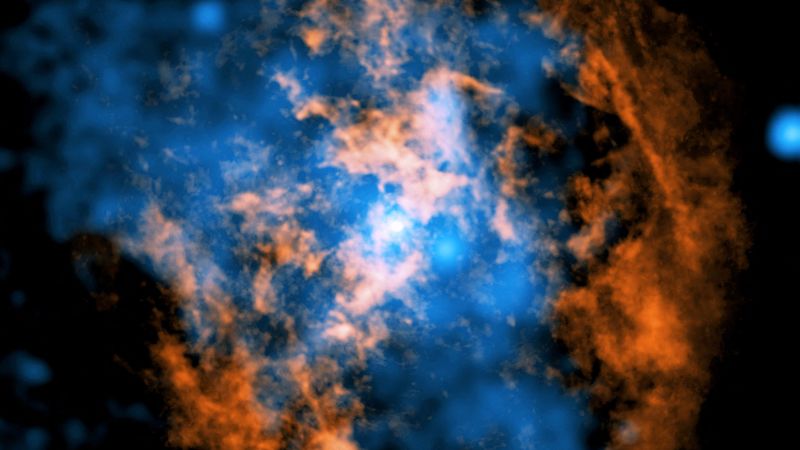
The wind’s behavior aligns with theoretical models of how supermassive black holes influence their surroundings. As material spirals into the event horizon, it generates intense friction and magnetic fields, propelling plasma outward at extreme speeds. The Milky Way’s black hole, though less active, still exhibits this process, albeit on a smaller scale. By comparing ALMA data with observations from NASA’s Chandra X-ray Observatory, scientists confirmed the presence of hot plasma interacting with the surrounding interstellar medium, creating a dynamic interplay of forces that has left a visible imprint in the gas structure.
Implications for Galactic Evolution
The detection of Sagittarius A*’s wind carries profound implications for understanding galaxy evolution. These outflows, often termed “feedback mechanisms,” regulate star formation by redistributing energy and material across the galactic core. In other galaxies, such winds have been linked to the suppression of excessive star birth, maintaining a delicate balance in cosmic ecosystems. “The Milky Way’s black hole is a unique laboratory for studying these processes,” added Christopher Reynolds, an astronomy professor at the University of Maryland. “Now that we’ve identified its wind, we can better model how it influences the galaxy’s structure and future development.”
This finding bridges a critical gap in our knowledge of black hole activity. While Sagittarius A* has been relatively quiescent, its wind suggests that it has been actively sculpting the galactic environment for thousands of years. The study’s implications extend beyond the Milky Way, offering a new perspective on the role of supermassive black holes in shaping the universe. “The Milky Way’s black hole may not be as passive as we believed,” Gorski emphasized. “Its hidden influence is now visible, thanks to advancements in observational technology.”