Wyndham Clark builds early 4-shot lead at US Open with lowest 36-hole score at Shinnecock

Wyndham Clark Sets 36-Hole Benchmark at US Open, Leads by Four Shots
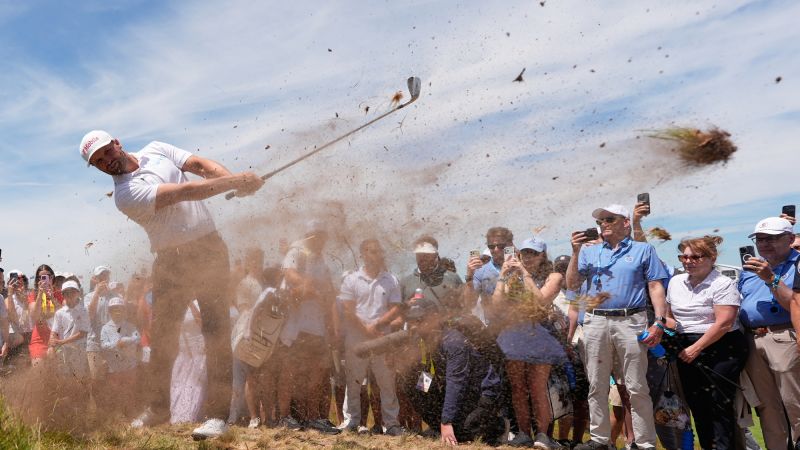
Wyndham Clark builds early 4 shot – Wyndham Clark has once again made his presence felt at Shinnecock Hills, solidifying his position as a formidable contender in the US Open. After posting the lowest opening round in the tournament’s history on Friday morning, he followed up with a composed second round, securing a four-shot advantage heading into the final two days. His steady performance contrasts sharply with last year’s struggles, when he missed the cut at Oakmont and famously damaged a locker in frustration. This time, Clark’s focus and composure have been key, as evidenced by his 69 in the second round, a score that placed him at 7-under 133—a mark surpassing the halfway performance of Phil Mickelson and Shigeki Maruyama in 2004 at the same Shinnecock venue.
Clark’s resilience was on full display as he navigated the course’s challenges with precision. The 18th green, known for its difficulty, became the stage for his final act—a 35-foot birdie putt that dropped and sealed his early lead. While the Shinnecock course remains unforgiving, Clark believes his performance is still evolving. “I really felt like I could be in double digits under par,” he said, reflecting on his potential. “But the great thing is, I didn’t feel like I was at my best, and I’m still in the lead. I hope to bring my A-game on the weekend.”
Consistency Among Contenders
Clark’s dominance was echoed by several other players who found their rhythm on the Shinnecock layout. Xander Schauffele, a regular in the US Open, posted a 66 to finish at 137, joining Matt Fitzpatrick in the same group. Fitzpatrick, a former champion, salvaged a 70 with two birdies in his final three holes, showcasing his ability to adapt under pressure. Similarly, Sam Stevens and Tom Kim contributed to the pack, with Stevens recording a 69 and Kim a 67, both finishing at 137. The course’s conditions, however, began to shift during the afternoon as it dried out, making the second round more demanding than the first.
Scottie Scheffler, aiming for a career Grand Slam, maintained a steady pace with a 68, finishing at 140. Rory McIlroy, who had been closing in on Clark, faced a rocky start to the back nine, beginning with three consecutive bogeys. Despite that, both McIlroy and Clark remain confident in their prospects. “If there’s a course where you feel like you still have a chance when you’re seven back, it’s definitely this one,” McIlroy remarked, acknowledging the evolving nature of Shinnecock as it gets drier and faster over the next two days.
Struggles and Surprises in the Field
While Clark and his peers thrived, not everyone found the same success. The two biggest stars from LIV Golf, Bryson DeChambeau and Jon Rahm, both missed the cut, highlighting the competitive gap. DeChambeau, who had already missed three consecutive majors, struggled to maintain consistency, while Rahm, a PGA Championship runner-up, failed to capitalize on his potential. His 78 in the second round marked his highest score in a US Open, with the USGA penalizing him for a two-shot penalty after he hit two drives off the property and lost his temper by throwing his club on the 15th hole of the fog-delayed first round.
For Rahm, the incident was a costly setback. The USGA’s decision to enforce the penalty immediately, without a prior warning, underscored the majors’ stricter behavior policies this year. The Masters was the first to implement the rule, and now Shinnecock Hills is following suit. Despite the penalty, Rahm managed to post a 65 in the second round, finishing at 3-over 143. This achievement is notable because it marks the first time in 97 years that a player has made 10 or more strokes over par in a US Open and still made the cut.
Collin Morikawa and the Morning Test
Collin Morikawa, who also shot a 65 in the second round, tied for the lowest score of the day. However, his performance left him in sixth place, five shots behind the leaders. The challenges of the course were compounded by the early morning start, as players had to return to the course at 6:35 a.m. after a 10-hour delay due to fog. This unusual schedule tested not only physical endurance but also mental fortitude, with the greens still relatively soft from the morning dew.
Justin Thomas and Sam Burns, who were part of the final group last year, also found themselves in contention, finishing at 139. Their performance, while commendable, pales in comparison to Clark’s commanding lead. The shifting weather and course conditions added another layer of difficulty, as the sun’s presence made the second round more challenging than the first. For Clark, this meant maintaining his focus and adapting to the demands of a rapidly changing layout.
Legacy and Future Prospects
The US Open at Shinnecock Hills continues to be a crucible for golf’s elite, testing their ability to perform under pressure. Clark’s 7-under 133 not only sets a new benchmark for the tournament’s opening 36 holes but also positions him as a strong favorite for the title. His early lead suggests that the course’s difficulty may favor players with composure and precision, traits he has demonstrated throughout the weekend.
Meanwhile, the inclusion of players like Joaquin Niemann and Collin Morikawa underscores the depth of talent in this year’s field. Niemann’s penalty for his outburst on the 15th hole may have cost him momentum, but his 65 in the second round still earned him a place in the cut. As the tournament progresses, the Shinnecock course is expected to become even more demanding, with its drier conditions and faster pace likely to test the limits of even the most seasoned professionals. The stakes are high, and the next two days could determine who emerges as the champion of this historic event.
With the field still in flux, Clark’s performance remains a focal point. His ability to stay calm and capitalize on opportunities has set him apart, and as the USGA continues to shape the course, his lead could either grow or shrink. The tournament is far from over, and every stroke from the remaining players could shift the balance of power. For now, however, Clark stands at the forefront, his 7-under total a testament to his skill and resilience.
A Shift in the Game’s Landscape
As the US Open progresses, the role of golf equipment is becoming increasingly significant. With advancements in technology and the integration of AI, the sport is on the brink of a new era. The ability to analyze data in real time and optimize performance could give players an edge, especially on a course like Shinnecock, where every decision carries weight. For Clark and his rivals, the challenge is not just about mastering the physical aspects of the game but also adapting to the evolving tools that shape modern golf.
The tournament’s legacy is also at play, with Shinnecock Hills serving as a classic test of character and skill. As players navigate the course’s demands, the 2004 record of 78.7 for the final round remains a benchmark, though this year’s field has already shown that it can compete with the best of them. With the competition fierce and the course becoming more unforgiving, the final two rounds promise to be a thrilling spectacle. Clark’s journey is just beginning, and the path to victory is as challenging as ever.