The ‘earthquake gate’ stopping a San Andreas disaster is under its highest stress in 1,000 years

San Andreas Fault at Record Stress Levels: 1,000-Year Risk for Major Earthquake
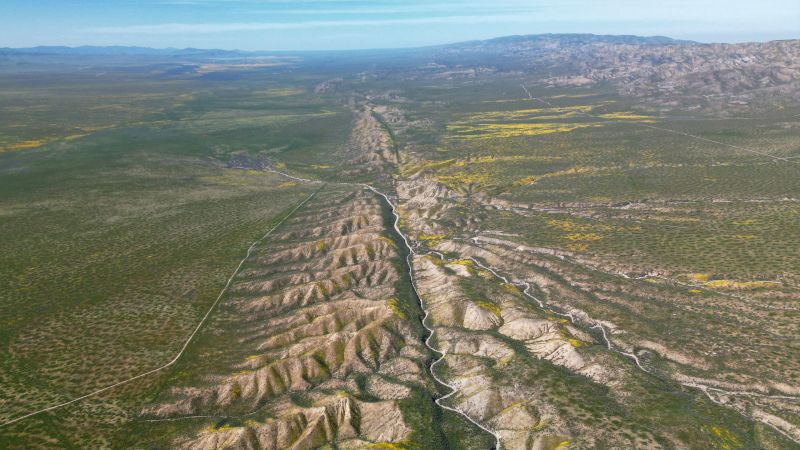
The earthquake gate stopping a San Andreas – Los Angeles, a city known for its cinematic thrills, now faces a seismic reality that could surpass even the most dramatic film scenes. A recent study reveals that the San Andreas fault—often referred to as the “earthquake gate” due to its role in determining fault behavior—is under unprecedented stress, with levels reaching their highest in over a millennium. This critical tectonic boundary, spanning Southern California, has accumulated energy that could lead to a catastrophic rupture, potentially triggering a widespread earthquake with devastating consequences for the region.
Stress Buildup and Fault Interaction Dynamics
The San Andreas and San Jacinto fault systems, which mark the boundary between the Pacific and North American tectonic plates, have remained locked for centuries. While annual plate movement is gradual, certain segments of these faults have been rigid, creating a buildup of stress that could release suddenly. Scientists warn that the current stress levels at Cajon Pass, a key intersection point, are nearing a threshold that might alter the fault’s behavior, making a multi-fault earthquake more likely than in previous centuries.
The “earthquake gate” concept highlights how stress distribution across fault lines can determine the scale of an event. Researchers found that stress differences between the San Andreas and San Jacinto faults have surged to 0.8 megapascals, significantly higher than the 0.3 megapascals observed in historical patterns. This imbalance suggests that a rupture starting on one fault could propagate to the other, creating a larger seismic event than isolated earthquakes typically produce.
Historical Context and Modern Data
Historical records provide insight into the potential for such interactions. The 1812 Wrightwood earthquake, which reached 7.5 on the Richter scale, is believed to have traversed Cajon Pass, affecting both fault systems and causing 40 fatalities. Today’s measurements show that stress on the San Jacinto Bernardino segment has increased to 3.6 megapascals, surpassing past peaks by 20%. Meanwhile, the Mojave South segment of the San Andreas fault records 2.8 megapascals, a level that has not been seen in a decade.
By analyzing the last 1,000 years of seismic activity, researchers identified a pattern where large ruptures tended to pass through Cajon Pass only when stress differences between the faults were minimal. The current situation, however, indicates a critical imbalance, raising concerns about the fault systems’ ability to contain energy safely. This finding underscores the importance of monitoring stress dynamics for accurate earthquake predictions.
Implications for Regional Infrastructure
The potential for a multi-fault earthquake could impact infrastructure across Southern California. A major rupture on the San Andreas fault alone might generate a 6.7-magnitude quake, but its interaction with the San Jacinto system could escalate the event to 7.4 to 7.8. Such a scenario would threaten major highways, railways, and energy networks, extending damage from Los Angeles through San Bernardino and into the Coachella Valley. The economic and social consequences of this could be profound, especially for densely populated areas.
Matthew Weingarten, a geologist at San Diego State University, emphasized that the stress balance at Cajon Pass is a key factor in earthquake magnitude. “Understanding this physics-based estimate is vital,” he said, noting that the current stress levels suggest the system is poised for a significant event. This insight could reshape how experts model seismic risks, shifting focus from arbitrary timelines to real-time stress monitoring.
Expert Perspectives and Preparedness Calls
The study’s lead author, Liliane Burkhard of the University of Bern in Switzerland, explained that the stress configuration today mirrors historical patterns where faults interacted to create larger earthquakes. “The gate’s position determines whether energy remains localized or spreads across multiple faults,” she said. Her team’s work, conducted partly at the University of Hawaiʻi at Mānoa, highlights the complexity of predicting seismic events and the need for updated risk assessments.
While the findings do not guarantee an immediate disaster, they signal an urgent need for improved preparedness. Emergency planners must account for the possibility of a larger rupture, which could affect more people and cause greater destruction than isolated quakes. Public awareness campaigns and infrastructure upgrades are critical to mitigating the impact of a potential San Andreas earthquake, ensuring communities are ready for the worst-case scenario.