
It’s a 6-3 Supreme Court: Ideological splits mount ahead of major end-of-term rulings
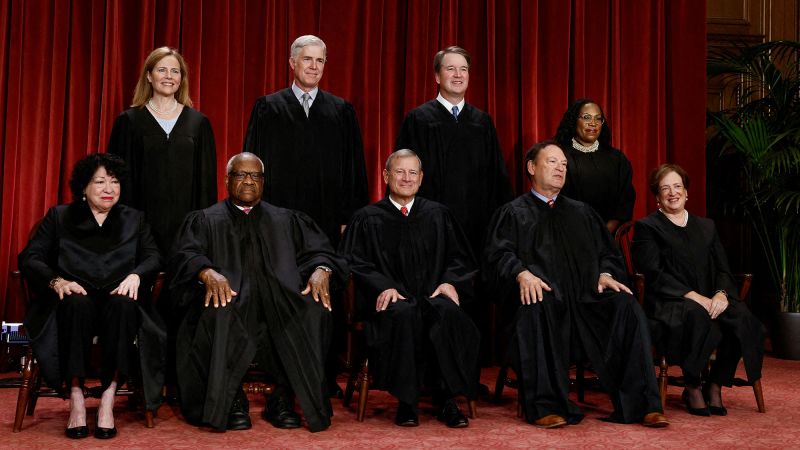
Supreme Court Faces Growing Ideological Divide as Term Winds Down
It s a 6 3 Supreme – As the Supreme Court approaches the end of its current term, it has reached a notable milestone: the frequency of its 6-3 rulings has surged, surpassing the total number from the previous term. This trend highlights a deepening partisan split among justices, with ideological alignment increasingly shaping the court’s decisions. The justices are set to release their upcoming rulings on Thursday, continuing a pattern that has drawn scrutiny from both political factions.
The Rise of Ideological Polarization
The court’s recent activity has underscored a shift toward ideological decision-making. Out of the five rulings issued this week, four were split 6-3, reflecting a stark divide between conservative and liberal justices. These decisions have touched on a range of issues, from the rights of religious prisoners to the legal challenges involving international property claims. Notably, the court’s early rulings this term have already surpassed the number of such splits from the prior year, signaling a potential new norm in how cases are resolved.
Among the most contentious rulings, the court’s April decision on the Voting Rights Act stands out. By striking down key provisions of the law, the justices effectively empowered Republicans to redraw congressional districts in Southern states like Louisiana and Alabama, creating favorable conditions for the GOP in this year’s midterm elections. This outcome, along with others, has sparked debates about the court’s role in shaping political outcomes and its perceived legitimacy in a polarized era.
Partisan Rulings and Their Implications
While critics often point to the 6-3 rulings as evidence of the court’s politicization, the justices themselves have emphasized the importance of unanimous decisions. Last month, Justice Amy Coney Barrett, a conservative appointee, dismissed the focus on partisan splits, arguing that the media overstates their significance. She noted that the majority of the court’s cases are resolved with broader consensus, even if some involve highly technical legal arguments.
Similarly, Justice Neil Gorsuch, who was appointed by President Trump in 2017, highlighted the court’s track record of unanimous rulings. “Nine old people appointed by five different presidents over the course of 30 years from all around the country, and we are able to resolve cases lower courts disagreed on unanimously 40% of the time,” Gorsuch remarked during a speech at the Reagan Library. This statistic, he argued, demonstrates the justices’ ability to find common ground despite their ideological differences.
Examples of Split Rulings
Recent cases have further illustrated the court’s ideological divide. A 6-3 decision barred a Rastafarian man from suing prison officials after they cut his dreadlocks, citing a federal law that prioritizes institutional efficiency over religious practices. Another ruling allowed Exxon to pursue legal action against the Cuban government for property seized in 1960, reinforcing the court’s stance on international contracts. These cases, though seemingly disparate, underscore how the justices’ differing philosophies influence their interpretations of law.
The court’s split decisions have also raised questions about its approach to contemporary issues. For instance, the ruling on whether President Trump could remove officials from independent federal agencies, such as the Federal Trade Commission, was decided along ideological lines. This outcome has fueled accusations that the court is becoming a political body rather than an impartial arbiter of the law.
The Role of the Media and Public Perception
Political observers have seized on the 6-3 trend to argue about the court’s direction. Critics from the left and right alike use these splits to frame the justices’ decisions as either an expansion of conservative power or a shift toward liberal dominance. However, the justices have sought to counter this narrative by emphasizing the prevalence of unanimous rulings. According to data from SCOTUSblog, nearly 14% of the court’s merits decisions from 2020 to 2024 were split along ideological lines, a figure that has steadily grown.
David Cole, a Georgetown Law professor and former ACLU legal director, has warned that the court’s reliance on partisan splits undermines its credibility. “The justices are supposed to be guided by law, not politics,” Cole stated in a recent interview. He argued that while differing legal perspectives are natural, the increasing frequency of 6-3 decisions risks making the court appear as an extension of the political process rather than an independent institution.
Unanimous Rulings and the Court’s Docket
Despite the rise in 6-3 decisions, the Supreme Court has still managed to reach more than half of its rulings unanimously. This includes cases such as the February decision invalidating Trump’s global tariffs, which saw a majority of three conservatives and three liberals align. Such outcomes suggest that the justices are not entirely divided on major issues, though their ideological differences often surface in more politically charged cases.
However, as the term nears its conclusion, the court’s docket is expected to intensify. With a dozen landmark cases remaining, the likelihood of unanimous rulings will likely decrease. These cases, including those on presidential power and transgender rights, are anticipated to test the justices’ ability to maintain unity. The focus on these high-stakes issues has already led to heated exchanges among the justices, both in written opinions and public statements, as they navigate the challenges of their current term.
The Legacy of a Polarized Court
The growing emphasis on ideological splits has reshaped the Supreme Court’s public image. While some argue that the justices are simply reflecting the broader societal divide, others contend that the court is becoming an arena for partisan battles. The upcoming rulings, particularly those involving significant policy impacts, will likely determine whether this trend continues or if the justices can find a way to balance their differences.
As the court prepares to deliver its final decisions of the term, the question remains: will its decisions reinforce the perception of a politicized judiciary, or will they showcase a return to judicial independence? The answer may hinge on how the justices handle their remaining cases and whether they can maintain a narrative of impartiality amid mounting criticism. The stakes are high, and the implications extend far beyond the courtroom, influencing the future of American law and governance.
