
John Roberts fought for decades to overturn Humphrey’s Executor
John Roberts Championed Over Four Decades to Repeal Humphrey’s Executor
John Roberts fought for decades to overturn – Chief Justice John Roberts has long advocated for a US president with expansive executive authority, one capable of dismissing heads of independent agencies without legislative constraints. This vision, which he has pursued for more than four decades, reached its pivotal moment this week as the Supreme Court overturned the 1935 precedent in Humphrey’s Executor v. United States, a landmark decision that had limited the president’s power to remove agency leaders. The reversal, led by Roberts, marked a significant shift in the judiciary’s interpretation of presidential authority, reshaping the balance of power between the executive and the independent agencies it oversees.
Reagan’s Early Influence and the 1983 Memo
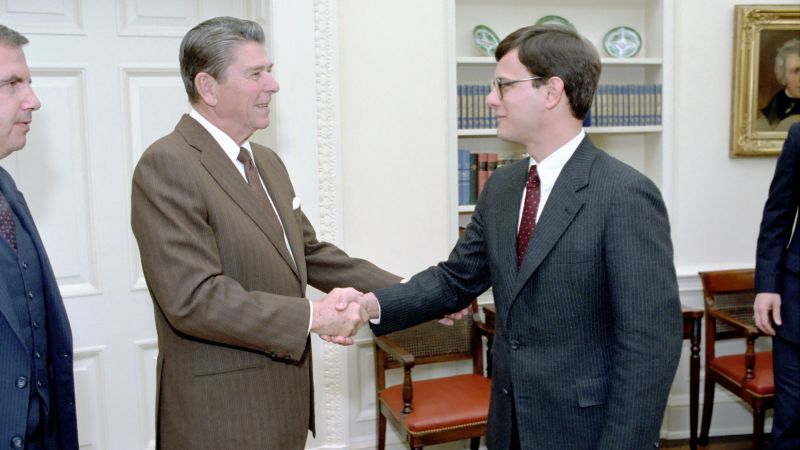
Roberts’ advocacy for a strong executive began during his tenure as a young lawyer in the Reagan administration in the early 1980s. In 1983, he penned a memo to White House counsel that criticized the constitutional framework allowing Congress to restrict presidential firing power. “The time is ripe to reconsider the constitutional anomaly of independent agencies,” he wrote, arguing that these entities, while intended to operate independently, had created a barrier to the president’s ability to act decisively. This sentiment would later become a cornerstone of his judicial philosophy, as he ascended to the Supreme Court in 2005.
“The time is ripe to reconsider the constitutional anomaly of independent agencies.”
Roberts’ push to dismantle the 1935 precedent gained momentum during his time on the bench, where he frequently emphasized the importance of preserving presidential control over executive functions. In a 2010 case, he articulated his position by stating, “Without such power, the President could not be held fully accountable for discharging his own responsibilities; the buck would stop somewhere else.” This argument underscored his belief that the president’s ability to remove agency heads was essential for maintaining executive accountability and efficiency.
“Without such power, the President could not be held fully accountable for discharging his own responsibilities; the buck would stop somewhere else.”
The 1935 Decision and Roberts’ Judicial Strategy
The 1935 case, Humphrey’s Executor v. United States, had established that the president could not remove agency heads unless Congress explicitly allowed it. Roberts, however, viewed this as an outdated limitation on executive power. In his majority opinion this week, he framed the ruling as a correction to the Court’s previous reluctance to expand presidential authority. “If anything more is left of Humphrey’s, we overrule it,” Roberts declared, signaling the culmination of a decades-long effort to undo what he called a constitutional misstep.
Independent agencies, such as the Federal Trade Commission (FTC), have historically played a critical role in regulating aspects of daily life, from consumer protections to workplace safety. Roberts’ argument centered on the idea that these agencies, while important, could become tools of bureaucratic inertia if the president were unable to replace their leaders. His opinion stressed that the president’s authority to fire agency heads was a necessary check on their independence, ensuring that regulatory actions aligned with the broader goals of the executive branch.
Presidential Power in the Trump Era
Roberts’ commitment to expanding presidential power became evident in the 2024 case involving former President Donald Trump. In that ruling, the chief justice, along with fellow conservative justices, granted Trump substantial immunity from criminal prosecution, citing his “conclusive and preclusive” authority over executive decisions. This approach echoed his earlier work to weaken the constraints on the president’s firing power, demonstrating a pattern of strategic judicial decisions aimed at reinforcing executive control.
Roberts’ influence extended beyond the White House. His efforts to limit the reach of the 1965 Voting Rights Act, which had protected minority voters from discriminatory practices, mirrored his approach to independent agencies. By striking down key provisions of the act, he helped create a framework where the president could more directly shape policy outcomes, often without needing congressional approval. This trend continued as the Supreme Court rolled back federal protections for Black and Latino voters earlier this term, with Roberts playing a central role in the decision.
The FTC and the Battle Over Regulatory Independence
This week’s ruling had direct implications for agencies like the FTC, which was established in 1914 to safeguard consumers and enforce fair trade practices. The decision allowed the president to remove FTC commissioners at will, undermining the agency’s independence and potentially altering its regulatory priorities. Roberts’ opinion highlighted the need for a president to have unchecked authority over these bodies, arguing that the current system of congressional oversight had created an unnecessary hurdle for executive action.
Conversely, critics, including Justice Sonia Sotomayor, warned that the ruling threatened the stability of the regulatory framework. In her dissent, Sotomayor emphasized the importance of insulating agencies from presidential pressure, noting that they play a vital role in areas such as public health, safety, and environmental protection. “The Court gives the President a power unknown even to the English Crown against which the Founders revolted,” she wrote, arguing that the decision elevated the president above the other branches of government by transforming a duty to execute laws into a license to disregard them.
“The Court gives the President a power unknown even to the English Crown against which the Founders revolted, elevating him above his once-coequal branches by transforming a duty to take care that the laws be faithfully executed into a license to act in defiance of those very laws.”
The legislative framework that created agencies like the FTC originally intended to ensure their independence by defining specific terms of office for commissioners. However, Roberts’ interpretation of the Constitution suggests that this independence is secondary to the president’s ability to direct executive functions. His approach has been both praised and criticized, with supporters calling it a return to the Founders’ vision of a strong executive, while opponents argue it weakens the checks and balances that protect democratic governance.
A Legacy of Executive Centralization
Roberts’ strategic patience paid off this week, as the Court’s 6-3 majority aligned with his vision of presidential supremacy. This outcome reflects a broader trend in his jurisprudence, where he has consistently sought to expand the president’s reach while curbing the influence of Congress and the judiciary. The same dynamic that allowed Trump to bypass legal scrutiny during his second term is now evident in the Court’s decision to grant the president unfettered control over independent agencies.
As the ruling took effect, the implications for American governance became clear. Independent agencies, which have long been trusted to act in the public interest, are now subject to the president’s direct influence. This shift raises concerns about the potential for regulatory capture and the erosion of institutional autonomy. Yet, for Roberts, the decision represents a long-awaited victory in restoring the president’s constitutional role as the primary executor of the nation’s laws.
