
Trump’s Freedom 250 gives the founders an AI glow-up
Trump’s Freedom 250 Redesigns Founding Fathers with AI
Trump s Freedom 250 gives the founders – In a striking reinterpretation of American history, the Freedom 250 project has transformed the likenesses of the nation’s Revolutionary War-era figures through the lens of artificial intelligence. This initiative, launched under the Trump administration, aims to commemorate the semiquincentennial of the founding of the United States. Among the figures reimagined is Dr. Benjamin Rush, a physician and academic who played a pivotal role in the nation’s early days. His AI-generated portrait, featured on the Freedom 250 website, presents a version of Rush that diverges significantly from historical depictions.
A Digital Rebirth of Historical Figures
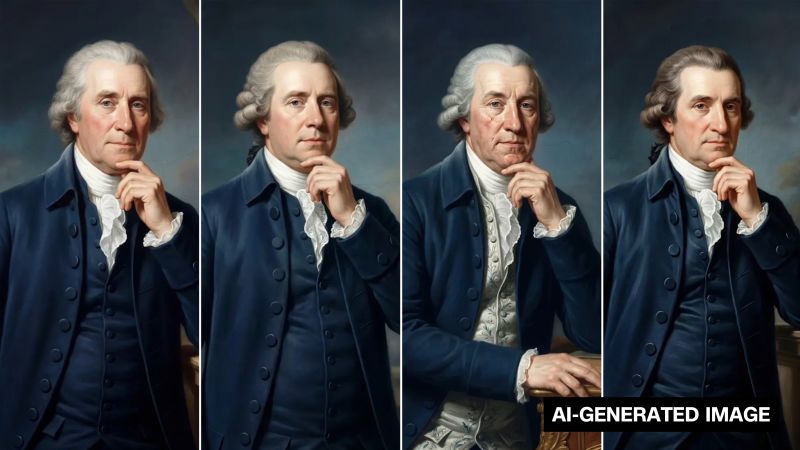
The AI-enhanced Rush appears with a smooth, porcelain-like brow and a radiant glow that sets him apart from his 18th-century counterparts. His hair is sleek and curly, his nose straight and unremarkable, and he tilts his head slightly, gesturing with an index finger near his cheek. His eyes, rendered in methylene-blue, and his faint smile evoke a modern aesthetic, blending the familiar with the surreal. This contrasts sharply with traditional portraits of Rush, which typically showcased a man with flat hair and more angular features.
One of the most notable historical references is the 1812 portrait by Thomas Sully, which depicted Rush with a long, downturned nose and a pinched expression, his hand resting on a desk as he gazed over an open book. The AI version, however, is distinctly different. A digital watermark identifies it as a product of Google’s generative AI, signaling a departure from the past. This shift is part of a broader effort to modernize the appearance of the Founding Fathers for a contemporary audience.
Uniformity and Conformity in the Portrait Gallery
The project’s approach to visual representation has sparked debate among historians. While the goal is to educate the public, the AI-generated images often converge on a singular, canonical style. Many of the figures, including Washington, Jefferson, and Franklin, are depicted with strikingly similar features and poses, creating a sense of uniformity that seems almost deliberate. This trend extends to the clothing, with subjects frequently clad in near-identical blue coats—despite historical records indicating a variety of attire in their lifetimes.
Isabelle Roughol, a public historian, has pointed out the anachronistic nature of these portrayals. “The ‘Ladies of the Revolution’ in the gallery are particularly out of step with their historical context,” she noted in a widely viewed video. For instance, Dolley Madison, portrayed as an adult woman, would have been only eight years old during the Revolutionary War. Martha Washington, known as “Lady Washington,” is notably absent from the collection, raising questions about the selection process.
The AI’s alterations are not limited to facial features. The portrait of Abigail Adams, for example, appears more stylized than her known appearances. While she died in 1818, her face in the digital gallery seems overly taut, with eyes that are wider than those in 1766’s pastel portrait by Benjamin Blyth. That original artwork captured Adams as a 21-year-old with almond-shaped features, a slightly hooked nose, and a thin upper lip. The AI version, however, gives her a more polished look, even adding an anime-like intensity to her gaze.
Historical Context and Stylistic Choices
Historians have critiqued the project for its corporate vision of American history. Zara Anishanslin, a scholar at the University of Delaware and author of *The Painter’s Fire*, explained that the AI-generated images often prioritize consistency over accuracy. “The details are altered to align with a more uniform style, as if these figures were designed for a modern audience,” she said. This includes changes to clothing styles and poses that reflect 19th-century fashions rather than 18th-century norms.
Take Benjamin Franklin, whose AI portrait mirrors the gray coat he famously wore to emphasize his country’s republican simplicity. However, the digital version tightens his jawline and smooths his features, transforming him into a figure that seems more akin to a 21st-century CEO. The cut of the shoulders and the cravats worn by the AI-generated founders are also more aligned with Victorian-era fashion, according to Anishanslin. These choices suggest a deliberate effort to blend historical figures with a contemporary visual language.
Such uniformity extends to the gestures and expressions of the portraits. Some subjects adopt poses that would have been unconventional for their time, such as arms crossed over the chest or fingers cradling their chins in thought. Rush’s image, for instance, combines both elements—a pose that feels more like a modern-day power figure than an 18th-century statesman. This stylization has led to a critique of the project’s approach, with some arguing that it oversimplifies the diversity of the Founding Fathers’ appearances.
The Future of Historical Imagery
While the Freedom 250 project has generated both praise and controversy, it reflects a growing trend in how history is visualized. By using AI to create a cohesive and polished image of the past, the project challenges traditional methods of representation. For some, this is a refreshing way to engage with historical figures in a relatable manner. For others, it raises concerns about the loss of historical authenticity.
The AI-generated portraits also invite a conversation about the role of technology in shaping historical narratives. As digital tools become more sophisticated, they offer new ways to reimagine the past, potentially blurring the lines between fact and fiction. The use of a watermark to identify these images as AI products is a step toward transparency, but the overall effect remains a blend of the real and the reimagined.
Ultimately, the Freedom 250 initiative is a testament to the power of AI in transforming historical imagery. It presents a version of the Founding Fathers that is both modern and stylized, offering a fresh perspective on the past. Whether this approach enhances or distorts the historical record remains a matter of debate, but it undeniably sparks a dialogue about how we choose to remember those who shaped the nation’s identity.
“It’s almost like modern CEO imagery that’s being grafted onto these 18th century founders,” said Zara Anishanslin. “The result is a vision of history that feels more like a brand than a collection of individuals.”
As the project continues to expand, its impact on public perception of the Revolutionary era will likely grow. The AI portraits may serve as a bridge between past and present, but they also highlight the challenges of preserving historical accuracy in an era of digital innovation.
