
Top general fired by Trump administration criticizes use of military for political missions
Former US General Condemns Military’s Role in Political Missions
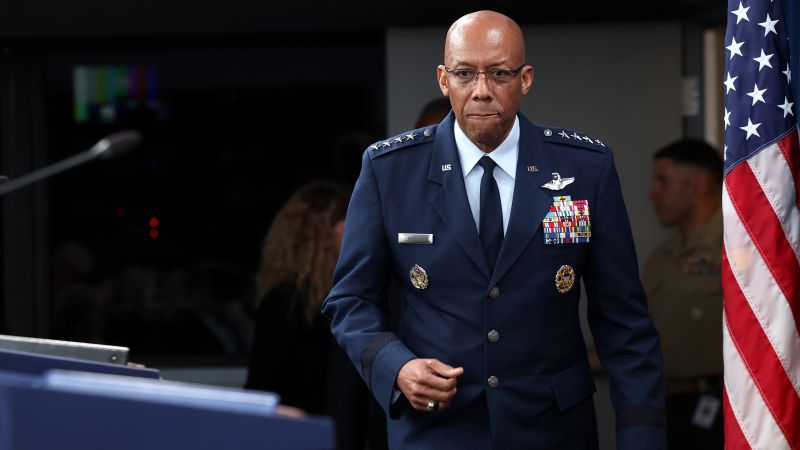
Top general fired by Trump administration – In a recent opinion piece published in Foreign Affairs, retired Air Force General Charles Q. Brown, once the head of the Joint Chiefs of Staff, voiced concerns about the Trump administration’s reliance on the military for domestic political objectives. The article, released on Friday, highlighted the growing trend of using armed forces in missions that extend beyond traditional combat roles, such as deploying troops to address crime in urban centers. Brown, the second Black individual to hold the nation’s highest military rank, emphasized that this practice risks undermining the military’s core purpose and straining its relationship with the civilian leadership.
The Op-Ed’s Key Arguments
Brown, alongside Duke political science professor Peter Feaver and North Carolina attorney Andrew Kragie, argued that when leaders prioritize political agendas over military readiness, the armed forces face increased scrutiny. “When presidents deploy the military for more contentious purposes, such as tackling urban crime, the mission of the armed forces becomes more complicated,” the trio wrote. They warned that shifting focus to domestic issues diverts attention from the military’s primary role of defending national security. “It is not the military’s duty to save the republic from political stalemates,” the authors added, suggesting that overburdening the armed forces could lead to long-term challenges in maintaining their effectiveness.
“When presidents use the armed forces for more politically contentious missions, such as addressing domestic crime in cities, the work of the military becomes more fraught.”
The article also critiqued the administration’s pattern of assigning military operations to resolve societal issues. “Resorting to a military solution rather than fixing the underlying incapacity or dysfunction in civilian institutions diverts the military from focusing on its primary combat mission,” they noted. This perspective reflects a broader debate about the balance between military and civilian responsibilities, with Brown suggesting that the current approach risks eroding public trust in both domains.
Context and Current Events
Brown’s criticism comes after his dismissal from the Joint Chiefs in February 2025, a move that also saw Admiral Lisa Franchetti, the Navy’s chief and the first woman on the Joint Chiefs, removed from her post. The administration had implemented policies to reduce diversity and inclusion initiatives, which Brown saw as a contributing factor to the military’s politicization. At the Aspen Ideas Festival last week, he expanded on these concerns, stating that the recent firings of Pentagon officials were not solely based on performance but reflected a broader trend of ideological alignment over professional merit.
“What’s starting to happen now is not about merit. It’s important we understand that all these people that are being removed are very well experienced, and my concern is that the impact it has on those that are still continuing to serve.”
Brown questioned whether remaining military personnel would feel secure in their careers if the administration continued to prioritize political loyalty. “Are they going to have a fair opportunity to advance in their career going forth?” he asked. This critique aligns with his broader view that the military should remain an apolitical institution, capable of serving the nation’s needs without being drawn into partisan conflicts.
Deployment of Troops and Political Reactions
The Trump administration’s strategy to leverage the military for domestic tasks has intensified since the president’s return to office. Under Defense Secretary Pete Hegseth, the use of troops in urban areas has expanded, with thousands of National Guard members and hundreds of Marines deployed to major cities like Washington, DC, and Los Angeles. Hegseth recently praised the National Guard’s efforts in Washington, where protests had erupted, calling the demonstrators “ingrates.” “They can’t see law and order and common sense in front of them,” he stated. “There’s nothing ideological about this group, nothing political about this exercise.”
“Law and order is something all Americans deserve.”
Brown and his co-authors pointed out that while the Trump administration’s actions were not explicitly criticized in the op-ed, they did highlight how both Trump and former President Joe Biden had historically turned to the military for domestic challenges, such as responding to the pandemic. This acknowledgment suggests that the issue of military involvement in political matters is not unique to the Trump era but has roots in broader presidential strategies. However, the current administration’s emphasis on deploying troops for law enforcement purposes has raised new questions about the appropriate scope of military operations.
Broader Implications of Patriotism
Alongside their critique of military politicization, Brown and his co-authors explored the concept of patriotism in the context of America’s 250th anniversary. “Patriotism means recognizing the promise of America’s founding, the progress of its past, and the potential of a shared future,” they wrote. The authors emphasized that service to a cause greater than oneself, a principle cultivated in military training, is accessible to all citizens, regardless of their uniform status. “In ways big and small, Americans can recognize this milestone of 250 years as a moment to rejuvenate the national interdependence that our founders proclaimed along with independence,” they added.
This section of the article underscores the tension between the military’s role as a national institution and its potential entanglement in political movements. By linking patriotism to the idea of collective effort, Brown and his collaborators suggest that the military’s involvement in domestic issues should complement, not replace, the work of civilian agencies. They argue that the 250th anniversary offers a chance to reflect on how the nation’s founding ideals can guide its current challenges, including the balance of power between the military and elected officials.
Legacy and Future Concerns
The firing of Brown and other high-ranking officials has sparked discussions about the stability of the military hierarchy and the impact of political decisions on its leadership. While the op-ed did not directly target President Trump, it highlighted the administration’s tendency to use military resources for domestic policy. This approach, the authors contend, blurs the lines between military and political functions, potentially compromising the armed forces’ ability to act as an impartial entity.
Brown’s critique also reflects concerns about the long-term consequences of politicizing the military. “If you ask too much of the military, you risk the entire enterprise,” he wrote. The piece serves as a reminder of the importance of maintaining the military’s independence, ensuring it remains a pillar of national security rather than a tool for political convenience. As the nation marks its 250th anniversary, the debate over the military’s role in society continues to evolve, with Brown’s perspective offering a critical lens on how political leaders shape its purpose.
Contributors to this report include CNN’s Oren Liebermann and Haley Britzky, who provided insights into the administration’s policies and their impact on the military’s operations. The article underscores the ongoing dialogue about the relationship between the armed forces and political leadership, emphasizing the need for clarity and purpose in their collaboration.
