
How roasted meats went spinning all the way around the world
The Global Journey of Spinning Roasted Meats
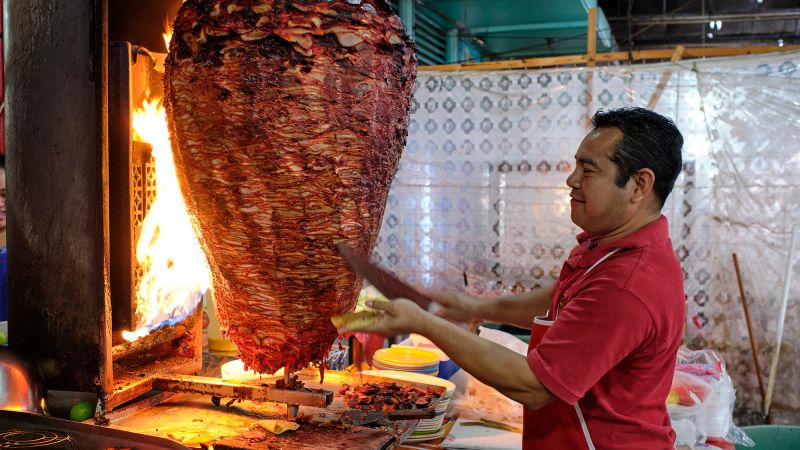
How roasted meats went spinning all – Roasting meat on a rotating spit is more than just a cooking method—it’s a cultural phenomenon that has evolved over millennia, leaving its mark on kitchens and streets worldwide. Raul Morales, the third-generation owner of Taqueria Vista Hermosa in Los Angeles, embodies this legacy. Known for his al pastor tacos, Morales, who was born in Mexico City, often finds himself recognized by fans even during his off-hours. During a visit to Universal Studios Hollywood, he was briefly interrupted by a crowd of admirers who shouted, “Chef Al Pastor!” as he waited in line. Morales chuckled at the moment, explaining that the nickname grew from decades of dedication to perfecting the dish. His family’s recipes, passed down through generations, feature pork shaved from a vertical spit, wrapped in fresh tortillas, and seasoned with a blend of ancient and modern flavors.
Ancient Roots of Rotating Roasts
Long before the taco cart became a staple of urban food culture, the concept of roasting meat on a spit was already embedded in human history. Food historian Ken Albala, a professor at the University of the Pacific, argues that this technique is among the oldest in culinary tradition. “When you thread meat onto a spinning spit, it doesn’t stay in one place for long,” Albala remarked, highlighting the practicality of the method. The act of rotating the meat allows for even heat distribution, enhancing both texture and taste. This process, he said, likely began with early humans who discovered that slow, controlled cooking could transform raw ingredients into something more palatable.
Susan Sherratt, an emeritus professor of East Mediterranean archaeology at the University of Sheffield, adds historical context to this practice. In the journal *Hesperia*, she notes that spit-roasted meats appear in the Homeric epics *The Iliad* and *The Odyssey*, suggesting their presence in ancient Greek feasts. Evidence from the Aegean region shows that iron spits, capable of holding whole animals or large cuts of meat, were already in use as early as the 10th century BCE. These spits, often found in tombs of male warriors, point to a tradition tied to communal activities and symbolic rituals. Sherratt posits that roasting meat may have been a way to reinforce bonds between men, mirroring the roles of hunting and warfare in ancient societies. “The tools used in these rituals—like swords and spits—resembled the weapons of war,” she explained. “This connection to male identity likely made spit-roasting a favored method among warriors and leaders.”
The Ottoman Empire’s Culinary Innovation
While the tradition of roasting meat on a spit dates back thousands of years, the Ottoman Empire played a pivotal role in refining it into a more specialized dish. Around the 15th century, cooks in the empire began slicing meat into thin layers and stacking them on a vertical spit, allowing the meat to cook as it rotated. This innovation, which Mary Işın describes in her book *Bountiful Empire: A History of Ottoman Cuisine*, transformed the process into a method that could produce more consistent results. Miniature paintings from a 1620 manuscript commissioned by Ottoman statesman Hafız Ahmed Paşa depict this technique in action, showing chefs carefully extracting slices from the spit for presentation. Işın interprets these images as evidence of a dish reserved for the elite, suggesting it was served at royal gatherings.
Though the paintings do not specify the name of the dish, Işın’s research reveals that 15th-century Ottoman texts referred to it as *çevirme kebabı*, or “turned kebabs.” This term highlights the key feature of the method: the continuous rotation of the meat, ensuring even cooking and a tender, flavorful result. As the dish spread across the empire, which at its peak spanned from central Europe to the Arabian Peninsula, the name *çevirme* eventually entered Arabic and English as shawarma, a term now synonymous with the Middle Eastern street food. However, the word *döner* also emerged in the Turkish language, eventually overshadowing *çevirme* in some regions. “Both terms describe the same concept—something that revolves,” Işın clarified. She notes that while *döner* wasn’t recorded in print until 1908, it was likely in common use by then. The transition from courtly delicacy to everyday street food reflects the dish’s adaptability and enduring appeal.
From Local Specialties to Global Icons
As trade routes expanded and cultures intersected, spit-roasted meats transcended their origins, becoming integral to cuisines around the world. In Mexico, the al pastor taco—a dish rooted in the traditional *tacos de la pastor*—grew out of the practice of rotating meat over an open flame, much like the Ottoman *çevirme* kebab. However, the Mexican version incorporated local ingredients, such as pineapple and achiote, creating a unique flavor profile. Similarly, shawarma, which evolved from the Ottoman technique, became a staple in cities like Baghdad and Damascus, where its aromatic spices and quick-service model made it a favorite among urban dwellers.
The journey of this dish wasn’t limited to the Middle East and Latin America. As migrants moved across continents, they carried the idea of rotating meat with them, adapting it to local tastes and resources. In the United States, for instance, Morales’ al pastor tacos have become a symbol of cultural fusion, blending traditional Mexican methods with modern fast-casual dining. “The way we cook it today is a mix of old and new,” he said, emphasizing the dish’s ability to evolve while retaining its core identity. This adaptability is also evident in other regions, where variations of the technique have led to the development of dishes like the Korean *galbi* or the Indian *tandoor* roasting, each with its own unique twists.
The global popularity of spit-roasted meats can also be traced to their role in social gatherings. In the 1800s, Turkish döner became a staple in Istanbul’s kebab houses, drawing travelers and locals alike. French visitor François Pouqueville noted in his writings that foreigners consistently praised the dish as the country’s most delectable offering. “The meat is so tender, it melts in your mouth,” he wrote, capturing the universal appeal of the method. This same sentiment echoes in modern times, where the sight of a rotating spit in a street vendor’s stall or a restaurant’s kitchen remains a familiar and enticing image.
Despite its ancient origins, the modern practice of spit-roasting continues to thrive, blending historical techniques with contemporary innovation. Whether it’s the slow-rotating pork in a Mexican taco, the aromatic shawarma in a Middle Eastern kebab shop, or the global variations that have emerged in recent decades, the core principle remains unchanged: the meat is cooked beside the heat, not directly on it, allowing for a depth of flavor that can’t be replicated by other methods. Albala, reflecting on this, said, “Any place you have a pointy stick or a sword, people are going to figure out quickly that cooking with it off to the side of the fire can create something richer.” This insight underscores the ingenuity of early cooks who, through trial and error, developed a method that would outlive civilizations and cross oceans.
Today, the legacy of spit-roasted meats is a testament to the power of cultural exchange and culinary adaptation. From the Aegean to the Ottoman Empire, and from Mexico to Istanbul, the dish has continually reinvented itself, proving that the act of spinning meat over fire is as much a story of human connection as it is a technique of cooking. As new generations of chefs and food enthusiasts experiment with flavors and formats, the tradition lives on—spinning through time, across continents, and into the hearts of those who savor its rich, smoky allure.
