
Bodies lie unclaimed and rats run rampant as months on Gaza’s ceasefire remains unfulfilled
Gaza’s Ceasefire Deal and Its Unfulfilled Promises
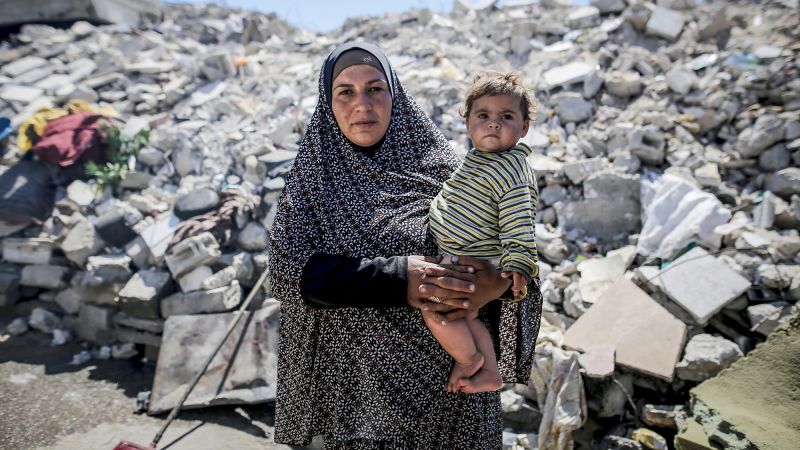
Bodies lie unclaimed and rats run rampant – Months after the signing of a ceasefire agreement between Israel and Hamas, the situation in Gaza remains dire. The agreement, intended to bring stability to the war-torn territory, has failed to deliver lasting peace. As the sun sets over the Strip, the landscape is marred by the aftermath of relentless conflict—burned fields, shattered homes, and a population struggling to rebuild their lives amid ongoing violence.
The Cost of War on Gaza’s Children
Fourteen-year-old Karam, now displaced with his siblings, clutches a football as he walks through the rubble of Deir al-Balah. The teenager, who once dreamed of becoming a professional player, recalls the days before the war when life was filled with joy. “We played in the streets, chasing dreams,” he says, his voice tinged with sorrow. “But now, life is just a cycle of destruction.”
“My dream was to become a footballer. I used to play with my friends in the street. Life before the war was beautiful. But now, there is no life,” said Karam, displaced with his two brothers and sister.
The ceasefire, signed in late October 2023, was meant to mark a turning point. Yet, as the months pass, the agreement has become synonymous with stagnation. Residents speak of a “dangerous status quo,” where the violence persists and the promise of peace feels distant. For Karam, the contrast between past and present is stark, and he is not alone in his despair.
The Ceasefire Framework and Its Challenges
Following the October 7, 2023 attacks on Israel, which ignited a two-year conflict in Gaza, Israel and Hamas inked a two-phase ceasefire plan. The deal outlined key objectives: the withdrawal of Israeli forces, Hamas’s full disarmament, the deployment of an international security force, and the establishment of a new Palestinian authority. However, both sides have accused each other of breaching the terms, casting doubt on the agreement’s viability.
Despite the optimism of the deal, progress has been slow. The Palestinian Ministry of Health reported at least 1,059 deaths and 3,429 injuries in Gaza since the agreement took effect. A CNN analysis highlights that one child has been killed daily on average in the Strip, underscoring the grim toll on its youngest citizens. The situation has been compounded by the continued presence of Israeli military forces, which have expanded their control beyond the initial “yellow line” established in the deal.
Nikolay Mladenov, a former UN official overseeing the implementation of the truce, warned in May that the current state of affairs risks turning the agreement into a “political blood libel.” While the ceasefire was hailed as a breakthrough, the reality for many Gazans is far more complex. The international community, including the US and Iran, has invested in peace talks, but the war’s brutality has not abated.
The Human Toll of Displacement
Over 1.9 million Gazans—nearly the entire population—have been displaced, with many fleeing their homes multiple times. The UN has noted that this number has remained stagnant, intensifying the humanitarian crisis. In makeshift shelters, families endure harsh conditions, often without adequate ventilation or clean water. The lack of progress has left them in limbo, unable to return to their destroyed villages.
“You can be bombed anytime, anywhere,” said Sally Saleh, an aid worker in Deir al-Balah. “There is no actual ceasefire here.” The phrase echoes the frustration of countless residents who have become accustomed to the constant threat of violence. In the absence of a stable peace, the health of the population has deteriorated. A UN report from May warned that ectoparasitic infections, such as those caused by rats, have spread across 80% of displacement zones.
“We have spoken to parents whose children have been bitten by rats, who are terrified that it will happen again,” said Saleh, head of emergency operations for the UK-based NGO Medical Aid for Palestinians (MAP).
Rats, cockroaches, and weasels now roam freely through the ruins, gnawing on food supplies and even biting infants. Some families have resorted to hanging food containers from the ceilings of their tents to keep them out of reach. The creatures have become an uninvited part of daily life, with their presence adding to the psychological strain of survival.
Struggles for Basic Needs
With limited access to clean water, residents have turned to digging makeshift latrines, leading to soil and water contamination. Hosni Nadeem Mohanna, a spokesperson for Gaza’s water municipality, described the crisis as a “silent emergency” that threatens public health. Meanwhile, the international force promised as part of the ceasefire deal has yet to arrive, leaving security responsibilities to a fractured system.
“The international community talks about peace, but we’re still living in the ashes,” said one resident in the southern town of Khan Younis. The deal’s failure to address the root causes of the conflict has fueled skepticism. For many, the ceasefire is a mirage, with Israel continuing to target Hamas members and Hamas refusing to surrender its weapons. This stalemate has kept the region in a state of perpetual tension.
Legacy of a Broken Truce
As the months pass, the impact of the ceasefire’s shortcomings becomes increasingly evident. The UN’s recent findings suggest that Israel’s actions may qualify as genocide, with deliberate attacks on children being cited as evidence. Israel has rejected this characterization, calling it a “political blood libel.”
Despite the international efforts to broker peace, the situation on the ground remains unchanged. For those displaced, the struggle is not just for shelter but for survival. The rats, now a symbol of the region’s decay, have burrowed into aid packages, forcing families to discard essential supplies. The air is thick with the scent of burning debris, and the sound of distant explosions is a familiar backdrop to daily life.
While the ceasefire deal was meant to end the conflict, it has instead extended the war’s reach. The balance of power has shifted little, and the cycle of violence continues. For residents like Karam, the dream of a peaceful future now feels like a distant hope, overshadowed by the reality of a fragile truce that has done little to ease their suffering.
A Future of Uncertainty
The Board of Peace, established to advance the ceasefire plan, recently held meetings in Cyprus. However, these sessions have not yielded a clear path forward. Officials have yet to confirm a timeline for the Palestinian technocrat committee, which was supposed to take over governance from Hamas. Without this, the power dynamics in Gaza remain unchanged, and the war’s effects linger like a shadow.
As the world watches, the people of Gaza endure. Their resilience is evident, but their plight is undeniable. The unclaimed bodies, the relentless rats, and the echoing silence of once-vibrant neighborhoods tell a story of a ceasefire that has failed to deliver peace. In the words of Sally Saleh, “We are still waiting for the deal to mean something.”
