
Deadly Russian strikes hammer Kyiv on eve of Trump trip to critical NATO summit
Deadly Russian Strikes Hammer Kyiv on Eve of Trump Trip to Critical NATO Summit
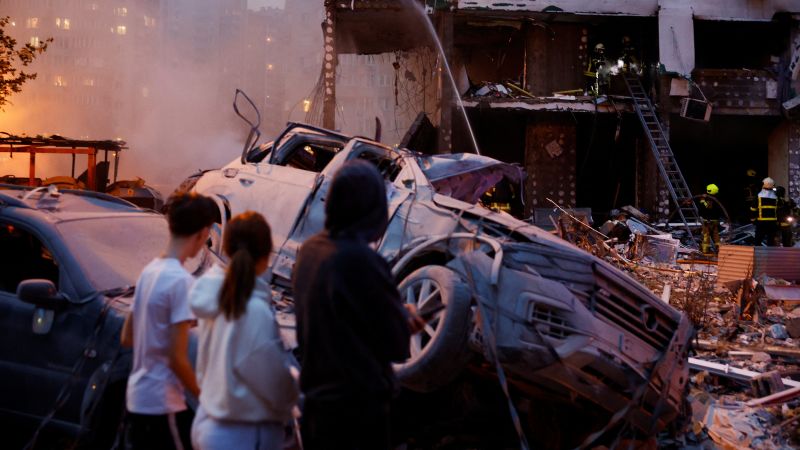
Deadly Russian strikes hammer Kyiv on eve – On the morning of July 5, Kyiv, Ukraine’s capital, endured a severe Russian attack that left at least seven residents dead and 24 others injured. The assault, which occurred just hours before U.S. President Donald Trump’s arrival at a key NATO summit in Turkey, marked another wave of devastation in a conflict that has already claimed thousands of lives. Explosions rumbled through the city center, with multiple residential buildings suffering extensive damage. As the coordinated strike unfolded, residents scrambled for safety, some trapped in the upper levels of structures, while others sought refuge in shelters after air raid sirens blared across the city.
Evacuations and Ongoing Search Efforts
Kyiv Mayor Vitali Klitschko reported that emergency teams had begun extracting civilians, including children, from a damaged building in the Podilskyi district. The operation, which started early Monday, involved efforts to stabilize the structure and rescue those still inside. Despite these actions, the search for survivors continued, highlighting the challenges faced by first responders in a rapidly escalating crisis. The attack, which combined ballistic missiles with drone strikes, demonstrated the intensity of Moscow’s tactics in targeting urban areas.
City officials confirmed that fires erupted in several districts, complicating rescue operations and forcing evacuations in nearby neighborhoods. The scale of destruction raised concerns about the city’s resilience against repeated strikes. Meanwhile, Ukrainian President Volodymyr Zelensky had issued a warning just hours earlier, asserting that “Moscow was preparing a new massive strike.” His statement, shared on social media platform X, framed the attack as a deliberate move by Russia to disrupt the upcoming NATO summit, which is set to begin on Tuesday.
Background of the Attack
The strike on Kyiv follows a previous barrage on July 4, which had already proven to be one of the deadliest in the war. That attack resulted in 30 fatalities, the third-highest toll in the conflict since its inception. The current assault, described as “exceptionally deadly,” underscores the escalating stakes as Russia intensifies its efforts to destabilize the capital. Kyiv’s southeastern Darnytskyi district, which sustained heavy damage during the prior attack, emerged as a focal point once again, with residents being evacuated from ruined buildings.
Zelensky’s comments about the timing of the strike emphasized its strategic significance. “This is typical of Putin: right after America’s Independence Day and before the NATO Summit in Ankara,” he said, referencing the critical juncture for diplomacy. The president’s repeated appeals for military support suggest that the attack is a test of resolve for both the U.S. and its European allies. With Trump set to attend the summit, the timing of the strike could influence the tone of discussions on Ukraine’s defense and the broader geopolitical landscape.
Trump’s Diplomatic Engagement
Russian President Vladimir Putin and Trump engaged in a 90-minute call on July 4, according to Moscow’s foreign ministry. The conversation, characterized as “businesslike,” was expected to set the stage for the NATO summit. Despite this diplomatic outreach, the attack on Kyiv underscored the ongoing hostilities. Trump had previously pledged to resolve the war within 24 hours of taking office, but over 500 days into his second term, the administration has yet to establish a clear path toward peace. The U.S. leader’s repeated offers to assist Ukraine reflect a commitment to maintaining momentum in the conflict.
Meanwhile, Ukraine has launched its own counterattacks, targeting Russian infrastructure with missile and drone strikes. Recent operations have focused on key locations such as oil refineries, ports, and military factories, disrupting Moscow’s logistical capabilities. This dual approach of defense and offense highlights the country’s determination to challenge Russian advances. However, the lethality of the latest Kyiv strike reveals the limitations of Ukraine’s current air defense systems, particularly against advanced weaponry like jet-powered drones.
Advanced Russian Weaponry and Ukrainian Defenses
The recent attack demonstrated the effectiveness of Russia’s evolving arsenal, which includes short-range ballistic missiles, loitering munitions, and high-speed drones such as the Geran-4 UAV. These jet-powered drones, capable of flying at incredible speeds, have proven difficult to intercept with Ukraine’s existing mobile fire units. To counter this threat, Zelensky has repeatedly called for more advanced systems, such as the Patriot missile defense, which he claims is essential for neutralizing Russian attacks.
Zelensky reiterated his plea for support during a Sunday address, stating, “Any delay with missiles for our air defense – missiles for Patriots – means the loss of lives, and it encourages Russia to continue the war.” The latest versions of Patriot interceptors are designed to engage a range of targets, including short-range ballistic missiles, cruise missiles, and drones, at altitudes up to 15 kilometers and distances of 35 kilometers. This capability could shift the balance of power in the skies over Ukraine, but the need for rapid deployment remains urgent.
Strategic Implications for the Summit
The timing of the attack has added pressure to the NATO summit, which will take place in Turkey. As Trump prepares to engage with allies and Russian officials, the assault serves as a reminder of the persistent threats facing Ukraine. The summit is expected to address key issues, including military aid, sanctions, and the future of the conflict. However, the ongoing attacks on Kyiv may force discussions to pivot toward immediate defense needs, overshadowing broader strategic goals.
Russian forces have continued to focus on the eastern Donetsk region, a strategic area that has been a primary target for Moscow. The war in Ukraine has seen increased frequency of attacks, with cities facing near-nightly strikes. Despite these challenges, Ukraine has managed to repel many assaults, though the resilience of its capital has been tested repeatedly. The destruction in Kyiv highlights the difficulty of safeguarding urban centers against a well-coordinated assault, as well as the importance of air defense systems in mitigating casualties.
As the situation in Kyiv escalates, the international community watches closely. The NATO summit represents a critical opportunity for collective action, but the attack may also serve as a warning of Russia’s willingness to escalate. Zelensky’s call for more advanced weapons, such as the Patriot system, underscores the gap between Ukraine’s current capabilities and the scale of the threat. The U.S. and its allies must decide how to respond, balancing diplomatic negotiations with the urgency of military support.
The attack on Kyiv has become a defining moment in the war, symbolizing the enduring conflict between Moscow and Kyiv. With Trump’s presence at the summit, the global stage is set for a pivotal discussion on the future of the war. The devastation in the city, however, serves as a stark reminder of the human cost and the challenges that lie ahead. As rescuers work tirelessly to save lives, the international community faces the task of addressing the immediate crisis while seeking long-term solutions to the conflict.
