
Too ugly, too noisy, too… American? France’s great air con debate
Too Ugly, Too Noisy, Too… American? France’s Great Air Con Debate
Too ugly too noisy too American – As scorching temperatures return to France, the nation finds itself grappling once again with the same pressing question that dominated discussions in June: why is air conditioning still a contentious issue? The recent heatwave has pushed citizens to their limits, with some resorting to unconventional methods to stay cool. Lidl stores in the Paris region became battlegrounds on Thursday, as crowds surged to secure air conditioning units. In Aubervilliers, a suburb of Paris, the scene turned chaotic when doors gave way under the pressure of eager shoppers. “I saw people get trampled,” recounted one customer to *Le Parisien*. Another recounted the frustration of the moment: “I was in shock, I got shoved around in every direction, and unfortunately I didn’t leave with an AC unit.”
The Push for Cooling Solutions
With only 24% of French households equipped with air conditioning—up from 18% just two years ago—but still significantly lower than the 50% found in Italy, the demand for cooling has surged. For many, the heat has been unbearable, prompting last-minute dashes to retailers. Alexia, a 26-year-old from the outskirts of Paris, described her decision to purchase an AC unit as a “last-minute panic.” She noted that all available models were sold out, forcing her to act swiftly before they disappeared entirely. “I had to rush to get another one before there was absolutely none left,” she said.
The crisis extends beyond homes. Just 7% of French schools have air conditioning, leading to widespread closures during the June heatwave. Classrooms became stifling, with students and staff seeking refuge in shaded areas or open spaces. Meanwhile, hospitals and public buildings have become the focus of political debate, as leaders weigh the urgency of cooling infrastructure against traditional French values.
Resistance Rooted in Tradition and Perception
France’s reluctance to embrace air conditioning is deeply cultural. For decades, the appliance has been associated with the American lifestyle—seen as loud, visually unappealing, and unnecessary. This perception has been reinforced by a belief that conditioned air can lead to health issues, such as respiratory problems or a sense of artificial comfort. Historically, French architecture relied on passive cooling techniques: thick stone walls, heavy curtains, and the strategic use of shutters to block sunlight. These methods sufficed in milder summers but have struggled against the intensity of modern heatwaves.
The recent record-breaking heatwave, which would have been “virtually impossible” a few decades ago, has exposed the limitations of these traditional approaches. With temperatures soaring to dangerous levels, even the most ardent critics of air conditioning have begun to reconsider their stance. Over six days in June, health authorities reported more than 2,000 excess deaths, raising concerns about the health impacts of prolonged heat exposure. This has forced a shift in public opinion, as the debate over cooling systems evolves from a cultural preference to a survival necessity.
The Politics of Air Conditioning
As the 2027 presidential race approaches, air conditioning has become a key political issue. The far-right National Rally, led by Marine Le Pen, has emerged as the most vocal advocate for widespread installation. The party has proposed a national “plan clim” to equip every school and hospital with cooling systems, backed by $23 billion in government-guaranteed, interest-free loans. This plan aims to address the urgent need for infrastructure upgrades while positioning the party as a forward-thinking alternative to traditional French policies.
On the left, the debate is more fragmented. The Greens, once the staunchest opponents of air conditioning, have begun to soften their position. Party leader Marine Tondelier recently acknowledged that cooling is now essential in certain public spaces, such as schools and hospitals. However, the hard-left France Unbowed party remains skeptical, with Jean-Luc Mélenchon warning that installing AC units everywhere could “cause more harm.” He argues that over-reliance on technology risks undermining long-term environmental goals.
The government, caught between these opposing views, has taken a middle ground. It has approved emergency air conditioning installations in hospitals while maintaining its commitment to insulation-first approaches. This balance reflects the nation’s struggle to reconcile modern needs with historical values. The political tension reached a peak when the Greens filed a motion of no confidence against the government’s heatwave response. Though the motion failed, it underscored how deeply divided the issue has become.
Environmental Concerns and Energy Mix
Resistance to air conditioning is also framed in environmental terms, with critics arguing that it contributes directly to climate change. However, France’s energy mix complicates this narrative. Over 95% of the country’s electricity comes from low-carbon sources, with nuclear power alone supplying two-thirds of the grid. This means that running an air conditioner in France carries a much lower carbon footprint compared to countries like Poland or Germany, where fossil fuels dominate energy production. For instance, the environmental impact of air conditioning in France is significantly less than in regions heavily reliant on coal or gas.
Despite this, the debate remains fierce. Environmentalists fear that widespread adoption could lead to increased energy consumption and strain on the grid, especially during peak hours. Yet, the urgency of the current heatwave has pushed many to prioritize immediate relief over long-term considerations. “We need to adapt or suffer the consequences,” said one analyst, highlighting the growing recognition that cooling solutions are not just a luxury but a necessity in a warming world.
A Nation at a Crossroads
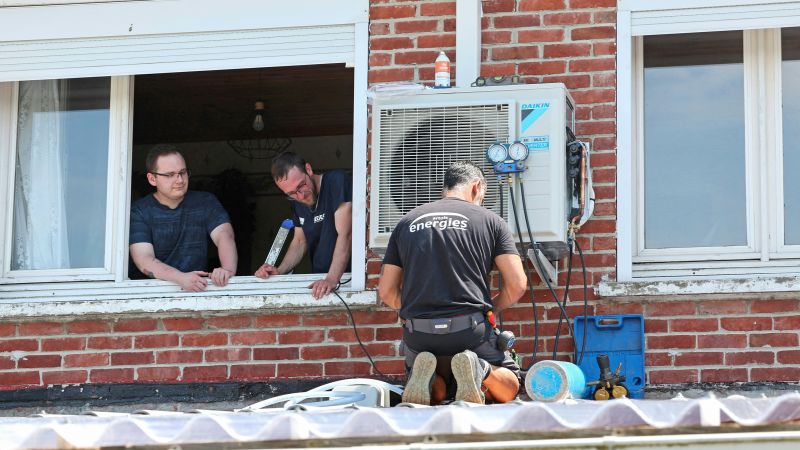
The clash between tradition and modernity is now a defining feature of France’s approach to climate resilience. While the nation’s architectural heritage is celebrated, it is also a source of regulatory hurdles. In 19th-century buildings that shape Paris’ skyline, residents often face strict rules against installing exterior condenser units. Heritage protections aim to preserve the city’s aesthetic, but they have also slowed the adoption of cooling systems in historic neighborhoods.
Co-owned buildings add another layer of complexity, requiring approval from property associations before installations can proceed. Without this, units may be removed forcefully, creating frustration among residents. As the heatwave intensifies, these bureaucratic challenges have sparked calls for reform. Some argue that the current system is outdated and needs to evolve to meet the demands of a hotter climate. Others, however, believe that France’s unique approach to cooling—blending tradition with innovation—offers a sustainable model for the future.
With the heatwave as a catalyst, France stands at a crossroads. The nation’s cultural resistance to air conditioning is waning, but the path forward remains uncertain. As political leaders and citizens debate the role of cooling systems in daily life, one thing is clear: the demand for air conditioning is no longer a choice but a necessity. Whether it will be embraced as a symbol of progress or remain a point of contention will determine how France navigates the challenges of a warming planet.
For now, the streets of Paris and its suburbs tell a story of desperation and determination. Shoppers crowd stores, schools close their doors, and families seek any means to escape the relentless heat. The debate over air conditioning is not just about comfort—it is about identity, sustainability, and survival in an era of climate change.
