
The new tastemakers are cutlery designers
The New Tastemakers Are Cutlery Designers
The new tastemakers are cutlery designers – Dung Ngo, a design writer and collector, has amassed over 10,000 pieces of cutlery, a passion that began 25 years ago. At the time, he was 30 and felt that the flatware he bought from Target after college no longer aligned with his personal identity. During a visit to a vintage shop, he discovered a 40-piece set for $400, which sparked his fascination. The set, titled *Composition* by the renowned Finnish designer Tapio Wirkkala, became a pivotal moment in his journey. Today, a complete Wirkkala set can command prices exceeding $3,600, a testament to its enduring appeal.
A Legacy of Flatware
Driven by this discovery, Ngo immersed himself in the world of iconic cutlery, scouring eBay and antique shops for rare designs. He often relied on faded photographs from design magazines of the 1940s, 50s, and 60s to guide his search. “I became hooked,” he explained. “Cutlery is among the most intimate objects in daily life.” His obsession culminated in the creation of a 600-page book, *Knife Fork Spoon: Modernist Cutlery 1900–2025*, set for release in August. This publication is paired with an exhibition at the Denver Art Museum, showcasing over 150 designs organized thematically, such as airlines, children, and travel.
While the book and exhibition trace 125 years of flatware evolution, Ngo believes the narrative is incomplete. “There is also a future to this category,” he said. “Maybe I can actually participate in that future in a real, physical way, rather than just writing about it.” This realization led him to explore innovations in production methods, highlighting a critical gap in modern cutlery design.
Reimagining the Future
Ngo’s research revealed a structural issue: modern cutlery has remained largely unchanged for 150 years. “We start with a flat sheet of metal, then bend it,” he noted. “It can get quite three-dimensional, but never highly sculptural.” This observation was reinforced during his visit to Solingen, Germany’s traditional hub for cutlery makers. There, he found that only a few manufacturers remained, a stark contrast to the industry’s former vitality. “It’s nearly all gone,” he said, adding, “That was heartbreaking.”
His inspiration for a new direction came from a 3D-printed metal set by architect Greg Lynn for Alessi in 2007. At the time, the design was an experimental endeavor, costing $10,000 to $20,000 per set with only a limited number produced. “I called Greg and said, ‘Can I take your design and put it back into production?’ He said, ‘Absolutely. Now is the time – twenty years later is perfect,’” Ngo recalled. This conversation marked the beginning of a collaborative project aimed at redefining cutlery’s future.
Cultural and Personal Reinterpretations
Working with eleven international artists, Ngo set three guidelines: create a design that reflects personal identity, embodies cultural significance, and leverages 3D printing on sintered steel. He emphasized that function was secondary, stating, “You can buy that stuff from anywhere for fifty bucks.” The result was the exhibition *Knife, Fork, Spoon 3.0*, curated by Ngo and presented by the Los Angeles gallery Marta during the recent 3 Days of Design in Copenhagen.
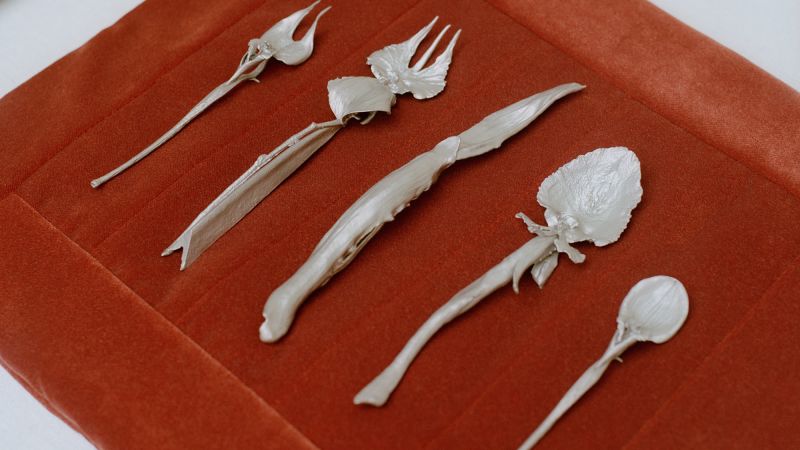
One standout piece came from Polish botanical designer and artist Marcin Rusak. His work, which Ngo described as pushing the brief to its limits, blends organic forms with geometric precision. Rusak’s inspiration stemmed from his family heritage: “Growing up, my grandfather was a nationally famous orchid breeder. In some ways, orchids are my first learned visual language,” he shared. The cutlery set appears to blur the line between nature and art, challenging traditional notions of flatware.
Other contributors brought diverse perspectives. Korean designer Minjae Kim reinterpreted the Western set by incorporating chopsticks, reflecting his cultural roots. Meanwhile, Nigerian designer Nifemi Marcus-Bello introduced a resin bowl, which complements his graphically shaped cutlery. “He explained that in Nigeria, when you go out to eat, you’re asked if you want to use a fork and spoon or eat with your hands, which is the traditional way. If you choose hands, you’re given a bowl of water to clean them—a ritual that’s central to dining,” Ngo noted.
Design as a Cultural Dialogue
Ngo was deliberate in his selection of artists, ensuring representation of underexplored voices. By including female designers, he aimed to highlight their historical absence in the field. “It’s about making cutlery more adaptable to different cultures,” he said. “I wanted the designs to resonate beyond Western aesthetics.” This approach underscores a broader movement toward inclusivity and global relevance in design.
The collaboration also emphasized the potential of 3D printing to revolutionize cutlery production. By using sintered steel—a material formed from compressed powder—the artists could craft intricate, sculptural forms previously unattainable with conventional methods. “This technology allows for unprecedented creativity,” Ngo explained. “It’s not just about making something beautiful; it’s about redefining how we interact with everyday objects.”
As the exhibition showcased, the future of cutlery design lies in merging tradition with innovation. Ngo’s work challenges the industry to move beyond its historical constraints, proving that even the humblest items can carry profound cultural and artistic weight. “Cutlery is more than a tool—it’s a reflection of who we are and how we live,” he said. “By reimagining it, we’re redefining the way people experience the act of eating.”
With *Knife Fork Spoon* and the exhibition, Ngo has not only documented the past but also ignited a conversation about the future. His vision invites designers to think beyond function, embracing the emotional and cultural dimensions of flatware. In doing so, he transforms a utilitarian object into a symbol of innovation, artistry, and personal expression.
Conclusion
The project serves as a bridge between eras, connecting the craftsmanship of the past with the possibilities of the present. By reviving forgotten designs and introducing new ones, Ngo highlights the dynamic nature of cutlery as a medium for storytelling and identity. “This isn’t just about preserving history—it’s about creating something that’s alive,” he said. As the industry embraces 3D printing and cultural diversity, the role of cutlery designers is evolving into a new, vital chapter of design history.
