
In Nigeria’s oil heartland, Olori Atuwatse III sees a different resource
Redefining Royalty: The Warri Kingdom’s Human Capital Revolution
In Nigeria s oil heartland Olori – Nestled within Nigeria’s petroleum-rich Niger Delta, the Warri Kingdom occupies a central position in one of Africa’s most economically significant regions. For generations, this territory has contributed substantially to the nation’s economic growth through its vast oil reserves. Yet beneath this wealth lies a paradox that many local residents recognize all too well. While billions flow from the ground, surrounding neighborhoods frequently struggle with inadequate infrastructure, insufficient educational facilities, limited healthcare access, and unreliable clean water supplies.
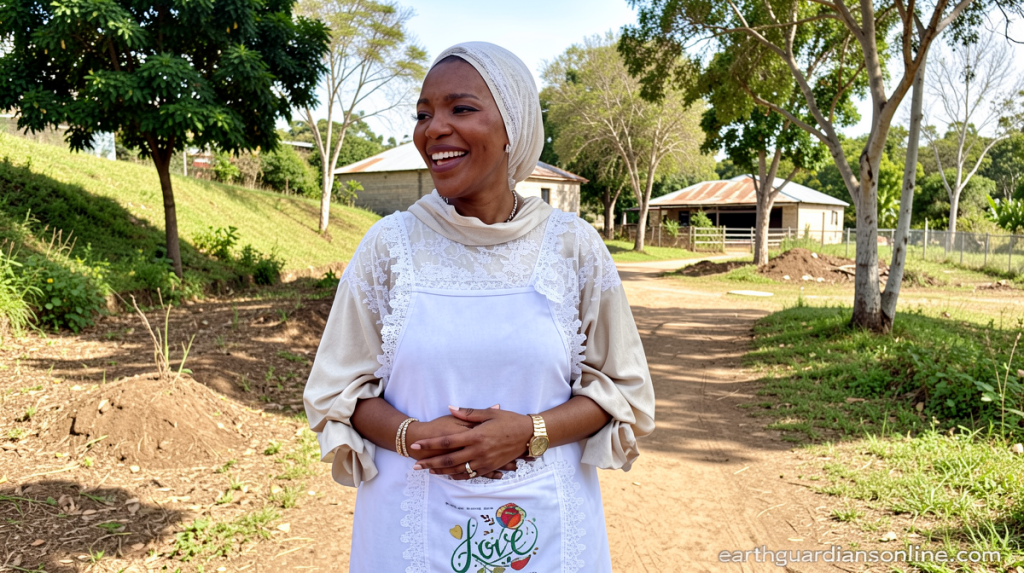
Olori Atuwatse III, the queen consort of Warri, has articulated this contradiction with clarity. Speaking with CNN’s Larry Madowo, she described the situation as a particular form of misfortune. “The kingdom sadly suffers from what I call the resource curse,” she explained. “Everything is taken out, but nothing is developed.” This observation captures the frustration of communities that generate enormous wealth yet see little of it returned to improve daily life.
A Modern Monarchy Takes Shape
When Tsola Emiko ascended to the throne as Ogiame Atuwatse III in 2021, becoming the twenty-first Olu or king of Warri, he and his wife embarked on an ambitious mission. Together, they envisioned a contemporary monarchy capable of addressing real community needs rather than merely maintaining ceremonial traditions. One of their first significant actions was establishing the Office of the Olori, which created an official institutional platform enabling the queen to champion development programs targeting women, children, and educational advancement.
Olori Atuwatse III approached her new role with serious purpose rather than superficial pageantry. “I didn’t embrace it with glamour,” she reflected. “What I felt was weight. What I felt was responsibility … a responsibility to use this platform of privilege to serve.” This sense of duty became the foundation for everything that followed.
The Royal Iwere Foundation and Its Mission
In 2021, the royal couple launched the Royal Iwere Foundation, organizing its work around three core pillars: education, empowerment, and environmental stewardship. These priorities have generated diverse programming that spans STEM education initiatives, ecological conservation projects, and entrepreneurship support designed to help women establish sustainable commercial enterprises.
Both the king and queen share a unified vision for their work. “Everything really is centered around human capital development,” Olori Atuwatse III stated. This philosophy became evident during a March graduation ceremony for EstablishHer, a six-month business and leadership program operated by the foundation. The queen reported that since the program’s inception, forty-four participants had formally registered their businesses, while additional graduates had secured new clients, expanded their operations, and gained valuable access to mentorship, professional networks, and financial resources.
Supporting these efforts, the foundation announced a loan facility worth 150 million naira, approximately equivalent to 110,000 dollars, specifically intended to help women expand their commercial ventures. “Our biggest resource is our human resource,” Olori Atuwatse III told CNN. “My vision, my hope is to build our people so that they can build our communities.”
Changing Mindsets, Changing Futures
For the queen, meaningful economic development begins with a shift in thinking long before any business venture commences. “To really change anything, we must first change how we think — not just what we think,” she observed. This insight came through personal experience. Olori Atuwatse III has spoken openly about her struggle with postpartum anxiety following the birth of her son in 2018. She described that period as a “mental breakthrough” that fundamentally altered her understanding of purpose and leadership.
This personal transformation now informs her approach to youth development and women’s empowerment programs. Her vision extends well beyond the boundaries of the Warri Kingdom itself. Through the Elevate Africa Fellowship, a ten-month mentoring program for mid-career professionals that she and her husband established, Olori Atuwatse III has pledged one million dollars toward developing emerging African leaders. She argues that collaboration across the continent remains essential for sustained progress.
“We must begin to elevate Africa across the continent,” she said. “We cannot just elevate Nigeria in isolation.”
The queen’s legacy aspirations transcend traditional measures of success. Rather than counting barrels of crude oil, she envisions a future defined by confident, empowered citizens. “We don’t believe that Africa is a problem to be solved,” she declared. “We believe Africa is rich. Africa is resilient. African excellence needs to be amplified.” This work, she emphasizes, is not merely about improving one community—it is about transforming how Africans and the global community perceive the entire continent.
