Tesla keeps hyping robotaxis as its future. But it’s trailing rival Waymo in a field yet to prove profitable

Tesla’s Robotaxi Hype vs. Waymo’s Real-World Lead
Earthguardiansonline.com – Tesla keeps hyping robotaxis as its core growth story, and this Thursday’s Cybercab unveiling is the latest chapter in that narrative. Yet the self-driving ride-hail sector still lacks a single operator with a track record of sustained profit. While Elon Musk positions autonomous vehicles as the structural pillar of the company’s long-term value, the operational data paints a picture of a firm lagging its nearest rival by a substantial distance in both fleet scale and deployment maturity.
What the Cybercab Reveal Actually Shows
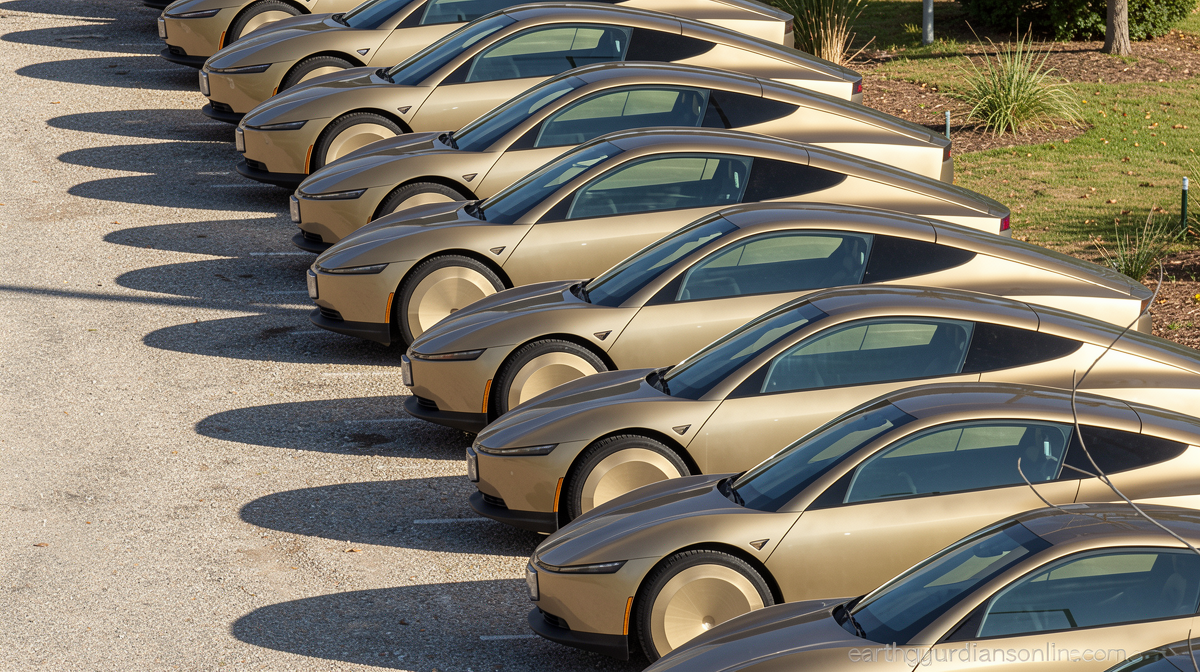
Details surrounding Thursday’s presentation were kept under tight wraps. The only advance material was a 51-second clip posted to X, depicting the compact two-seat vehicle threading through Austin traffic and cutting to app-based ride requests. Voiceover was sparse. The vehicle had first appeared publicly at a marquee Hollywood event roughly two years prior, and prototype units have since been spotted on public roads across several U.S. cities.
What Tesla has genuinely been running since June 2025 is a robotaxi pilot built on the Model Y platform, originally staffed by a company employee seated behind the steering wheel. In newer deployments, select vehicles have completed full passenger trips with no human aboard. The company declined to comment ahead of the Thursday showcase.
Musk’s Promises Against Market Reality
Musk has anchored much of the investor thesis on the Cybercab. Last year he forecast the service would reach half the U.S. population within 2025. In January he told shareholders the firm would eventually “make several times more Cybercabs per year than all our other vehicles combined.”
The deployment footprint tells a narrower story. Unsupervised rides are live in only six cities, all in Texas and Florida. Tesla stock (TSLA) has gained roughly seven percent over the trailing six months while closing Wednesday more than twenty percent below its year-ago price — a trajectory suggesting the market is discounting the most ambitious elements of the roadmap.
“Investing is about betting on the future,” Bryant Walker Smith, an autonomous-vehicle scholar at Stanford Law School’s Center for Internet and Society, noted. “Tesla is very good at selling that future. But at least with respect to automated driving everywhere and all the time, the company has been far less successful at actually delivering it.”
Waymo’s Scale Gap Keeps Widening
The distance between Tesla and Waymo, the Alphabet-backed driverless-ride operator, has grown sharply. In March, Waymo reported its fleet completing up to 500,000 paid, fully driverless trips weekly — a figure that had doubled over the prior twelve months. On Tuesday the company added Denver, San Diego, and Tampa, bringing its unsupervised-ride network to fourteen cities. Waymo also disclosed that through March its vehicles had logged 220 million miles of driverless customer travel since the service launched in 2018.
Tesla, by contrast, reported in July that its robotaxi fleet had accumulated approximately 380,000 miles of unsupervised operation — under 0.2 percent of Waymo’s stated mileage. The disparity highlights how far the Austin-based firm still has to go before its autonomous fleet can claim meaningful market presence.
The Unresolved Economics
Even a flawless nationwide rollout of the Cybercab does not guarantee a profitable unit economics. Smith frames the core obstacle as economic rather than purely technological.
“If you set aside development and hardware costs, you have the ongoing operational costs,” he said. “How do you compete with a Uber driver who might be making under minimum wage to provide and maintain their own car, to clean it and do all the other services that Waymo and Tesla may ultimately have to pay real people real money to do?”
That question sits at the center of the business model. A ride-hail platform must absorb vehicle maintenance, cleaning, insurance, charging or fuel, dispatch infrastructure, and customer support — line items a gig-economy driver historically internalizes at minimal wage. Automating the driving task removes one labor cost but introduces capital-intensive fleet management at scale.
Consumer behavior adds a further layer of uncertainty. Anthony Townsend, a senior research associate at Cornell Tech and author of Ghost Road: Beyond the Driverless Car, observes that persuading Americans to relinquish personal car ownership in favor of ride-sharing — human or autonomous — remains an open question. For those who do opt for rides over ownership, capturing market share in an already saturated and price-sensitive segment compounds the challenge.
Frequently Asked Questions
When does Tesla plan to launch the Cybercab robotaxi service? Tesla is scheduled to unveil the Cybercab robotaxi service this Thursday, though the company has not confirmed a specific commercial launch date or city beyond the existing Model Y-based pilot.
How does Tesla’s robotaxi mileage compare to Waymo’s? As of July, Tesla reported roughly 380,000 miles of unsupervised robotaxi operation. Waymo disclosed 220 million miles of driverless customer travel through March — making Tesla’s figure less than 0.2 percent of Waymo’s cumulative total.
Is the self-driving ride-hail industry profitable yet? No major operator has publicly demonstrated sustained profitability. Analysts and scholars point to ongoing operational costs — maintenance, cleaning, insurance, energy, and dispatch — as the primary barrier, even after development and hardware expenses are absorbed.
Where can Tesla’s unsupervised robotaxi rides currently be taken? Unsupervised rides are available in six cities, all located in Texas and Florida. Waymo, by comparison, offers unsupervised rides in fourteen cities as of this week.