
Wall Street is getting trampled by an AI sell-off. South Korean market plunges 10%
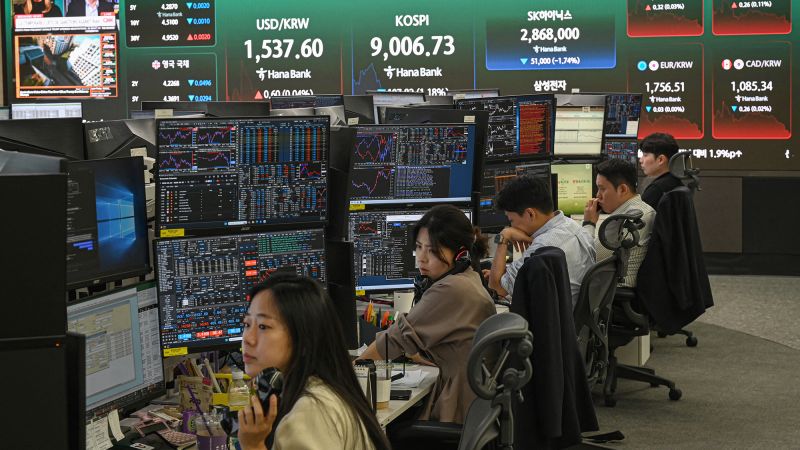
AI-Driven Market Turmoil Spreads Across Global Indices
Wall Street is getting trampled by – Markets have been shaken by a wave of volatility, with artificial intelligence once again at the center of the storm. What began as a modest tech sector retreat in the United States on Monday quickly cascaded into Asia on Tuesday, sparking alarm across major equity indices. The crisis reached its peak in South Korea, where the Kospi index experienced an unprecedented 10% drop, triggering a circuit breaker that forced a 20-minute pause in trading. This dramatic decline underscores the growing sensitivity of investors to AI-related risks, even as the broader market continues to navigate a complex landscape.
A Shifting Tide in Tech Stocks
The sell-off in tech equities started with a ripple effect in the US, where the Nasdaq Composite fell 1.9% in early trading on Tuesday. The S&P 500 also dipped 1.3%, while the Dow Jones Industrial Average opened 260 points lower, or 0.5%. These losses reflect a broader trend of investor caution, particularly as fears of an economic slowdown resurface. The Wall Street Volatility Index, which measures market anxiety, surged 17%, signaling a sharp increase in uncertainty. While no single event triggered the sell-off, the interconnectedness of global markets amplified the impact of these initial movements.
Analysts have pointed to multiple factors contributing to the panic. One immediate cause was the steep decline of Google (GOOG) and SpaceX (SPCX) on Monday, which sparked concerns about the sustainability of tech stocks’ recent gains. However, the reasons behind these drops are not entirely aligned with the broader market sentiment. Google’s 5% slide was attributed to a high-profile AI executive leaving to join Anthropic, a rival firm in the AI race. Meanwhile, SpaceX’s 16% fall on Monday was linked to post-IPO adjustments, a common phenomenon for companies that experience rapid stock price growth. Despite these specific triggers, the subsequent market reactions suggest a deeper, more generalized unease.
South Korea’s Market Collapse
South Korea’s Kospi index, which had surged 90% this year, faced a severe reversal on Tuesday. The index’s sharp decline of 10% sent shockwaves through the market, with tech giants SK Hynix and Samsung Electronics leading the charge. Both companies fell over 12%, their heavyweights status within the Kospi making their losses disproportionately impactful. Collectively, these two firms represent roughly half of the index’s market value, turning their individual declines into a catalyst for a broader market selloff.
While the exact cause of the panic remains unclear, the fear among traders suggests a growing perception that AI-driven valuations may be overextended. The rapid rise of AI stocks this year has created a scenario where even minor setbacks can trigger mass exits. As one trader noted, “The market is like a Jenga tower—every slight movement raises concerns about stability.” This metaphor captures the delicate balance of confidence in AI’s potential versus its current market overvaluation. With the Kospi down 10% in a single day, the risk of a cascading collapse has become a pressing concern.
“The Kospi is up 90% this year, so when the wind blows in an unexpected direction, it can lead traders—and, often more consequentially, trading algorithms—to head for the exits.” – Market analyst
The crisis in South Korea also reverberated across other Asian markets. Japan’s Nikkei 225 fell 3.6%, and SoftBank Group, a tech behemoth, dropped 15%. Most other Asian indices also declined by over 1%, highlighting the regional spread of the sell-off. While tech stocks have faced pressure lately, their overall decline has been relatively contained compared to the dramatic moves in the Kospi. For instance, the Nasdaq is down approximately 5.5% from its June 2 record high, yet it remains resilient in the face of AI-related volatility.
Fed Policy and Market Expectations
Some experts have tied the recent sell-off to the Federal Reserve’s stance on interest rates. The prospect of rate hikes later this year has long been a topic of discussion, but the Fed’s renewed commitment to curbing inflation may have intensified these concerns. New Fed Chairman Kevin Warsh’s press conference last Wednesday reinforced this narrative, stating the central bank would “double down” on its mission to stabilize prices. Traders interpreted this as a pledge to raise rates, even though the message was not entirely novel.
The potential for rate hikes is a key factor in investor behavior, especially for companies with high valuations. Tech firms, which have benefited from low interest rates and speculative fervor, are particularly vulnerable to higher borrowing costs. This dynamic has led to a reevaluation of AI stocks, with many traders questioning whether the current market valuations are justified. The Nasdaq’s recent drop, for example, has been accompanied by a broader sell-off in semiconductor companies, including Micron Technology (MU) and Marvell Technology (MRVL), which fell 11% and 7% respectively on Tuesday.
The broader market is also feeling the effects of this shift. Oracle (ORCL), a major player in enterprise software, saw a 2% decline, with its shares down 25% this month. This decline, coupled with the performance of other tech leaders, indicates a growing reluctance among investors to fund speculative ventures. Nvidia (NVDA), a key chipmaker, also fell 3% on Tuesday, further pressuring the technology sector. These losses, while not catastrophic, signal a transition from speculative optimism to cautious evaluation.
The Road Ahead: Uncertainty Lingers
Despite the recent downturn, the underlying momentum of the market remains intact. The sell-off in AI stocks is not a sign of a fundamental shift but rather a reflection of market overreaction. As one analyst observed, “The problem, as always with markets, is no one knows how high the Jenga tower goes.” This uncertainty is compounded by the fact that the market’s foundation—its reliance on AI innovation—has yet to be fully tested. The question now is whether the current volatility will be a short-lived correction or the beginning of a longer correction.
The broader context of market trends also plays a role. After President Donald Trump announced a ceasefire in Iran in April, global markets shifted focus from geopolitical risks to technological progress. However, the recent sell-off suggests that this focus has now turned inward. Oil prices, which had been rising in anticipation of economic recovery, fell slightly on Tuesday as traders prioritized AI-related concerns over traditional economic indicators. This shift highlights the extent to which investor sentiment is dominated by speculative trends, even in the absence of clear economic data.
As the market continues to adjust, the role of AI in shaping investor behavior will remain central. While the initial panic may have subsided, the underlying fears of overvaluation persist. The sharp decline in South Korea’s Kospi serves as a cautionary tale for markets that have grown too reliant on AI-driven optimism. With the US and Asian indices reacting to the same catalysts, the global financial landscape is now more interconnected than ever, creating a scenario where a single event can trigger widespread market turbulence.
The path forward will depend on how quickly markets can regain confidence. For now, the sell-off serves as a reminder of the fragility of growth-driven valuations. Whether this is a temporary setback or a sign of deeper structural challenges remains to be seen. As the dust settles, investors will be watching closely for any new developments that could tip the balance of the Jenga tower once more.
