
What you need to breathe easier when the air is full of smoke
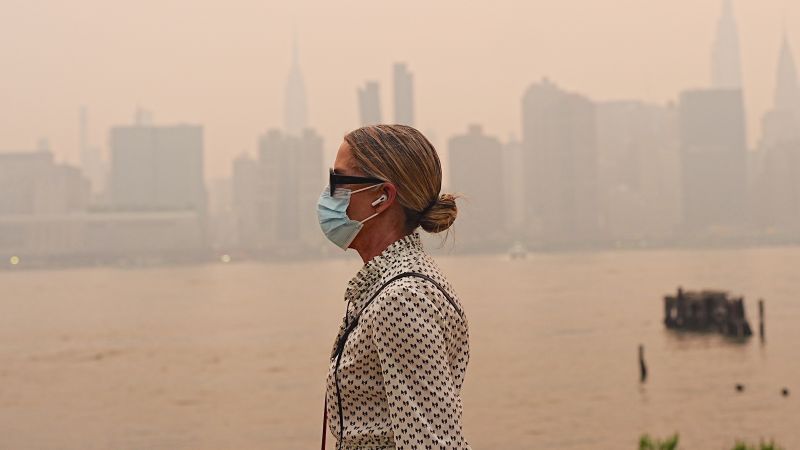
What you need to breathe easier – Many millions of Americans and Canadians are breathing bad air right now due to smoke from hundreds of Canadian wildfires and additional wildfires in northern Minnesota. If you’re in an affected area, it’s important to check air quality before you go anywhere this weekend, and keep certain items on hand to make life much more breathable when smoke is in the air. Wildfire smoke is a dangerous mix of gases and tiny particles – including the biggest danger to human health, particle pollution called PM2.5, microscopic particles smaller than a width of a human hair that can get stuck deep in your lungs or even enter the bloodstream, leading to more health problems down the road.
Doctors are emphasizing the importance of minimizing your time in the smoke as much as possible. Before you plan your day or go out, check AirNow.gov, says Dr. Rebecca Bascom, an attending physician who trains fellows in pulmonary and critical care medicine at Penn State.
“They do real-time monitoring, so you’re able to know where your area is at a specific time, so you have both forecasting where you can try to predict what you’re going to be up against,” she said. “Our access to information that we can use for our own health planning is so much better than it used to be.” If AirNow.gov or your favorite weather app says the air quality is at an unhealthy red or the very unhealthy purple level, doctors recommend staying home. “We really should be mindful that even if we don’t have any underlying lung disease, we can still have problems breathing, particularly in this environment with the wildfire smoke,” said Dr.
Rubabin Tooba, a pulmonologist with a secondary specialty in critical care medicine at Northwestern Medicine Palos Hospital. Prevention is always the best place to start with wildfire smoke, said Dr. Saema Tahir, a New York-based pulmonologist and critical care specialist.
“Rule of thumb: It doesn’t matter if you’re healthy or not, young or old. Avoidance is always the best practice,” she said. Before and after images: Wildfire smoke casts skylines in dystopian haze If you’re home, close your windows and doors and run your air-conditioning.
Units in windows and above doors need to be “very, very nicely sealed,” Tahir said, so they don’t allow external air in. Also make sure your home is well-ventilated, particularly in hot weather. “Heat actually creates more particles that get into the air, and then you have the smoke on top of that.
It really exacerbates all the particles we’re breathing in,” Tooba said. “It is key to be in spaces where the air is ventilated since air that’s stagnant, the particles are just staying in place, and that’s not good for us, either.” To keep home air as clean as possible, use a HEPA filter. These air purification systems are designed to capture at least 99.97% of airborne particles, even the tiny ones like smoke, dust and dander, according to the US Environmental Protection Agency.
Dr. Kirsten Koehler, a professor in the environmental health and engineering departments who studies air quality issues at Johns Hopkins, said it’s important to keep windows closed, keep central air on and use a MERV filter on your HVAC system if possible. MERV stands for Minimum Efficiency Reporting Value, and it measures the filter’s ability to remove airborne particles ranging from 0.3 to 10 microns.
“You can tell the efficiency of those by looking at the MERV rating on those, and the higher the number, the better,” she said. With HEPA filters, it’s important to use those appropriate for the house, Koehler said. The label or the manufacturer’s website should say how big a space the filter should work in.
Otherwise, you can use more than one portable air purifier, or use a smaller one in a smaller space and keep that space closed, Koehler said. How you can minimize the health risks of wildfire smoke If you don’t have HEPA filters, one lower-cost option is a Corsi Rosenthal box, which can be built at home using four MERV 13 filters, a box fan, duct tape and scissors. Instructions are available online.
“Even building your own with just even a single filter in a box fan can provide some filtration for your space,” Koehler said. Put the filter behind the fan so it filters the air before it gets to the fan blade and doesn’t get the blade dirty. Hypoallergenic bedding can help if you have asthma or another lung condition, Tooba said.
Hypoallergenic bedding like pillows, comforters and bedsheets is designed to resist common indoor allergens like pollen, pet dander and dust mites. It’s made from fabrics that are tightly woven or antimicrobial and can prevent irritants from settling into the fabric. Keep trips outside the house to a minimum on heavy smoke days.
Try to keep plenty of water, shelf-stable food and prescription medications on hand. If you have pets, make sure there’s extra pet food, and consider pee pads for dogs if you don’t want to take them on as many walks. “Do not try and do any heavy cleaning where there’s going to be dust in the air, because there’s already enough particulates in the air,” said Dr.
Aida Capo, a pulmonologist at Hackensack Meridian Palisades Medical Center. If you have to cook, use the microwave, or use the fan to ventilate the air. “Barbecuing and the heat with the air quality is just not a good mix right now because then you’re just inhaling what you’re cooking and inhaling the outside air, too,” Tooba said.
Doctors suggest that your emergency kit include well-fitted N95, KN95 or P100 masks. It’s good to have one per person per day. If you have children, make sure you get a child-size mask that fits properly.
Don’t bother using cloth or surgical masks, since they don’t really protect against the tiny particles found in wildfire smoke. One big reason why doctors suggest that people with asthma or other breathing problems stay home is because masks can be hard for them to wear comfortably. Over 100 million people under air quality alerts from wildfire smoke “An N95 mask can reduce the exposure, but that’s hard to wear.
People with asthma have trouble with the pull of the mask against their face, and the N95 just works on the particles and not on the vapor phase of this wildfire smoke, and both can contribute to the difficulties in the respiratory system,” Bascom said. If you have asthma or COPD, be sure you have your regular medicine, your rescue inhaler, a spacer and a nebulizer if you use one, and don’t hesitate to get things checked out if something doesn’t feel right. “If you experience shortness of breath or chest pain, dizziness, you should obviously see your doctor right away, or go to the emergency room,” Capo said.
“Allergy medicine is also recommended because poor air quality can produce worsening allergies for everybody: itchy, watery eyes, runny nose, skin discomfort. “An asthma attack can kick in at any moment with this air quality. We’ve seen it in the emergency room, and I’ve seen it in my office these past couple of days,” Capo said.
Tahir said it is also really important to keep rescue inhalers as close as possible, in a bag or pocket. “And always have one nearby at home,” she said. “Sometimes, people are running to go to their car or to bed, and the inhaler is all the way across the apartment or wherever it may be.
Have them in multiple areas so you’re not exerting yourself to get that inhaler. “And if it just doesn’t feel good, take yourself to the ER. It’s better to be safe than sorry, and sometimes it’s hard to backtrack, when you end up on a breathing machine, so know the alarms and take yourself to the emergency room if you need to,” she said.
If you’re hitting the road and expect to be in smoky conditions for a while, bring plenty of water and shelf-stable snacks, along with power bank for your devices and extra charging cables. If you’re driving through smoky areas, don’t put the top down or use the sunroof. “A best recommendation is to keep the windows closed and then use the recirculation setting on your car.
This will keep pulling the car from your cabin through your air filter again and then back into the car, so you’re not pulling the outdoor air in,” Koehler said. Bring glasses, not just contacts, since wildfire smoke can irritate the eyes. You may also want to bring lubricating eye drops or artificial tears to avoid dryness and irritation.
If you’re going away for the weekend, be sure to bring at least a week’s worth of prescription medications in case you get stuck somewhere. If you’re flying, keep those medications in your carry-on rather than your checked luggage, just in case your checked bag gets delayed. Will wildfire smoke impact the World Cup final?
Days with poor air quality should be taken seriously, Capo said, and people really should stay home if they can. “I always recommend people look at the air quality before they go out, and if it’s poor or you’re getting the alerts, just stay inside. This is not the time to go out for a long walk or have a picnic,” she said.
“It’s just not a good idea.”
