12 of Trump’s most bizarre moments on the Iran war

Daftar Isi
Trump’s Iran War Rhetoric: A Catalogue of Contradictions and Unmoored Proposals
Earthguardiansonline.com – The conflict between the United States and Iran has now stretched past its fifth month, and with each passing week the gap between what the president says and what is actually happening on the ground has widened into something almost surreal. In a single Tuesday this week, Donald Trump threatened military action against a second Middle Eastern state, suggested the Strait of Hormuz should become American territory, and flatly denied that any negotiations with Tehran were underway — a position that ran directly counter to what his own administration had communicated just days earlier. The war, which began in early March, has become a recurring stage for remarks that range from wildly optimistic to openly fantastical, all delivered while enormous geopolitical stakes hang in the balance.
The Hormuz Gambit: From Joint Venture to American Territory
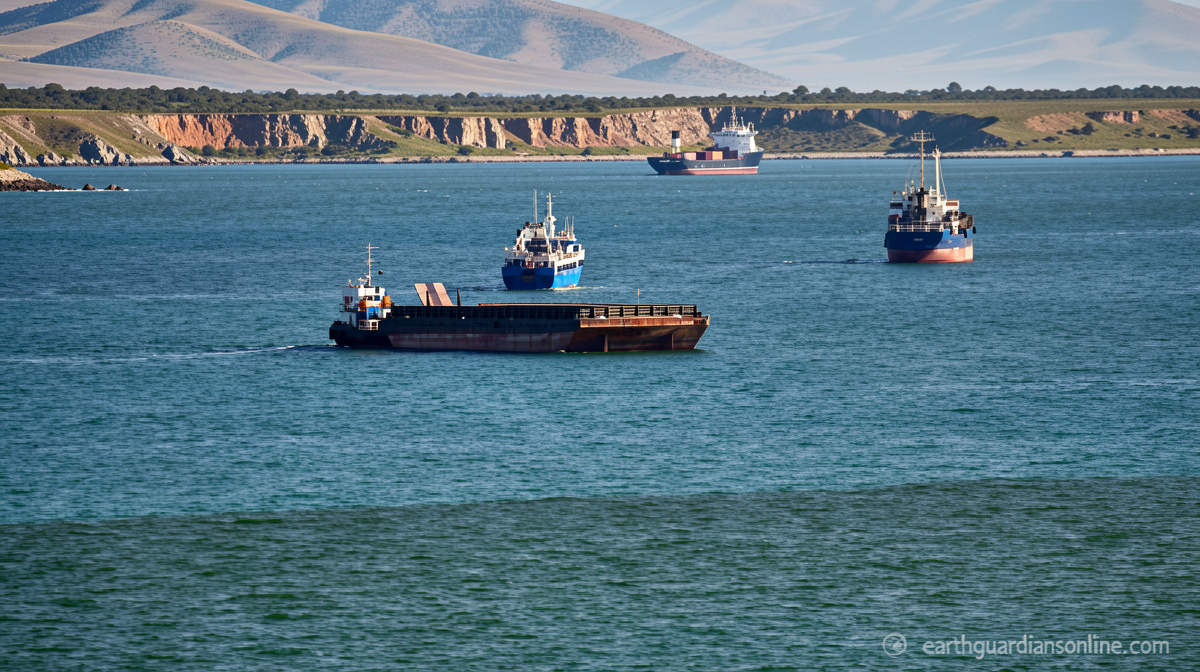
Perhaps no sequence of remarks illustrates the president’s tendency to propose solutions that defy basic geopolitical logic quite like his evolving ideas about the Strait of Hormuz — the narrow waterway through which roughly a fifth of the world’s oil passes. On April 8, speaking to ABC News correspondent Jonathan Karl, Trump floated the notion that Washington and Tehran might form a “joint venture” to collect tolls from ships transiting the strait.
“We’re thinking of doing it as a joint venture. It’s a way of securing it — also securing it from lots of other people,” Trump told the interviewer. “It’s a beautiful thing.”
The proposal sat uneasily with the reality that Iran and the United States have been adversaries for nearly five decades, a relationship punctuated by decades of mutual hostility and by Iranian crowds chanting “death to America.” It also contradicted the position of Secretary of State Marco Rubio, who had previously described the very idea of tolling an international waterway as both “illegal” and “dangerous for the world.” Weeks later, the rhetoric escalated further: Trump suggested the strait should simply become a piece of U.S. territory, a notion with no precedent in modern international law and no apparent mechanism for implementation.
“The Deal Is Right Around the Corner” — Repeatedly
Since early April, Trump has told the American public, on more than three dozen occasions by mid-June, that a comprehensive agreement with Iran was imminent. As far back as April 7, he posted on social media that talks were “very far along” and required only two more weeks “to be finalized and consummated.” He capped that post with the declaration that “it is an Honor to have this Longterm problem close to resolution.”
That resolution has not materialized. Iran has since signaled the opposite of desperation — including by violating the terms of a memorandum of understanding reached in June, a document that contained favorable provisions for Tehran. Yet the president continued to insist, well into July and beyond, that a deal was moments away and that Iran was eager to sign.
From “Rational People” to “Cuckoo” in Three Weeks
On June 16, at the G7 summit in France, Trump offered a surprisingly warm assessment of Iran’s leadership.
“We’re dealing with people that I think are very rational people,” he said. “They were nice to deal with. They were strong people, smart people. … But they’re not radicalized, and they’re, you know, looking to help their country.”
Critics at the time called the characterization Pollyannaish. The praise lasted exactly three weeks. After negotiations predictably collapsed, Trump turned to a NATO summit in Turkey and described those same leaders in markedly different terms.
“They violate the agreement every day,” he said. “They lie. They cheat.”
In the same breath, he labeled them “cuckoo,” “evil,” “sick,” “dirty players,” and “scum” — a vocabulary shift so abrupt that commentators struggled to identify which set of people he was describing.
“Iran Agreed to Everything” — And Then Didn’t
On April 17, speaking to CBS News, Trump asserted that Tehran had “agreed to everything” Washington demanded. The list he implied included halting support for proxy groups such as Hamas and Hezbollah, surrendering its stockpile of enriched uranium, and committing permanently to cease enrichment. None of those concessions materialized. There is no documentary evidence that Iran ever agreed to them. Even the June memorandum of understanding, which did come into existence, contained none of those items.
“The War Is Very Complete” — Ten Days In
On March 9, barely ten days after hostilities began, Trump told CBS News:
“I think the war is very complete, pretty much.”
The conflict has since lasted 172 days and counting, with no end in sight. The comment stands as one of the starkest examples of a president describing an active, ongoing war as though it were already finished.
Missiles: “In Relative Proportion, I Think It’s OK”
When the war began, Trump declared that a primary objective was to “raze their missile industry to the ground,” framing Iran’s arsenal as an existential threat to U.S. troops stationed across the region. By June 17, however, his tone had shifted dramatically.
“They have to have some, because other people have some,” he said, attempting to broker a deal. “Missiles aren’t the problem” because “they don’t blow up the planet.”
He followed up with: “In relative proportion, I think it’s OK.” The whiplash between calling for total destruction of a missile program and then dismissing the same missiles as proportionally acceptable left observers uncertain which policy, if either, was actually guiding U.S. strategy.
Neighbors Who Were “Largely Neutral”
Also on March 9, Trump claimed that Iran’s Gulf neighbors “were largely neutral” until Tehran attacked them, then added that those neighbors “came on to our side and started attacking them, and actually quite successfully,” naming Saudi Arabia, the UAE, and Qatar.
In reality, most Gulf states had worked assiduously to stay out of the conflict. Saudi Arabia did become somewhat entangled last month, but the broader picture of a regional coalition forming against Iran did not match the president’s account.
“The Beginning of Building a New Country”
On March 9, Trump described the war’s purpose in terms that sounded less like a military objective and more like a nation-building project: “It’s the beginning of building a new country.” He expanded on the idea on April 6, suggesting the United States “may even get involved with helping them” in that reconstruction.
No formal plan, no congressional authorization, and no interagency strategy document has accompanied these remarks. They remain, as with much of the president’s wartime commentary, floating assertions with no operational counterpart.
What the Pattern Suggests
Taken together, these remarks paint a picture of a leader who appears to be improvising his own understanding of the conflict in real time — praising adversaries one week and denouncing them the next, declaring wars over before they have begun, proposing economic arrangements between enemies as though decades of hostility were a minor inconvenience. For a conflict that has already consumed five months, displaced populations, and strained alliances across the Gulf and beyond, the stakes of such rhetorical instability are not merely academic. They shape what allies believe, what adversaries calculate, and what the American public is asked to accept as the administration’s actual position on any given day.
Related Reading
Frequently Asked Questions
What is 12 of Trump s most bizarre?
12 of Trump s most bizarre is the main topic of this guide. The article explains the context, practical details, and next steps readers should understand.
Why does 12 of Trump s most bizarre matter?
12 of Trump s most bizarre matters because readers are looking for a useful answer, not just a short summary. Good content should match search intent and help them decide what to do next.