
Exclusive: The FAA is evaluating risks to flights from Trump’s ‘triumphal arch’
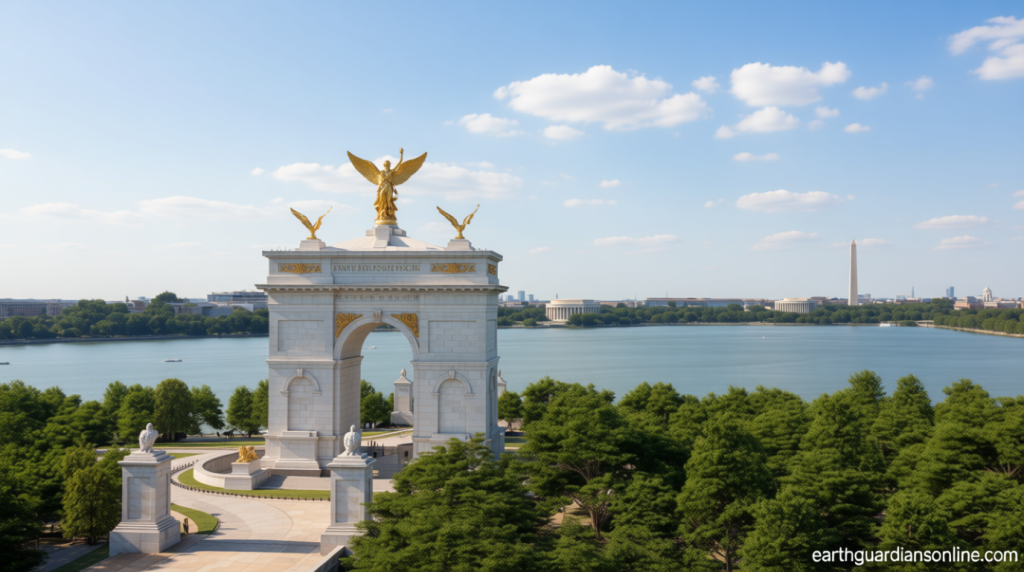
FAA Assessing Potential Flight Risks of Trump’s Proposed “Triumphal Arch” in Washington
Exclusive – The Federal Aviation Administration is currently reviewing the impact of a planned 250-foot “triumphal arch” near Ronald Reagan Washington National Airport, a decision prompted by the Trump administration’s request. The structure, intended to commemorate the United States’ 250th anniversary, would be located on a grassy plot at the end of Memorial Bridge, facing the Lincoln Memorial. While the arch’s design has garnered significant attention, its proximity to one of the nation’s busiest airports has raised concerns about aviation safety. Documents obtained by CNN reveal that the Department of the Interior, specifically the National Park Service, has formally asked the FAA to conduct an aeronautical study on the project. This request underscores the potential for the arch to disrupt airspace, a factor that triggers regulatory scrutiny under FAA guidelines.
Regulatory Framework and Evaluation Process
FAA regulations stipulate that any structure exceeding 200 feet in height must undergo a thorough analysis if it could interfere with flight paths. The arch, with a total height of 279 feet when the site’s elevation is factored in, falls under this category. Although the FAA typically aims to complete such evaluations within 45 to 90 days, the process often extends to nine months, depending on the complexity of the case. Despite the agency’s commitment to a timeline, officials have yet to specify when the arch’s assessment will conclude. This uncertainty has sparked discussions about the speed at which the project might move forward, particularly given the urgency of Trump’s original plans.
Aviation experts emphasize that the north approach flight path, which pilots use to navigate around the Pentagon and the Washington Monument, already presents significant challenges. The addition of the arch could complicate this route further, creating potential hazards for aircraft. The FAA’s review will examine critical factors, including runway length, airport elevation, the structure’s exact coordinates, and the height of temporary cranes during construction. These elements are essential to determining whether the arch poses a risk to air traffic. The agency also plans to consult with multiple federal agencies, including the Department of Defense and the Department of Homeland Security, as well as branches of the military such as the Army, Air Force, and Navy.
Past Incidents and Airspace Concerns
The airspace corridor near Reagan National Airport has a history of high-profile accidents, which has intensified scrutiny of the arch’s placement. Notably, a midair collision between an American Airlines plane and a Black Hawk helicopter occurred last year, and in 1982, a commercial aircraft crashed into the 14th Street Bridge during takeoff. These incidents highlight the importance of maintaining clear skies in the area. On a typical day, more than 900 commercial flights pass through Reagan National, making the airspace one of the most congested in the country. The FAA’s analysis will assess whether the arch could contribute to similar risks, especially in the context of the existing flight path complexities.
Insiders familiar with the approval process have expressed doubts about the thoroughness of the review, citing concerns over the influence of Trump’s appointees on decision-making. The president’s close ties with certain officials have raised fears that the arch may be fast-tracked without adequate consideration of its aviation implications. “I fear that regardless of any defects in the arch’s design, it will be rammed through by the government bodies that need to approve it,” one committee source stated in a recent statement. This sentiment reflects a broader apprehension that the project’s prioritization might overshadow safety protocols, even as the FAA begins its evaluation.
Interagency Collaboration and Approval Timelines
The National Capital Planning Commission (NCPC), a key body in the approval process, has confirmed it is collaborating with the FAA to ensure alignment in its assessment. “We regularly work with other agencies that have review roles to synchronize evaluations,” the NCPC informed CNN. However, the committee has not yet established a specific timeline for its review of the arch. Meanwhile, the Commission of Fine Arts, which has previously endorsed early designs for the structure, is reviewing a revised concept. While the commission has not confirmed whether the FAA’s concerns will influence its final decision, the revised plan has already entered the evaluation stage.
Trump’s vision for the arch includes a bold timeline, with construction set to begin within two months of its announcement. This accelerated schedule has led to questions about whether the FAA’s analysis will be given sufficient time to assess all potential risks. Under current regulations, a request for an obstruction analysis should be submitted 45 days before construction starts. However, the administration’s ability to proceed without a final FAA determination means that the arch could be erected before all safety issues are resolved. This has prompted debates about the balance between political momentum and technical due diligence.
Impact on Aviation and Future Considerations
The FAA’s evaluation will determine whether the arch requires mitigation measures, such as height reductions or the installation of hazard lights. If a hazard is identified, the administration has 60 days to implement changes. The agency’s final decision could have lasting implications for air traffic in Washington, particularly for pilots navigating the north approach. The arch’s location near a major airport and its proximity to iconic landmarks make it a focal point for both national pride and safety debates.
As the project moves forward, its approval will depend on the coordinated efforts of multiple agencies. The National Parks Service’s initial request has initiated a chain of evaluations, but the final outcome remains uncertain. With the FAA’s study still in progress and the NCPC’s timeline yet to be confirmed, the arch’s construction could proceed with minimal delays. However, the potential for rapid approval without addressing all safety concerns has left aviation experts wary. They argue that the arch’s design must be scrutinized meticulously to prevent any disruptions to the delicate balance of air travel in the nation’s capital.
Political and Practical Implications
Trump’s proposed arch is emblematic of his approach to large-scale projects, often prioritizing speed and symbolism over prolonged deliberation. Similar to his plans for a new White House ballroom and the renaming of the Kennedy Center, the arch reflects a pattern of quick decision-making driven by political objectives. While this strategy has proven effective in securing approvals for other initiatives, it has also drawn criticism for overlooking technical and logistical challenges. The FAA’s role in this process is critical, as its findings will determine whether the arch can be safely integrated into the existing infrastructure without compromising flight operations.
The arch’s potential impact on aviation underscores the need for a transparent and rigorous evaluation process. As the FAA delves deeper into the study, it must weigh the structure’s height against the frequency of air traffic and the historical risks in the area. The agency’s decision will not only affect the immediate vicinity of Reagan National but also set a precedent for future projects near airports. With the administration’s support and the urgency of the timeline, the arch’s fate hinges on whether the FAA can balance political momentum with aviation safety. The outcome of this assessment will shape how the nation’s capital continues to evolve its skyline and airspace management strategies.
