G7 leaders — and the rest of the world — wait for clarity on US-Iran agreement

G7 leaders — and the rest of the world — wait for clarity on US-Iran agreement
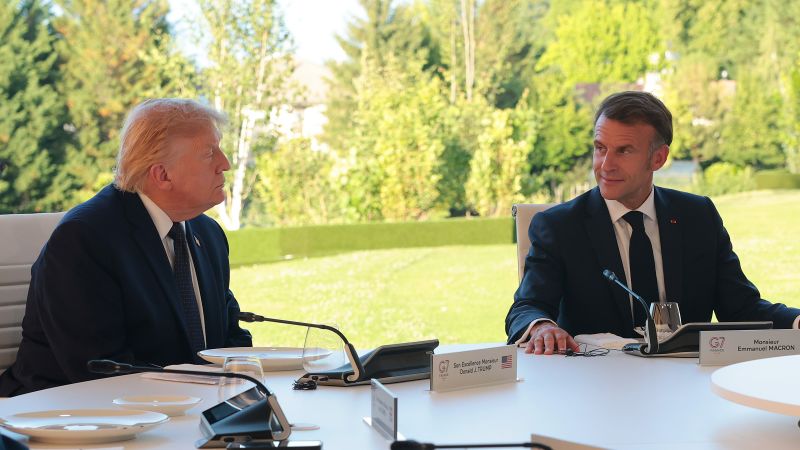
G7 leaders – As the sun dipped below the horizon on Monday evening, the leaders of the world’s leading economies gathered for a casual dinner overlooking the shimmering Lake Geneva. The event, held in the scenic alpine resort of Évian-les-Bains, was meant to foster collaboration on global issues, but it quickly became clear that the attendees were more focused on deciphering the intricacies of a recent pact between the United States and Iran. Despite the nearly two-hour gathering, the exact nature of President Donald Trump’s agreement with Iran remained shrouded in ambiguity, leaving many still puzzled by its terms.
Two officials close to the negotiations revealed that at least some of the G7 leaders departed the custom-built pavilion as uncertain about the plan’s specifics as they had arrived. The agreement, formalized in a virtual signing on Sunday, is a one-and-a-half page memorandum that has yet to be fully disclosed. With neither the U.S. nor Iran releasing the document, statements from both sides have occasionally clashed, creating confusion among allies and observers alike.
The lack of transparency has raised concerns even among Trump’s staunchest supporters. A senior U.S. official described the process as secretive, noting that while the text of the memorandum was expected to be made public before Friday’s formal signing in Switzerland, the timeline for its release remains unclear. This inconsistency has led to frustration, as European leaders like Macron and others in the G7 group have sought to review the document to make informed decisions. “I want it to be released. So probably pretty soon,” Trump remarked during the dinner, adding, “I would say some time after Friday.”
“I have asked for days, why can’t we, the people, see the damn MOU? Not through people briefed by an anonymous person. Honestly, I’ve never seen anything like this. If it is a great outcome for peace, then release it,” conservative commentator Mark Levin wrote on X.
Levin’s criticism reflects growing unease within the U.S. political spectrum. While Trump has frequently praised Levin on his Fox News show, the media outlet and its audience have grown increasingly skeptical of the administration’s handling of the agreement. The document’s secrecy has sparked questions about whether the deal truly benefits global stability or serves U.S. interests at the expense of transparency.
The agreement’s core objective appears to be the resolution of tensions over the Strait of Hormuz, a critical waterway for global oil trade. Trump asserted that the strait would operate “permanently toll-free,” a claim that contrasts with Iranian assurances to maintain control over passage and impose fees when necessary. This divergence in interpretation has left European officials, such as those from France and the United Kingdom, uncertain about how to proceed with commitments to support the deal.
Trump’s strained relationships with G7 leaders have been a recurring theme in recent weeks. During the summit, he was seated between French President Emmanuel Macron and British Prime Minister Keir Starmer, two figures he has publicly criticized for not aligning with his policies during the Iran war. Macron and Starmer have both expressed willingness to assist in clearing mines from the Strait of Hormuz, but their participation in the talks has been tempered by the need for more clarity on the pact’s details.
As the summit continued, Trump’s aides hinted at the U.S. strategy for the future. They anticipated European nations would contribute to a $300 billion reconstruction fund for Iran, a move that has drawn mixed reactions. Qatar, in particular, has played a significant role in the negotiations, with its officials working closely with the U.S. to secure support for the financial commitment. However, the absence of a public text has made it challenging for the broader international community to grasp the full implications of the deal.
While the G7 leaders awaited the agreement’s release, the U.S. government remained tight-lipped. Officials from the White House and the State Department provided varying explanations of the plan’s structure, with some suggesting the text would be unveiled soon and others deferring to future discussions. This uncertainty has also affected the perception of the deal’s effectiveness, with critics arguing that the lack of transparency undermines its credibility.
Monday’s dinner, initially framed as a symbolic gesture of unity, became a stage for further speculation. Trump’s remarks about the document’s timing, coupled with Macron’s support for the accord, highlighted the diplomatic balancing act at play. Despite the initial enthusiasm, the event underscored the challenge of aligning global interests when the details of a major agreement remain elusive. As the summit progressed, the anticipation for Friday’s formal signing loomed large, but the path to clarity remained uncertain.
The agreement’s potential impact on regional security and international relations is a subject of debate. While some see it as a breakthrough in easing tensions, others fear it could lead to new complications. For example, the U.S. emphasis on a “toll-free” strait contrasts with Iran’s control over the waterway, a key point of contention. Without a clear understanding of the terms, nations like Egypt and the United Arab Emirates—whose officials have been deeply involved in the talks—face the dilemma of endorsing a deal they have yet to fully review.
As the G7 summit concludes, the question remains: will the memorandum be released in time for Friday’s signing, or will the uncertainty persist? The answer could shape not only the future of U.S.-Iran relations but also the trust that other nations place in the agreement. With the world watching closely, the leaders’ next steps will be crucial in determining whether this pact can bridge divides or deepen confusion.