
Louisiana lawmakers pass new congressional map to give GOP additional House seat
Louisiana Lawmakers Pass New Congressional Map to Give GOP Additional House Seat
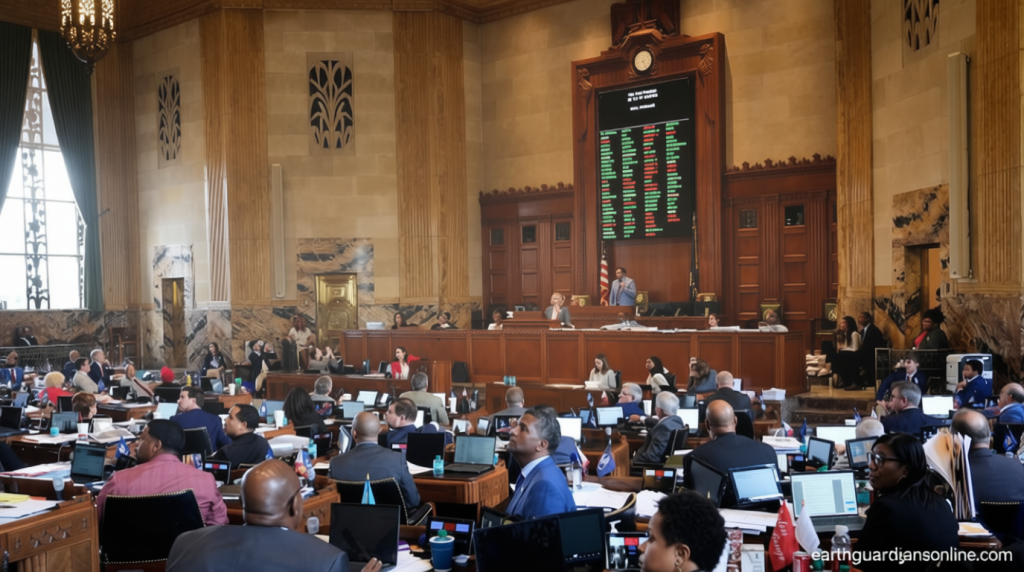
Louisiana lawmakers pass new congressional map – On Friday, Louisiana lawmakers finalized a revised congressional district map, a move intended to bolster Republican prospects in the upcoming House elections while removing one of the state’s two majority-Black districts, both of which are currently held by Democrats. The plan was swiftly approved by the state Senate in a 28-10 vote along party lines and later signed into law by Republican Governor Jeff Landry. This adjustment marks a significant step in the ongoing effort to reshape electoral boundaries, with implications that extend beyond Louisiana’s borders.
Supreme Court Decision Sparks Redistricting Shift
The new map comes in the wake of a pivotal Supreme Court ruling in late April, which invalidated Louisiana’s previous district configuration as an unlawful racial gerrymander. This decision weakened the 1965 Voting Rights Act, a landmark piece of legislation that had long protected minority voting rights. The ruling intensified the national redistricting debate, particularly as President Donald Trump’s administration pushed to secure Republicans’ narrow majority in the midterm elections. Southern states, including Louisiana, have since taken advantage of this legal landscape to redraw their districts, favoring the GOP.
The original map, which had been in place since 2024, included two districts with a majority-Black population. These districts had been a key factor in maintaining Democratic representation in the state’s House delegation. However, the Supreme Court’s decision to strike down the old map as racially discriminatory opened the door for Republicans to claim a strategic advantage. Louisiana’s new map aims to consolidate Democratic votes by reducing the number of majority-Black districts, potentially shifting the balance of power in favor of the GOP.
Political Strategy and Racial Gerrymandering Debate
Republicans had initially considered creating a map that would give them a chance to win all six of Louisiana’s House seats. This bold approach, however, required adding more registered Democrats to Republican-controlled districts, which could have backfired by diluting their voting strength. The final map approved by lawmakers instead features a 5-1 split, which Republicans argue is more secure for their majority and better safeguards House Speaker Mike Johnson from facing a tough re-election campaign.
Democrats, on the other hand, accuse the new map of being racially gerrymandered. They argue that the plan forces Black voters—many of whom align with the Democratic Party—into a single district, effectively reducing their influence in other areas. During the legislative debate, Democratic state Senator Royce Duplessis criticized the move, likening it to a “vicious, vicious race to the bottom” in the South. He pointed out that states like South Carolina had resisted redrawing their maps during an election year, emphasizing the urgency of the current effort.
“I purposely put more Democrats into District 2 to make the remaining districts better performing for Republicans,” stated Republican state Senator Jay Morris, the bill’s sponsor. Morris asserted that party affiliation, not race, dictated the boundaries of the districts. He instructed map demographers to exclude race-related data from the final proposal, ensuring that the arguments presented to lawmakers remained focused on political strategy rather than racial considerations.
Despite this claim, Democratic Senator Sam Jenkins challenged Morris’s stance, suggesting the map was a “racially gerrymandered district that’s going to get us into a lot of trouble here.” Morris responded with a simple “Agree to disagree,” underscoring the partisan divide over the issue.
Primary Date Changes and Electoral Impact
In response to the Supreme Court’s decision, Governor Landry delayed the state’s closed primary for the US House, originally scheduled for May 16, and moved it to November 3. This change allowed Republican lawmakers to finalize and approve a new map before the primary, ensuring the party could align its candidates with the updated boundaries. All candidates, regardless of political affiliation, will now appear on the ballot in their respective districts, a key feature of the open primary system.
The new map redraws the district of Democratic Representative Cleo Fields, concentrating Black voters into a single district in the Baton Rouge area and southern Louisiana. It also redistributes parts of Baton Rouge into a heavily Democratic district centered in New Orleans, which is currently represented by Democratic Rep. Troy Carter. These adjustments are designed to maximize Republican chances in the House races while minimizing Democratic gains.
Legal Challenges and National Implications
With the new map in place, Democrats anticipate legal battles over its racial implications. The American Civil Liberties Union of Louisiana hinted at potential litigation, calling the plan a “racial gerrymander hiding behind the thin veneer of partisanship.” Legal experts warn that this fight may not be over, as the Supreme Court’s ruling has already set a precedent for challenging redistricting efforts on racial grounds.
Meanwhile, the successful plaintiffs in the Supreme Court’s decision criticized the state legislature for keeping a majority-Black district unchanged. This critique highlights the tension between the original intent of the Voting Rights Act and the current efforts to weaken its protections. Across the South, several other Republican-controlled states have followed Louisiana’s lead, using the weakened act to reshape their own districts. So far, these efforts have favored the GOP, but the outcome of November’s elections remains uncertain.
Democrats argue that the redistricting strategy could still yield six additional seats in states like California and Utah, where new districts are being drawn. Republicans, however, believe their gains in Louisiana and other Southern states could secure as many as 15 seats nationwide. As the November elections approach, the battle over district lines continues to shape the balance of power in the US House, with both parties vying to secure an advantage in a closely divided chamber.
