
Mamdani marks July 4 with a pro-immigration speech, ripping Trump’s policies without using his name
Mamdani Marks July 4 with a Pro-Immigration Speech, Criticizing Trump’s Policies Without Naming Him
A Patriotic Address on America’s 250th Anniversary
Mamdani marks July 4 with a pro – On the eve of the United States’ 250th birthday, New York City Mayor Zohran Mamdani delivered a speech that redefined the essence of patriotism. Instead of celebrating the nation’s achievements alone, he emphasized that true pride in America requires addressing its foundational ideals alongside its current shortcomings. The speech, held at a symbolic location in NYC, aimed to contrast with President Donald Trump’s anticipated remarks at Mount Rushmore, framing immigration as a central theme to challenge prevailing narratives about the country’s identity.
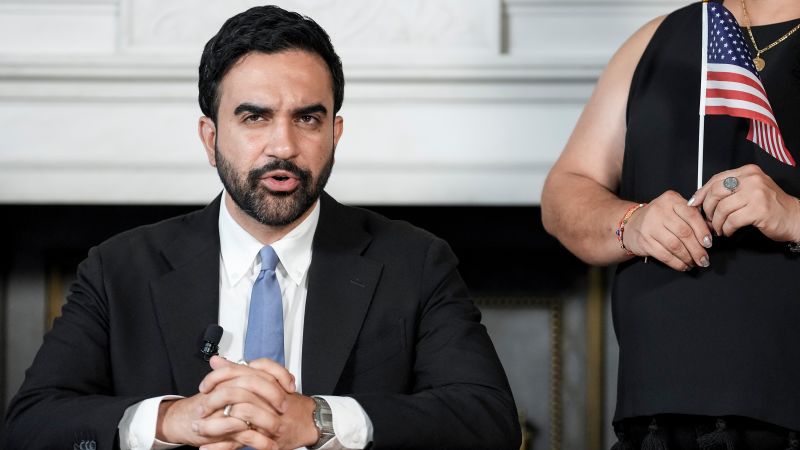
Mamdani, a naturalized citizen from Uganda, stood before a crowd that included immigrants who had been granted citizenship through years of hard work and dedication. The backdrop of the event featured a desk once used by George Washington, underscoring the historical role of immigrants in shaping the nation. “America, if you ask them, becomes less the more people it welcomes,” he declared, a statement that resonated deeply with his audience and highlighted his belief that the country’s greatness is tied to its openness.
“America, they will tell you, belongs only to those with the right accent or the right shade of skin. The rest of us, they insist, should be grateful for merely being allowed to visit.”
The mayor’s remarks were sharp, targeting powerful entities he argued benefit from America’s immigrant contributions while restricting access to its opportunities. He described a scenario where immigrants face systemic challenges, such as being displaced by those who “terrorize our streets” and “spirit them away in unmarked vans.” This imagery painted a vivid picture of the struggles faced by undocumented residents, whom Mamdani claimed are often overlooked despite their vital role in the economy.
A Legacy of Immigrant Influence
While the speech did not explicitly name Trump, the mayor’s critique aligned closely with the president’s policies. He noted that the nation’s wealth has been built by individuals with “calloused, dirt-streaked hands” — factory workers, laborers, and artists who contribute tirelessly to the country’s progress. “We see a nation that has allowed so much of that wealth to be held instead in the soft hands of a precious few,” he said, a clear reference to the growing disparity between immigrants and the elite.
Mamdani’s personal story of immigration added a layer of authenticity to his message. He recounted how, during his arrival in the United States, he and his family first glimpsed the Statue of Liberty from an airplane. “That moment symbolized the promise of this country,” he explained, reinforcing the idea that immigration is both a personal and national journey of transformation.
Though he did not mention Trump directly, the speech’s tone left little doubt about its target. Mamdani, who had previously met with the president twice at the White House, positioned himself as a counterpoint to the administration’s approach. His argument centered on the belief that America’s strength lies in its ability to evolve through the contributions of its diverse population, rather than rigid borders or exclusionary policies.
Political Aspirations and Constitutional Limits
The event marked one of Mamdani’s most prominent national appearances since assuming office in January. As a democratic socialist, he has increasingly emerged as a key figure within the Democratic Party, advocating for progressive reforms and shaping the party’s direction. His speech was part of a broader effort to position himself as a leader in the movement to expand access to citizenship and challenge policies that limit opportunities for immigrants.
Despite his rising influence, Mamdani remains constrained by the Constitution, which bars him from seeking the presidency or vice-presidency due to his naturalized status. This limitation has sparked discussions about potential amendments to the document, but the mayor has been vocal in his support for the current framework. “The Constitution looks good just the way it is,” he told ABC News last week, a sentiment that reflects his commitment to constitutional principles even as he pushes for policy changes.
His focus on the November midterms and the 2028 Democratic presidential nomination suggests a strategic vision for the future. By aligning himself with candidates who have gained momentum in New York’s recent primaries, Mamdani has positioned himself as a bridge between grassroots activism and national leadership. His speech on July 4 was not just a celebration of America’s history but a call to action for its future, urging the nation to live up to the values enshrined in its founding documents.
Located just steps away from where the Declaration of Independence was first read to the Continental Army, NYC Hall became a powerful stage for Mamdani’s message. The setting amplified the contrast between the nation’s revolutionary ideals and its contemporary challenges, reinforcing his argument that immigration is both a symbol of America’s enduring promise and a test of its commitment to those ideals. As he spoke, the audience was reminded that the United States was built by immigrants, and its future depends on their continued participation.
Mamdani’s critique extended beyond policy to the cultural narrative surrounding immigration. He argued that the current system often favors those with “the right accent or the right shade of skin,” marginalizing others who contribute to the country’s fabric. This perspective, rooted in personal experience and collective struggle, has galvanized support among progressive voters while also drawing criticism from those who view his stance as radical.
The speech’s themes of resilience and inclusivity were underscored by the presence of immigrants at the event, who stood as living testaments to the nation’s capacity for transformation. By drawing on their stories, Mamdani framed his message not as a political attack but as a celebration of America’s ability to adapt and grow. His words, however, carried a pointed challenge to the status quo, urging leaders to recognize that the country’s strength lies in its diversity, not its exclusion.
As the nation approaches its 250th anniversary, Mamdani’s speech offered a vision of a more inclusive future. By blending historical context with modern challenges, he positioned himself as a defender of America’s founding principles while advocating for policies that reflect its evolving reality. His ability to articulate this vision without directly naming Trump highlights his skill in framing criticism within a broader narrative of national identity and progress.
In a country that often debates the meaning of patriotism, Mamdani’s address served as a reminder that the true measure of a nation is how it treats those who arrive at its shores. His words echoed the sentiment that America’s greatness is not a fixed state but a continuous process, shaped by the contributions of immigrants and the ideals they strive to uphold.
