
Trump’s Iran agreement draws rare reproach from powerful Republicans
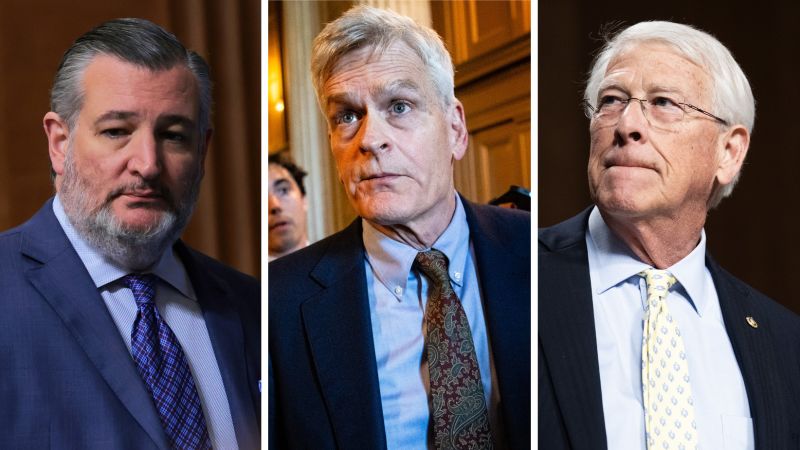
Trump’s Iran Agreement Sparks Unusual Criticism from Key Republicans
Trump s Iran agreement draws rare – President Donald Trump’s recent deal with Iran has stirred unexpected skepticism among influential members of the Republican Party, signaling a shift in the political landscape of Capitol Hill. While the initial reaction from some senior GOP lawmakers was one of silence, a growing number have begun to voice concerns over the agreement’s terms, questioning its impact on national security and U.S. interests. This dissent, though rare, highlights the increasing fractures within the party, particularly as Trump faces mounting pressure to secure legislative backing for his foreign policy initiatives.
Ambivalent Reactions from the GOP
Within hours of learning the specifics of the agreement, a faction of Republican senators expressed reservations. Some, like outgoing Louisiana Senator Bill Cassidy, were so unsettled that they initially avoided public commentary. But by the following day, a notable group of GOP lawmakers had taken to criticizing the deal, with several calling for a complete overhaul of Trump’s approach to Iran. Cassidy, who is retiring from the Senate, summarized his concerns bluntly:
“Iran’s left stronger, we are left weaker.”
Similarly, Texas Senator John Cornyn, also set to leave Congress, stated:
“Everything I’ve heard about, it causes me concern.”
Alaska Senator Lisa Murkowski echoed these sentiments, noting that the agreement seemed to leave Iran in a comparable position to its pre-2015 state. “It’s tough to say that the agreement is one that leaves Iran in a worse place and the United States in a better place,” she remarked, later adding:
“A lot of money has been spent, some lives have been lost, and yet you have Iran in a place where it almost looks like this is where they were before.”
These remarks suggest that even some of Trump’s allies are reevaluating the deal’s effectiveness, particularly its financial concessions and sanctions relief.
Eroding Support Amid Political Challenges
The rising tide of Republican opposition has raised alarms for Trump, indicating that the agreement may not hold up in a potential vote, even within a Republican-majority Congress. This discord comes at a critical juncture in Trump’s presidency, as his party grapples with internal tensions over various issues, including his controversial ballroom project, retaliatory measures against adversaries, and recent disputes over the intelligence chief. The shifting sentiment within the GOP could complicate broader efforts to advance legislative priorities before the midterm elections.
One of the most vocal critics is Senator Roger Wicker of Mississippi, the top Republican on the Senate’s influential Armed Services Committee. Wicker initially remained silent after the White House released the agreement’s key details, but by Thursday, he had issued a sharp critique. “I am concerned that the memorandum of understanding negotiates away the victories of Operation Epic Fury in ways that are completely out of step with the President’s goals,” Wicker wrote in his statement. He highlighted the $300 billion rebuilding fund as a major point of contention, arguing that it undermines previous efforts to weaken Iran’s nuclear capabilities.
Wicker compared the current deal to the 2015 agreement under President Barack Obama, which he once called a “failed 1938 Munich Accords” analogy. “The perks for Iran in a prior deal with then-President Obama will look like a pittance by comparison,” he said, emphasizing the financial incentives offered to Iran. His cautionary stance was evident in his public messaging, as he distributed copies of his statement to journalists rather than answering questions directly. This approach reflects a strategic effort to amplify his criticism while avoiding overt confrontation with the administration.
Broader Implications for the GOP
Senator Ted Cruz of Texas, a vocal Iran hawk, has also joined the chorus of dissent. He criticized the agreement’s $300 billion reconstruction fund, arguing that it allows Iran to profit from its strategic position in the Strait of Hormuz. “History demonstrates that giving billions of dollars to theocratic lunatics who want to murder us is an exceptionally bad idea,” Cruz said. “And I think unfortunately the president is receiving some really bad advice on this deal.” He warned that such financial aid could be used to fund Iran’s aggression, potentially threatening American lives.
These criticisms are not isolated. A Republican senator, speaking on condition of anonymity, described the Senate GOP as experiencing “a high level of dismay” over the agreement. This senator, who is part of the leadership, expressed doubts about the likelihood of a final deal being reached, suggesting that Iran may not be willing to accept the terms proposed. Such skepticism could delay the agreement’s implementation and create uncertainty about its long-term viability.
The agreement’s financial aspects, particularly the $300 billion fund, have become a focal point for Republican dissent. This fund is intended to support Iran’s economic recovery, which critics argue rewards the country’s nuclear ambitions. Thune, the Senate Majority Leader, initially downplayed the agreement’s significance, stating he was still “digesting” the details. However, he later acknowledged that the deal serves as a first step, conditional on Iran’s compliance with its commitments. This cautious endorsement underscores the mixed feelings within the Republican ranks.
As the debate over the Iran agreement intensifies, its implications for the GOP’s electoral prospects become increasingly clear. The deal’s passage could depend on securing support from lawmakers who have previously aligned with Trump’s policies. Yet, with a significant portion of the party questioning the terms, the White House faces an uphill battle to rally consensus. The financial burden of the agreement, combined with its strategic risks, adds to the pressure on Trump to justify his decision to the American public.
In a broader context, the dissent over the Iran deal reflects a deeper political challenge for the GOP. The party’s leaders, including Thune, are navigating a complex environment where internal disagreements threaten to undermine unity. This tension is compounded by the looming debate on an expensive bill to fund Iran war operations, which could become a contentious issue in the upcoming summer session. If the agreement fails to gain traction, it may leave Trump and his party in a precarious position, potentially affecting their ability to achieve other legislative goals before the midterms.
