
What happened to the Trump administration’s in-your-face mass deportations?
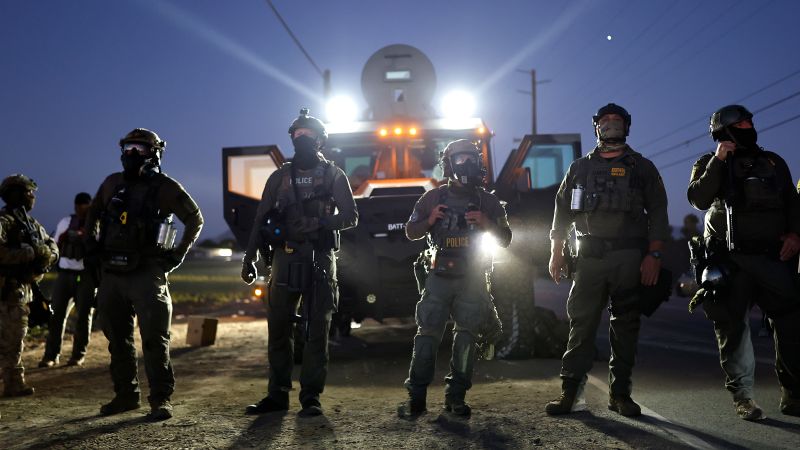
What happened to the Trump administration – The White House has intentionally retreated from its in-your-face deportation approach after confrontations between federal and state officials in multiple states erupted in Minneapolis earlier this year, when video of masked agents killing protesters sparked outrage and protest. The officials, beyond Trump, most associated with those tactics are gone. US Border Patrol official Greg Bovino has retired.
Department of Homeland Security Secretary Kristi Noem was fired. I went to CNN’s Priscilla Alvarez, who has covered immigration for years, to understand what has and has not changed in the Trump administration’s efforts. WOLF: In the months since Minneapolis, it seems like there’s been a real change in how the administration is pursuing its mass deportation policy.
What has happened? ALVAREZ: To best answer your question, I think it’s good to revisit Minneapolis for one reason in particular, which is the arrival of Tom Homan. Recall that after the death of the two US citizens by federal agents, the president dispatched Tom Homan, his border czar, to Minneapolis to course correct.
When Homan arrived, there was a noticeable shift in the way that immigration enforcement operations were happening. Whereas before you had Gregory Bovino, then a top Border Patrol official with his aggressive approach to enforcement, you had Homeland Security Secretary Kristi Noem, who was ultimately the one who backed and approved Bovino’s style — all of it was quite flashy and in your face. When Homan came in, the noticeable shift was that suddenly immigration enforcement, while still happening, was happening far more under the radar.
What occurred there has been happening now across the country. Bovino left the US Border Patrol, and at DHS, Secretary Kristi Noem was fired by President Donald Trump, and that led to Markwayne Mullin taking that position. The substance of the policies has not changed.
They are still being aggressive in arresting undocumented immigrants nationwide, but the way in which it’s done and the way that they showcase it has changed. Before, you had very flashy, in-your-face videos across all social media of these operations. Now, you don’t necessarily have that.
It’s much more quiet, as Secretary Mullin describes it. WOLF: Is Homan effectively setting the policy, or has Mullin put his own mark on things? ALVAREZ: The way to think about this is, first of all, Tom Homan is a veteran law enforcement official.
He worked at Immigration and Customs Enforcement for many, many years, for Republican and Democratic administrations. Now, he’s in this unique position of White House Border Czar. Under Secretary Noem, the two of them did not talk to one another.
They had a quite tense relationship. With Secretary Markwayne Mullin, Homan does talk to him. They actually regularly say publicly how often they are talking with one another.
What we’re seeing now is the sort of staple Tom Homan approach to immigration enforcement. He calls it a targeted approach, which is to say targeting people with criminal histories, but not foreclosing that if they come across other undocumented immigrants who perhaps have no criminal history, that they too can be swept up in those operations. But when we’re talking big picture, which is to say the administration’s or the president’s immigration agenda, that is also dictated by Stephen Miller, the White House deputy chief of staff.
He also has his mark on all of this. I think the difference, and where people may be confused, is that Homan is very enforcement-minded. That is the slice of things that he is focused on.
Miller has generally led the charge on the big picture immigration agenda, which is driving policy and policy changes across multiple departments that touch immigration. WOLF: Are immigration and border officials still doing the things that were so controversial months ago, like wearing masks, targeting people near schools, things that rubbed Americans the wrong way in the lead up to Minneapolis. Is that still going on?
ALVAREZ: The short answer is yes. And I do want to be clear, Homan has been around this whole time. The difference was that Homan and Noem were not on the same page about how immigration enforcement was carried out, and now Homan and Mullin are, and so they’re more in lockstep in terms of how immigration enforcement is done.
But yes, agents are still wearing masks. There are still people who are being arrested who do not have a criminal history, but are in the United States illegally. So, it’s not always just the worst of the worst, which is what we hear from this administration.
They themselves have similarly said that there are people that they are arresting who don’t have criminal history. They are still placing them in detention and still deporting them, and they’re still deporting them to far-flung countries that they may not have any connection to. I would say one difference that certainly made a splash now is the use of warrants.
Recall, there was a time where there was an interpretation that ICE was making that administrative warrants (warrants issued without a judge) could be used to go onto private property. Mullin said during his confirmation hearing that that should be an authority under a judicial warrant, not an administrative warrant, which is the one used for immigration arrests. That change has happened on the ground, but otherwise a lot of it remains the same.
A record $170 billion is being spent on mass deportation and border security WOLF: The Trump administration wanted to deport a million people or more. Is that still a goal? Are they on track to reach that number?
ALVAREZ: That’s absolutely a goal for them. I think there’s nuance here. They did not reach a million deportations in a year, which was their stated goal at the start of the Trump administration last year.
What they often say — they being the Department of Homeland Security — is that millions of people have self-deported, and so they sort of lump that into their overarching goal that that they have deported a million people. We don’t have the data that backs up the number of self deportations that the administration often talks about. We know from our own reporting that tens of thousands of people have opted to use their CBP Home program, as they call it, to facilitate their self-deportation and take advantage of the financial incentives that the administration has often talked about.
But we do not have anything or any evidence to show that millions of people have decided to self-deport. I will note that I have reported on self-deportations, and there are certainly cases where people do not wish to use the program, or even publicize that they are self-deported from the US. So it is just a very hard number to quantify.
We have also heard from Tom Homan this year that mass deportations are certainly on track, and they are very much moving forward with their aggressive campaign. WOLF: What do we know about whether people are taking money from the administration to self-deport? ALVAREZ: I’ve done some reporting on this, and I have spoken to people who did get the money, the financial incentives, which are up to $2,600.
There is a program which the administration set up for people to opt into self-deportation. They could opt in, they would go to their origin country, and that is where they would collect the financial incentive. I have talked to people who have done that and have collected the money.
There are still people that I have spoken with, and one that a family we profiled last year that decided to self-deport to Mexico, but never told the government. They did not want the government to know what they were doing. They had no interest in collecting the financial incentive.
That was their choice, and they decided to leave. My point is that it is a very hard number to quantify in terms of how many people are self-deporting. The administration has come out with their number repeatedly — it’s over 2.2 million.
We just don’t have any evidence to back that up. WOLF: The administration has also removed temporary protective status (TPS) for various communities of people who sought refuge in the US (Haiti, Syria, Afghanistan and more). How are those efforts working at this point?
ALVAREZ: Well, I think what you’re getting at is something that I’ve heard from multiple Homeland Security officials, which is to make it so hard for undocumented immigrants and some immigrants in the US legally to be in the United States that they choose to leave the country. Deporting someone is hard. There is a reason that previous administrations have not been able to get to a million deportations in a year.
It’s a process. And so to reach the numbers they want to reach, they do have to depend in part on people deciding to leave on their own, and they can get people to do that by making them feel the squeeze. Yes, the administration has rescinded temporary protected status, which is a form of humanitarian relief for people already in the US to live and work here legally for a period of time.
This happened under the first Trump administration as well. Republicans generally don’t like this program because they feel that something that is meant to be temporary gets extended over and over again, and it loses sort of the temporary aspect, which is true. Some of these statuses have gone on for a very long time.
They get renewed over multiple administrations, so that makes someone who was living here with the protection they have, protections to be here, to live and work here. You strip that away, then they are here illegally, right? And that makes your life much more difficult.
So, you were able to work legally, now you’re not able to work legally. All of this is the subject of lawsuits that are still ongoing in the courts, but I think what this really boils down to is make it so hard to be in the US that you choose to leave, you being the person that is the subject of this crackdown. They do that by tightening the screws across the immigration system for those who are undocumented and for those who are trying to be trying to be here legally or already are here legally and are trying to obtain green cards, and the rest.
WOLF: Trump has bragged that the border is effectively secure now, and that nobody is crossing the border. Do we believe that to be true? ALVAREZ: No, people are always crossing the border.
I think it’s just a numbers game. There are fewer crossing the border than there used to be. There are fewer releases than there used to be.
What does that mean? Under, for example, the Biden administration, they were so overwhelmed by the number of people crossing that after screening and vetting individuals, they would release them into the United States to continue on with their immigration proceedings. That is happening far less under the Trump administration.
They are being apprehended and then they may be detained, or they may be immediately sent back to their origin country. But people are always crossing the border, it’s just a matter of how many, and certainly there are far fewer that are crossing now than were under the previous administration, when there was a crisis along the US Southern border. WOLF: Do we think that the message that the administration has tried to put out there, that essentially the US is not hospitable to immigration, and particularly undocumented immigration, has that had the effect of making fewer people want to come here?
ALVAREZ: The US has generally leaned on deterrence policy over the years to keep people from illegally migrating to the United States. I think that is a fragile thing. For example, there was the zero-tolerance policy, otherwise known as the family separation policy, under the first Trump administration in 2018 and certainly that was jarring and meant as a deterrent for people to not legally migrate.
Yet a year later I was covering a crisis on the border under the first Trump administration. The pandemic happened, and that led to massive migratory flows in the Western Hemisphere that couldn’t have been anticipated prior to the pandemic. Certainly people are seeing what’s happening in the US and they feel discouraged or not interested in coming here and migrating here, but there is a world of possibilities of things that can happen around the globe that are outside of the policymakers’ control that could lead to people coming here in bigger numbers, and I think that’s always something that the Department of Homeland Security is watching for.
WOLF: As somebody who covers this every day, what is the thing that you wish more people understood about the mass deportation effort in the last couple of months? ALVAREZ: We often use the term mass deportation because that is what President Trump campaigned on. It is what we hear from his officials when talking about his immigration agenda, but the administration’s immigration agenda is not solely focused on people who are in the United States illegally, nor people who are in the United States illegally and have committed crimes.
The agenda is broader than that. It is a tightening of the screws of the entire US immigration system that not only has consequences for people in the US illegally, but also for people who are here legally, who are, or who are trying to come to the US legally, and I think that that part of this often gets missed. It’s not just about deporting undocumented immigrants, it is a wholesale rethinking of the US immigration system, and who is allowed to be here or not be here.
