Jalen Brunson’s MVP-winning performance cements his legacy as the greatest New York Knick of all time

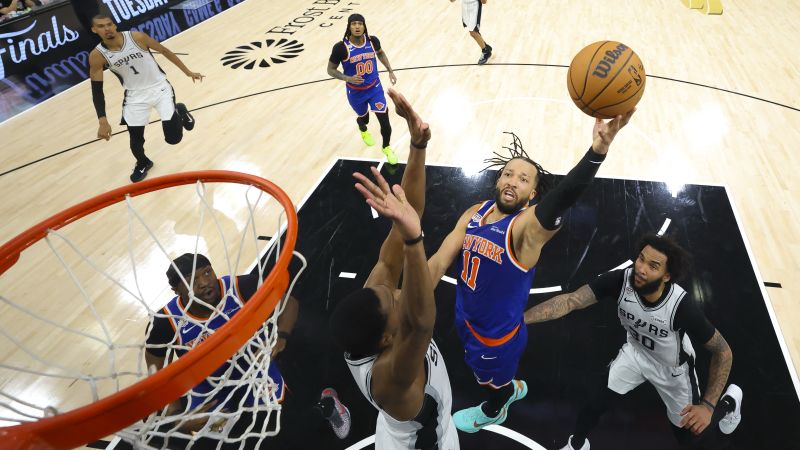
Jalen Brunson’s MVP-winning performance cements his legacy as the greatest New York Knick of all time
Jalen Brunson s MVP winning performance – When the New York Knicks secured their first NBA championship in 53 years, the triumph wasn’t just a victory for the team—it was a defining moment for Jalen Brunson. At 29, the point guard has now claimed two college titles, multiple National Player of the Year accolades, an NBA championship, and the Finals MVP award. His relentless drive and leadership transformed the Knicks from a team of underdogs into champions, a feat that has rewritten their legacy in the annals of basketball history. The journey to that moment, however, was paved with challenges that tested his resolve time and again.
A Rivalry That Shaped a Career
The 2017 NCAA tournament game between Villanova and Temple became a flashpoint in Brunson’s early career. For years, the rivalry had been a cultural touchstone, dividing fans and families across Philadelphia and the surrounding regions. Villanova’s dominance in that era was so absolute that their 22nd consecutive win against Temple felt like a coronation. Yet, for the Owls’ supporters, it was a personal defeat. Brunson, the then-sophomore, had chosen to wear the Wildcats’ jersey instead of Temple’s, where his father, Rick, had once played under John Chaney. The decision sparked outrage among Temple fans, who viewed it as a betrayal. They chanted his name, lambasted his father’s legacy, and booed every time he touched the ball. But Brunson’s response was nothing short of heroic. For every harsh critique, he answered with a three-pointer, a steal, or a defensive stand. By the game’s end, his 31 points not only secured Villanova’s win but also silenced the critics, proving that talent and determination could transcend rivalry.
That game became a microcosm of Brunson’s character. While the Knicks’ 53-year championship drought felt like a distant memory, the parallels were undeniable. In 2026, as the Spurs led the NBA Finals series 3-2, the Knicks were down by as many as 10 points in the fourth quarter of Game 5. The pressure was immense, and the odds seemed stacked against them. Yet Brunson, ever the underdog, refused to let the narrative dictate his fate. His performance in that game—45 points in a 18-minute span—was a masterclass in resilience, a testament to the fire that had burned within him since his college days.
The Knicks’ Comeback and Brunson’s Leadership
With the World’s Most Famous Arena packed and the city’s residents eager to see their team reclaim glory, Brunson’s heroics in Game 5 were nothing short of legendary. The Knicks had been trailing the Spurs for much of the series, and the third quarter felt like a turning point. When Victor Wembayama blocked Brunson’s shot in his landing space, the referees chose to ignore the flagrant foul. The moment sparked a fiery reaction from Brunson, who chased the officials, his composure cracking for the first time all series. It was a rare display of emotion, but it underscored the weight of the moment.
Brunson’s performance in that game was a culmination of years of preparation. From the moment he stepped onto the hardwood as a freshman at Villanova, he had been a leader, a competitor, and a symbol of perseverance. His ability to rise above adversity was no accident. It was the result of countless hours spent mastering the game, of refusing to back down even when the odds were stacked against him. In the NBA Finals, where the stakes were higher than ever, Brunson channeled that same tenacity. He didn’t just play—he commanded the game, turning the Knicks into a team that could not be stopped.
“I have no words,” an overwhelmed Brunson told ESPN’s Lisa Salters after the game, his eyes glistening with emotion. “It’s everything I ever dreamed of. I don’t know what I’m feeling. I’m just, like, in awe.”
That quote captured the essence of Brunson’s journey. The Knicks had trailed in every game against San Antonio, and the path to victory was anything but clear. But Brunson, with his unyielding focus, refused to let that define the outcome. He became the heartbeat of the team, a leader who could inspire even when the circumstances were dire. His actions spoke louder than words: when Karl Anthony Towns fouled out, when Landry Shamet left with a sprained leg, and when Mitchell Robinson played with one usable hand, Brunson stepped up. He didn’t just carry the team—he redefined what it meant to be a champion.
A Legacy Forged in Fire
Brunson’s ability to thrive in the face of adversity has been a defining trait throughout his career. Even as a college player, he was known for his grit, his refusal to quit, and his willingness to do what others might not. That same spirit carried over to the NBA, where he transformed the Knicks from a historically underperforming franchise into a contender. The 2026 championship wasn’t just a result of talent—it was a product of his relentless work ethic and unshakable belief in the team’s potential.
His impact on the Knicks was profound. Where once the team was seen as a collection of stars with limited chemistry, Brunson brought a sense of unity and purpose. He imposed his will on the roster, pushing his teammates to rise to the occasion. The Knicks’ history as basketball’s epicenter was rekindled through his leadership, and for the first time in decades, the city felt the thrill of a championship. New York greats like Patrick Ewing and Charles Oakley watched from the stands, their legacies momentarily overshadowed by Brunson’s rise. It was a new era for the Knicks, and Brunson was its architect.
The final moments of Game 5 were a microcosm of that transformation. As the Knicks clawed back from a 55-50 deficit, Brunson’s game-winning three-pointer—delivered despite Wembayama’s block—was the spark that ignited the team’s comeback. The shot wasn’t just a play; it was a statement. It showed that even when the odds were against them, the Knicks had the heart to overcome. The Spurs, a team known for their precision and poise, were left wondering how they had been outmatched.
From College Star to NBA Champion
Brunson’s journey from a young phenom to an NBA champion is a story of perseverance and passion. His college days at Villanova were marked by excellence, where he became a cornerstone of the team’s success. But it was his ability to handle the pressure of the NBA Finals that truly set him apart. The moment he stepped onto the court in Game 5, the game felt like it was in his hands. His 45 points weren’t just a stat line—they were a declaration of his worth, a validation of his hard work, and a celebration of his unbreakable spirit.
Even in the face of early setbacks, Brunson remained focused. The Knicks’ history of losing to the Spurs in the playoffs was a source of frustration, but Brunson turned that into motivation. He reminded the team that resilience wasn’t about avoiding mistakes—it was about overcoming them. The Spurs had dominated the series with their defensive schemes and offensive efficiency, but the Knicks had a different mindset. They weren’t just playing to win; they were playing to prove that the legacy of the New York Knicks was still alive.
One of the most striking aspects of Brunson’s performance was his ability to remain calm under pressure. Unlike his college days, where the stakes were high but the consequences were less immediate, the NBA Finals demanded a level of composure that few could achieve. Yet Brunson, with his unwavering confidence, delivered. His post-game reaction—tears welling in his eyes, his voice trembling with emotion—was a powerful reminder of the magnitude of the moment. It wasn’t just about the win; it was about the journey, the sacrifices, and the belief that no challenge was too great.
Reflecting on his career, Brunson’s story is one of transformation. From a player who faced scorn for choosing Villanova over Temple to a leader who led the Knicks to glory, he has defied expectations at every turn. His ability to rise above adversity, to carry his team through moments of doubt, and to deliver when it mattered most has solidified his place in history. The Knicks’ 53-year championship drought ended not because of luck, but because of a player who refused to let the city down.
As the Knicks celebrated their first title since 1973, the narrative of the season became clear: Brunson wasn’t just a player—he was a symbol. His leadership, combined with his scoring ability and defensive tenacity, had turned the Knicks into a force that could not be ignored. The Spurs, once seen as the team to beat, were now the ones learning from the underdogs. In the end, it was Brunson’s belief in the team’s potential that made the difference. He had proven that even in the most dire circumstances, the Knicks could still rise to the occasion. And for that, he will be remembered as the greatest New York Knick of all time.