
The USA’s red card controversy explained and why the decision won’t be overturned
The USA’s Red Card Controversy Explained and Why the Decision Won’t Be Overturned
A Game-Changing Moment in the World Cup
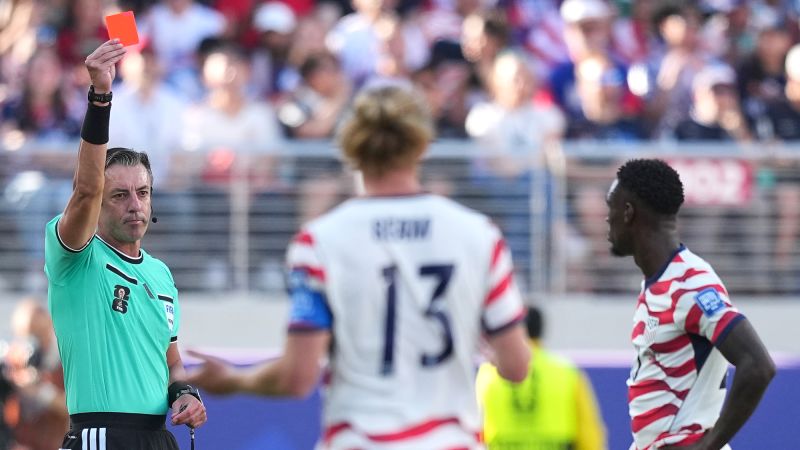
The USA s red card controversy – The World Cup has always been a stage for dramatic twists, but few moments have sparked as much debate as the controversial red card handed to U.S. forward Folarin Balogun during their Group H clash against Bosnia and Herzegovina. The incident, which occurred in the 66th minute, left fans and analysts scrambling for explanations, with many questioning whether the punishment was justified. Despite the U.S. securing a 2-0 victory, the decision to send Balogun off for dangerous play overshadowed the match, fueling discussions about consistency in refereeing across the tournament.
The Sequence That Divided the Crowd
As the U.S. pressed forward in their quest for a commanding lead, Balogun and Bosnia defender Tarik Muharemović collided during a routine challenge. At first glance, the contact seemed minimal, but the referee, Raphael Claus, called a stoppage for the defender’s apparent injury. It wasn’t until the replay showed the full sequence that the controversy unfolded. Balogun’s right foot had scraped Muharemović’s calf, then his cleats had pressed down on the defender’s ankle, which was awkwardly planted on the ground. While the action appeared accidental, the slow-motion replay made it look severe, sparking immediate backlash from fans and pundits alike.
FIFA’s Rules and the Appeal Process
The decision to send Balogun off for dangerous play was based on FIFA’s current regulations, which stipulate that a second caution results in an automatic suspension for the next match. According to the rules, “If a player or team official is sent off as a result of a direct or indirect red card (second caution), they will automatically be suspended from their team’s subsequent match,” FIFA clarified. This means Balogun’s red card for the second booking in the tournament would cost him his place in the Round of 16 showdown against Belgium. US Soccer confirmed they would not appeal the decision, leaving the striker with no choice but to watch his team’s crucial game from the sidelines.
A Debate Over Fairness and Consistency
The incident raised questions about the fairness of the punishment, especially in light of similar moments that went unpunished. One notable example was Lionel Messi’s accidental stamp on a defender’s leg during Argentina’s opening group match. Despite the injury, Messi received no red card and even completed the game with a hat-trick. “That’s the kind of inconsistency we see in soccer,” said one analyst, pointing out how different referees interpret the same actions. The disparity has left fans questioning whether the U.S. was treated unfairly, particularly given the emotional weight of the moment.
The situation also highlighted the importance of the Video Assistant Referee (VAR) system, which plays a pivotal role in modern football. Referees are now required to review key decisions, but the process has its own set of rules. In this case, Claus had to consult the VAR screen before issuing the red card, a step that added to the drama. While some argue that the technology ensures accuracy, others believe it can still lead to subjective calls, especially in high-pressure scenarios.
Reactions from the Sports World
Among the stunned reactions were those from athletes who had watched the incident in real time. Former NFL star JJ Watt was one of many to express disbelief, stating the call felt “unfair and inconsistent.” The same sentiment echoed from fellow athletes like NBA champion Josh Hart and NFL legend Patrick Mahomes, who took to social media to voice their opinions. “You’d think a second yellow would be more of a warning than a dismissal,” McKennie remarked, adding that the lack of a clear appeals process seemed “bogus.”
While the U.S. had the chance to challenge the decision, they were bound by FIFA’s protocol. US Soccer’s confirmation that they would not contest the red card came as a surprise to some, given the emotional impact of the moment. The team’s forward, who had been instrumental in the victory, now faces a setback that could affect their momentum. “It’s one thing to make a mistake, but when it happens to a star player, it feels like a bigger deal,” said a sports journalist, reflecting on the incident’s broader implications.
Spain’s Strong Position in the Tournament
Amid the U.S. controversy, Spain emerged as a clear favorite to advance from Group H. After a shaky draw against Cape Verde in their opening match, the La Roja side has since showcased improved cohesion and attacking flair, securing two consecutive wins. Their left winger, Nico Williams, was a key contributor, though his injury in the final group game raised concerns about their depth. Despite this setback, Spain’s young talent, including Lamine Yamal, has been a driving force, with the 16-year-old phenom appearing to regain full fitness and contribute decisively to the team’s progress.
The Impact of Unpredictable Decisions
Controversial calls like Balogun’s red card are a testament to the unpredictable nature of the World Cup. Soccer’s reliance on human judgment means that even the smallest miscalculations can have major consequences. While some fans argue that such decisions should be revisited, others accept that the sport’s drama lies in its ability to reward skill and penalize mistakes with equal force. “It’s part of the game,” said one referee, “but it’s also what makes it exciting.”
As the tournament progresses, the focus will inevitably shift to how these decisions shape the path of teams. For the U.S., the red card may be a setback, but the players’ ability to adapt and perform under pressure will determine their fate. Meanwhile, Spain’s dominance in Group H suggests they are well-positioned to advance, though they will face challenges in the next round. The World Cup continues to test the limits of fairness, strategy, and resilience, ensuring that every match carries the potential for unforgettable moments.
The Next Challenge for the U.S. and Beyond
With the U.S. set to face Belgium in the Round of 16, the team will need to overcome the red card without Balogun. Head coach Gregg Berhalter has emphasized the importance of teamwork, stating that the squad is “ready to adapt” to any obstacle. The game, scheduled for 3 p.m. ET at Los Angeles Stadium (SoFi Stadium), promises to be a high-stakes encounter. For fans, it’s a chance to see how the team will respond to adversity, while for the broader sports community, it’s a reminder of the fine line between brilliance and controversy in the beautiful game.
The incident also sparked a broader conversation about the role of referees in shaping the outcome of matches. While VAR has reduced some errors, it has also introduced new complexities, with fans debating the balance between technological precision and on-field spontaneity. As the tournament unfolds, these moments will continue to define the narrative, blending the thrill of competition with the human element that makes soccer so compelling. Whether it’s a star striker’s red card or a legendary player’s lucky escape, the World Cup ensures that every decision is a story waiting to be told.
