
Living, dying (and flying) artworks — Inside Anicka Yi’s ephemeral universe
Living, Dying (and Flying) Artworks — Inside Anicka Yi’s Ephemeral Universe
Interweaving Nature and Technology in Urban and Rural Spaces
Living dying and flying artworks – In the Hudson Valley, Anicka Yi has installed towering structures teeming with dynamic microbial life, their vibrant colors ranging from acid green to deep coffee, arranged like a prehistoric archaeological site at Storm King Art Center. Meanwhile, on Manhattan’s Lower East Side, two ethereal, jellyfish-like contraptions soar through the air on the fourth floor of the newly reopened New Museum, their tentacles rhythmically expanding and contracting as they glide above visitors. Earlier this month, a radiolaria-inspired sculpture, crafted from fiber optic strands and motorized mechanisms, hung suspended at Frieze New York, its arms subtly undulating in a hypnotic dance. These works, spanning both urban and rural landscapes, reflect a time when our connection to the unseen—be it microorganisms or machines—is sharper than ever, and the question lingers: which will outlast us first?
Immersing the Audience in Microbial Narratives
Anicka Yi has long pondered the intricate dance between the artificial and the natural, transforming abstract systems into tangible experiences. Her art invites viewers to confront the invisible forces that shape our world, often through sensory elements that challenge conventional perceptions. From swabbing bacteria from successful women to create scented narratives, to constructing intricate ant colonies modeled after circuit boards, Yi’s practice blurs the boundaries between biology and technology. Her recent projects, such as ecosystems designed for machine learning, further explore this duality, revealing how both organic and synthetic entities evolve over time.
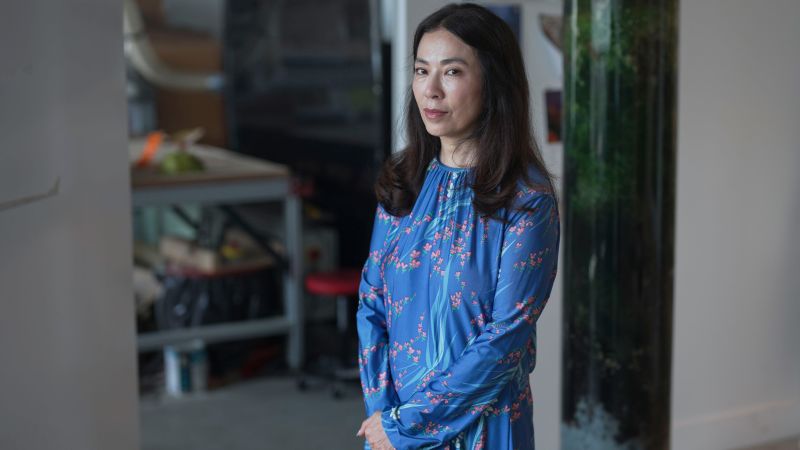
Yi’s studio in Greenpoint, Brooklyn, is a testament to her evolving vision. Shelves hold glass prototypes shaped like biomorphic forms, alongside a curated collection of fragrances. Among them, a bottle of Chanel No. 5 sits beside her own experimental scents, each representing a layer of her artistic inquiry. On a table, open cocoon-like lanterns hang in suspension, while samples of dyed and embroidered kelp are stored in numbered bags, a nod to the meticulous documentation of her materials. In one corner, a solitary prototype from her Storm King commission remains, its surface muddied by the soil and water of the sculpture park, a reminder of its temporary existence.
The Transient Beauty of “Message from the Mud”
“Message from the Mud,” Yi’s latest installation, encapsulates the idea of impermanence through its microbial inhabitants. The columns, nestled in a shallow pond at the heart of the excavated earth, are alive with organisms sensitive to light and heat. These living structures, left to their own devices, will vanish by the end of the summer season, much like the remnants of an ancient discovery. Yi described the piece as a way to “encapsulate something about this deep history and deep time that Storm King stands on,” a concept that stretches far beyond human comprehension.
The project draws on Winogradsky columns—a technique pioneered by Sergei Winogradsky over a century and a half ago. These self-sustaining ecosystems, filled with microbes and algae, develop distinct layers over time. Yi’s version incorporates local soil and pond water, along with added elements like shredded newspapers for carbon, eggshells for calcium, and diatomaceous earth. The process, she noted, is as much about patience as it is about precision, requiring two years of incubation under UV lights in a heated barn. “It’s a way to let the environment do the work,” she explained, contrasting this method with her algorithmic-based works.
Uncertainty as a Creative Catalyst
Unlike the controlled environments of her digital art, Yi’s microbial installations thrive on unpredictability. “Without the right conditions, the microbial neighborhoods will simply die off,” she remarked, acknowledging the delicate balance required to sustain them. This vulnerability extends to the physical space they occupy, as she humorously recounted concerns about bears overturning the columns once installed. “They’re pretty securely fastened to the ground,” she laughed, though she remains hopeful that turtles and frogs will eventually join the pond.
“I hope that people who are familiar with my practice can thoughtfully weave these works together and see the broader syntax I’m aiming for,” Yi said, reflecting on the cumulative nature of her artistic universe. “It takes time to develop that kind of scope and depth—ideas need to age and season, and you can’t do that as a young artist.”
A Collaboration Beyond the Visual
Storm King Art Center’s executive director, Nora Lawrence, emphasized the significance of Yi’s first outdoor installation. “She’s thinking about art that exists beyond the visual, and art that can continue to evolve without constant human intervention,” Lawrence noted in a phone conversation. This collaboration with the natural world is a departure from Yi’s earlier projects, which often centered on the tension between the organic and the synthetic. The site-specific nature of “Message from the Mud” allows the artwork to become part of the landscape, its temporary presence a dialogue with the environment itself.
Yi’s work challenges us to reconsider the fleeting nature of existence. Whether through the delicate movement of a flying machine or the slow decay of a microbial column, her art underscores the fragility of systems that define our reality. The microbial life in her installations, while seemingly minor, carries the weight of deep time, their survival dependent on the interplay of light, temperature, and the passage of days. This ephemeral quality invites viewers to engage with her work not as static objects, but as evolving processes that mirror the rhythms of nature and the unpredictability of human innovation.
From the sunlit studio where she experiments with scent and form to the open-air installations that harness the elements, Yi’s practice is a bridge between the micro and the macro. Her use of Winogradsky columns, which have been a cornerstone of microbiology since their invention in the late 1800s, exemplifies this bridge. These columns, once a tool for scientific study, are now transformed into artistic vessels, their layered hues a visual representation of the unseen ecosystems that shape our world. As Yi’s works continue to evolve, they remind us that the most profound connections often lie in the smallest, most transient moments.
Legacy in the Unseen
As Yi’s career advances, her installations grow in scale and complexity, each piece a thread in the tapestry of her larger universe. The microbial life in “Message from the Mud” is not just an artistic choice—it’s a statement about the interconnectedness of all things, both seen and unseen. By placing her works in environments where they must adapt and interact with the world around them, Yi ensures that her art remains in flux, a reflection of the ever-changing systems it seeks to illuminate. In this way, her creations become more than art; they are living histories, fragile and enduring, ephemeral yet eternal in their impact.
