
A Southern city’s ‘50-year overnight success story’
A Southern City’s ’50-Year Overnight Success Story’
A Southern city s 50 year – On a balmy spring evening, the heart of Greenville, South Carolina, pulses with life. Baseball enthusiasts, music lovers in cowboy boots, and families seeking a lively dinner scene fill the streets, a stark contrast to the city’s once-silent downtown. This revival, long overdue for many American towns, has transformed Greenville into a model of urban renewal. Yet, for residents like Andria and Terry Hancock, the journey to this vibrant present began decades ago, with the city’s once-dormant streets.
A Historic Revival
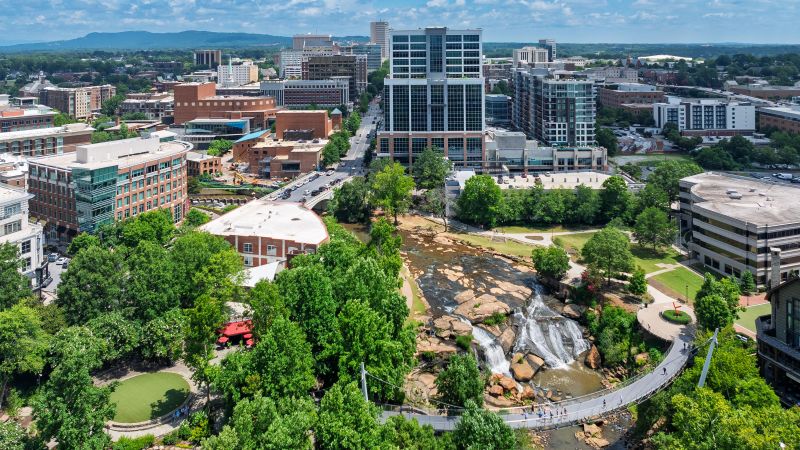
Greenville’s downtown now thrives as a hub of activity, its revitalization anchored by the Swamp Rabbit Trail—a 28-mile pedestrian and bike path that connects the city’s core to surrounding neighborhoods. Lined with parks and local enterprises, the trail has become a lifeline for both residents and visitors. The Reedy River, once a dumping ground for industrial waste, now flows through Falls Park, a space that has undergone dramatic transformation. A curved pedestrian suspension bridge, the Liberty Bridge, spans the river, offering a striking contrast to the four-lane bridge that once dominated the area. This change, spearheaded by the removal of the old bridge in 2002, marked a pivotal moment in the city’s comeback.
“One of the biggest changes is downtown—the Falls Park area,” said Andria Hancock, who recalled training with her husband for a 50k race on a Saturday morning. “When we first came here, there was a four-lane bridge going over the river,” added Terry Hancock. Their memories reflect a time when the city’s downtown was a shadow of its current self. In the 1980s, the Reedy River was infamous for its murky waters, stained by dyes and chemicals from the textile industry. The surrounding area, once a thriving industrial zone, had become a hub for drugs and prostitution.
The City’s Transformation
The shift began in earnest with the arrival of Mayor Max Heller in the 1970s. A refugee from Nazi-occupied Austria, Heller’s vision for Greenville laid the groundwork for a modern renaissance. His efforts, which included revitalizing neighborhoods and fostering cultural growth, earned him the title “Father of Modern Greenville.” Over the years, his legacy has been carried forward by successive leaders, including current mayor Knox White, who has guided the city since 1995.
Key milestones in this transformation include the opening of the Hyatt Regency hotel in the early 1980s, which brought a new level of sophistication to the area. Decades later, the Peace Center emerged as a cornerstone of Greenville’s arts scene, hosting Broadway shows and later expanding to include music venues like The Mockingbird and Coach Music Factory. The addition of Fluor Field in 2006, a baseball stadium modeled after Boston’s Fenway Park, further cemented the city’s appeal as a cultural destination. Minor league games at this historic ballpark draw crowds to the city’s West End, where the echoes of past industrial activity now blend with the hum of a thriving community.
Cultural and Culinary Vibrancy
Greenville’s resurgence is not limited to its physical spaces. The city’s dining scene has grown to include a Michelin-starred restaurant, alongside cozy eateries that reflect its eclectic character. In the arts district, once dominated by textile mills, creativity has flourished. For instance, Plant Stella, a unique hybrid of plant store, café, and terrarium bar, invites visitors to craft their own botanical haven. Nearby, Local Honey Coffee Co. offers handcrafted coffee beverages, served on petite bamboo trays and accompanied by artfully arranged floral displays in bud vases. These small businesses exemplify the city’s shift from industrial utility to cultural richness.
“It’s that package of a place that feels safe and vibrant and active,” said Russell Stall, executive director of the Greenville County Historical Society. He emphasized that the city’s appeal stems from its multifaceted identity, blending history with innovation. While the revitalization has been successful, Stall acknowledged its challenges. “We tore down a lot of the historic structures that we shouldn’t have,” he noted, citing the demolition of a “beautiful, musty, moldy City Hall” as a regrettable misstep. Despite such setbacks, the city’s transformation has continued, driven by a combination of community efforts and strategic investments.
Outdoor Recreation and Community Spaces
Greenville’s natural assets have also played a critical role in its resurgence. Nearby lakes and state parks offer opportunities for hiking, kayaking, and other activities, drawing residents and tourists alike. The Reedy River, now a focal point of the city’s green spaces, is accessible via pathways that connect downtown hotels like the Grand Bohemian Lodge to restaurants and cafes. This lodge, with its rustic wood-and-stone design, stands as a testament to the city’s modern approach to blending history with contemporary charm.
Stall described Greenville’s journey as “a 50-year overnight success story.” The phrase captures the city’s remarkable evolution, from a textile-driven economy to a dynamic urban center. The 1970s marked the decline of its once-bustling mills, which had long been the backbone of the region’s industry. By the 1980s, the downtown area had become a symbol of neglect, with the river’s polluted waters and the surrounding decay reflecting a broader trend of suburban sprawl. Yet, the city’s resolve to reclaim its identity has led to a renaissance that continues to unfold.
Today, Greenville’s downtown is a lively mosaic of culture, commerce, and community. The Liberty Bridge, which replaced the old four-lane structure, symbolizes the city’s commitment to pedestrian-friendly spaces. The park’s revitalization, praised as “one of the most significant revitalizations in the history of the city,” has turned a once-marginalized area into a cherished public space. As Andria Hancock noted, the transformation is palpable: “You can feel the difference when you walk through the streets now.”
From the 1970s to the present, Greenville has become a case study in urban renewal. Its success is attributed to a combination of factors, including the strategic removal of outdated infrastructure, the repurposing of industrial sites, and the integration of cultural institutions. The city’s ability to balance its historical roots with contemporary needs has made it a standout example of revitalization. As Stall explained, the process was not immediate but rather a gradual, deliberate effort that has paid off in the form of a thriving downtown and a growing population of residents who appreciate its unique blend of old and new.
Greenville’s story is one of resilience and reinvention. What once seemed like a dying city has now become a vibrant Southern metropolis, offering something for every visitor. Whether it’s the sounds of live music in the Peace Center, the aroma of fresh coffee at Local Honey Coffee Co., or the sight of a natural waterfall in Falls Park, the city’s transformation is evident. As it continues to evolve, Greenville remains a symbol of how a community can rebuild itself with vision, effort, and a commitment to preserving its past while embracing its future.
