
The chef with 18 Michelin stars who’s still largely undiscovered outside of France
A Culinary Visionary in the Shadows of France’s Gastronomic Heritage
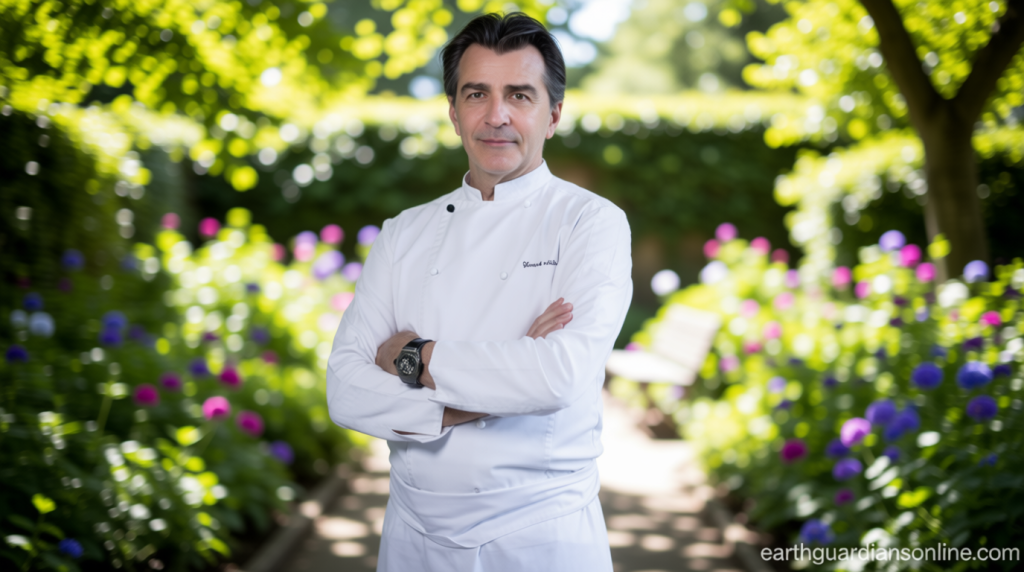
The chef with 18 Michelin stars – Yannick Alléno, a chef with an impressive 18 Michelin stars, remains a relatively unknown figure beyond the borders of his home country. While his culinary prowess has earned him recognition within France, the broader international audience still lingers in the realm of curiosity rather than familiarity. This article delves into the lesser-known story of Alléno, tracing his journey from the bustling kitchens of Paris to his role as a trailblazer in reinventing traditional French cuisine.
The Legacy of Pavillon Ledoyen
Nestled within the verdant grounds of Paris’ famed Champs Élysées, behind the Petit Palais where masterpieces by Rembrandt, Gauguin, and Cézanne adorn the walls, lies the historic Pavillon Ledoyen. This two-story Neoclassical structure, with its buttercream and forest green façade, has long been a symbol of Parisian gastronomy. Since its inception in 1792, the venue has welcomed luminaries such as Monet, Degas, and Zola, and local folklore even whispers of Napoleon Bonaparte and Joséphine de Beauharnais meeting there before it transformed into a restaurant. Now managed by the city of Paris, the building stands as a testament to culinary tradition, entrusted only to the most skilled chefs.
From Apprentice to Innovator
When Christian Le Squer, the former head of Pavillon Ledoyen, moved to Le Cinq in 2014, the restaurant was left in the hands of a new leader. Yannick Alléno, who took over as successor, brought with him a robust foundation in the culinary arts. Before his arrival, Alléno had already secured six Michelin stars across three venues: three at Le Meurice, a legendary palace hotel in Paris, and three at Le 1947 à Cheval Blanc, a restaurant nestled in the French ski resort of Courchevel. His rapid ascent to earning three stars at Pavillon Ledoyen—just seven months after its opening—highlighted his ability to blend classic French techniques with contemporary flair.
Despite his stellar reputation in France, Alléno’s international presence remains modest. His Michelin-starred breakfast menu at Pavyllon London, located within the Four Seasons Hotel, has drawn attention, yet his name is not as widely recognized abroad as it is at home. This is surprising given his influence on the evolution of French cuisine, particularly through his reimagining of sauces, a cornerstone of traditional cooking. Alléno’s methods have sparked debate, even among culinary purists, as he challenges the long-standing norms that once defined the discipline.
Expanding the Culinary Empire
Alléno’s ventures extend beyond Paris, with restaurants established in Monaco, Dubai, the United Kingdom, Japan, the UAE, South Korea, and Qatar. His creations, such as the two-star Franco-Japanese L’Abysse Paris and the one-star Pavyllon Paris, showcase his versatility and global appeal. However, his most recent achievement—earning a star for Monsieur Dior at 30 Montaigne, the restaurant inside the Parisian building where the fashion house Dior was founded—marked a significant milestone. This addition brought his total to 18 stars across 21 establishments, a tally that positions him as one of the most starred chefs in the world, rivaling the legendary Alain Ducasse.
Despite his international reach, Alléno’s fame is still largely confined to France. This is perhaps due to the country’s deep-rooted connection to haute cuisine, where traditional values often take precedence over novelty. Yet, his innovations have not gone unnoticed. At the 2026 Michelin Guide France & Monaco ceremony, the recognition of his new restaurant underscored the growing appreciation for his work, even as the broader world continues to explore his culinary contributions with cautious curiosity.
The Art of Sauce: A New Language for French Cooking
For Alléno, sauces are more than just condiments—they are the “verbs of French cuisine,” the elements that connect disparate ingredients into a seamless, harmonious dish. He describes this as the language through which flavors communicate, a concept that redefines the role of the saucier, or sauce maker, in modern gastronomy. While Auguste Escoffier once elevated the saucier to one of the most prestigious positions in the kitchen, the craft began to fade with the rise of nouvelle cuisine in the 1970s. Alléno has revived it, using cutting-edge techniques like dehydration, fermentation, and cryoconcentration to extract the essence of flavors into concentrated sauces.
His approach, termed “extractions,” transforms the way sauces are prepared and perceived. By distilling complex tastes into liquid form, Alléno creates sauces that are both innovative and rooted in tradition. This method has allowed him to push the boundaries of French cuisine, crafting dishes that balance heritage with modernity. For instance, he reimagines a simple beef fillet and asparagus by infusing them with sauces that reflect the interplay between bold and delicate elements, a technique that has garnered both acclaim and scrutiny within the culinary community.
A Personal Culinary Journey
Speaking to CNN Travel, Alléno reflects on his formative years, which shaped his culinary philosophy. “I come from a big family, one of those families that feels out of the novels we romanticize today,” he says. Growing up in the suburbs of central Paris, he was immersed in a world where his parents operated a popular neighborhood bistro and his grandmother, along with his cousins, played a pivotal role in nurturing his passion for cooking. “It was thanks to them that I was inspired to pursue this career,” he recalls, emphasizing the grassroots influences that guided his path.
Alléno’s training under traditional French chefs, many of whom hold the esteemed Meilleurs Ouvriers de France title, provided him with a solid foundation. He honed his skills in the prestigious kitchens of Paris, earning his first Michelin star in 2000 at Scribe. This early success paved the way for his later achievements, but it was his work at Pavillon Ledoyen that truly solidified his reputation. His ability to elevate the restaurant’s status with remarkable speed—securing three stars within seven months—demonstrates his mastery of both tradition and innovation.
For Alléno, the accumulation of Michelin stars is not merely a benchmark of excellence but a validation of his vision to transcend the foundations laid by Escoffier. “It means that all of the reform we’ve undertaken actually works,” he explains. This philosophy has driven him to reimagine French cuisine, making it more accessible while preserving its essence. His success has exceeded the expectations he held as an eight-year-old, when the dream of becoming a chef first took root in his mind. Today, his influence extends far beyond France, challenging the global perception of what French gastronomy can achieve.
As the world grapples with the rise of fast food, Alléno’s dedication to haute cuisine serves as a reminder of the enduring value of culinary artistry. His work at Pavillon Ledoyen and other establishments continues to attract diners willing to pay upwards of 330 euros for an experience that blends history with innovation. While his name may not yet echo across the globe, his impact on the culinary world is undeniable, and his journey exemplifies the quiet brilliance of a chef who remains largely undiscovered outside his native France.
