
As Trump accuses China of stealing voter data, Xi pitches Beijing as a responsible tech leader
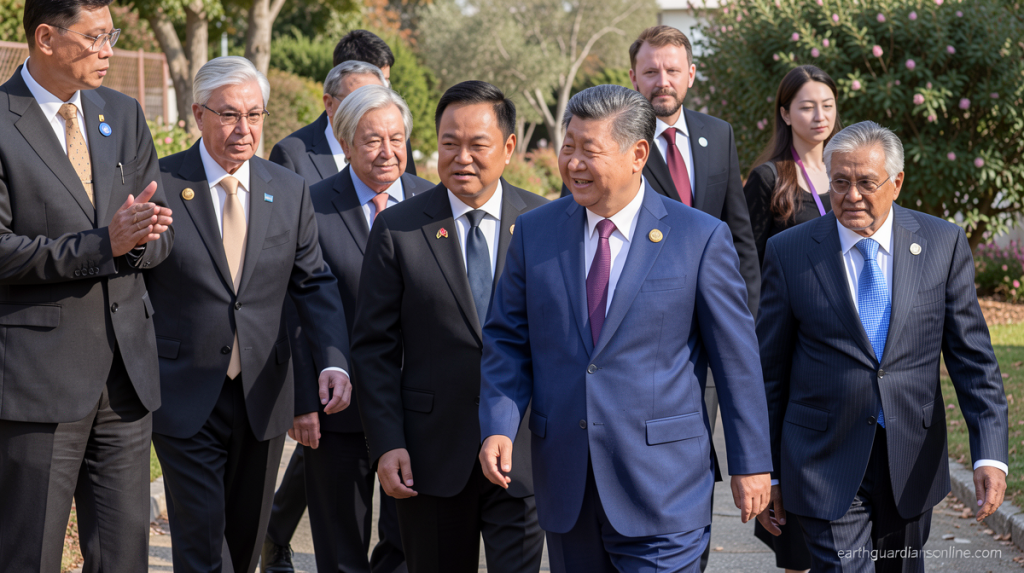
Contrasting Visions: Trump and Xi Present Divergent Messages on Technology and Global Influence
As Trump accuses China of stealing – While American President Donald Trump delivered a televised address from Washington accusing Beijing of exploiting American electoral information, Chinese leader Xi Jinping was simultaneously presenting an entirely different narrative to an international audience. Speaking to hundreds of technology executives, researchers, and industry professionals gathered in Shanghai on Friday for the inauguration of China’s premier artificial intelligence summit, Xi portrayed his nation as a responsible global force dedicated to shaping technological advancement for the benefit of all.
“With AI advancing at a staggering speed, we must ensure its development is for positive, for good, and for humanity,” Xi declared during his opening remarks to the assembled conference attendees.
The Chinese president emphasized the necessity of precise oversight mechanisms, noting that governance frameworks must be constantly refined to prevent any potential loss of control over these transformative technologies.
Xi’s remarks came mere minutes after Trump outlined numerous allegations against the Chinese government, most notably the claim that Beijing had unlawfully obtained 220 million American voter records as part of broader efforts to influence American electoral processes. Chinese officials have firmly rejected these accusations.
The Growing Technological Faultlines
This timing created a striking juxtaposition between two competing visions for the future of artificial intelligence and global technology governance. The contrasting messages highlight the deepening anxieties within the technological rivalry between Washington and Beijing—a competition that artificial intelligence is only intensifying.
Xi’s address represented a clear attempt to position China as the leader in establishing international AI regulations. This comes during a period of intense US-China competition over the technology, alongside growing concerns about national security implications, particularly AI’s capacity to exploit software and database vulnerabilities.
“Xi sees AI as an opportunity to get more allies to compete with the US, not just in AI technology, but also in international relations – (this is) AI diplomacy,” explained George Chen, Hong Kong-based chair of digital practice at The Asia Group consultancy.
During his speech, Xi directly challenged what he characterized as “overstretching the national security concept in the field of AI” and “placing one country’s security over that of others”—subtle references to how Beijing perceives the American approach to artificial intelligence governance.
Instead of adopting a purely defensive posture, China has promoted the vision of AI as a “global public good,” expressing willingness to collaborate with other nations in developing these technologies collectively.
China’s Strategic Positioning
Just before the conference began, China announced the creation of the World Artificial Intelligence Cooperation Organization (WAICO), a new alliance comprising 29 nations including Russia, Indonesia, and Pakistan—countries generally friendly to Beijing’s objectives.
Chen noted that China believes it missed opportunities to establish rules governing the global development of the internet over recent decades, but now finds itself in a considerably stronger position with the advent of artificial intelligence.
“Thirty or forty years ago, China was a very poor country … but everybody knows today is different, and if AI is the new internet, China doesn’t want to miss the opportunity again,” Chen observed.
While American companies are widely recognized for racing toward the technological frontier as their primary competitive strategy, their models continue to maintain leadership in both capabilities and the hardware infrastructure used for training and advancement. However, this advantage is gradually diminishing.
Beijing is pursuing an alternative approach to winning the AI competition: focusing on the application and scaling of artificial intelligence technology in robotics and automation, combined with large-scale global adoption, according to industry experts.
Chinese artificial intelligence companies such as DeepSeek and Zhipu have achieved significant progress in closing the performance gap with their American counterparts. An increasing number of international users are choosing their open-source models, attracted by lower operating costs compared to Silicon Valley alternatives.
According to an analysis by Our World In Data, Chinese firms secured 20 positions among the daily top 50 AI models on OpenRouter in May, a substantial increase from just five at the beginning of 2025. Most remaining positions are held by American companies.
Washington has recently accused Chinese entities of conducting “deliberate, industrial-scale campaigns to distill US frontier AI”—a process where smaller models train on larger ones to enhance their own capabilities. Additionally, a Chinese regulator warned earlier this month about a serious security “backdoor” risk in Anthropic’s Claude Code tool, though Anthropic clarified that this experimental mechanism for tracking platform abuse was not accessible within China.
