
East Asia’s tallest tree is the ‘Heaven Sword,’ an environmental guardian
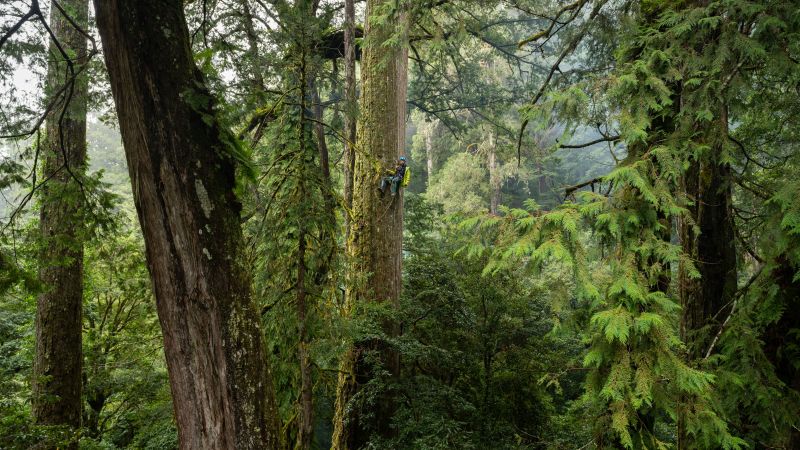
East Asia’s Tallest Tree Revealed: A Guardian of the Natural World
East Asia s tallest tree is – For over a decade, a team of dedicated researchers has unraveled the secrets of East Asia’s tallest known tree, nestled in a hidden valley beside one of Taiwan’s longest rivers. This monumental fir, named “Heaven Sword of the Da’an River,” has captivated scientists and nature enthusiasts alike, not only for its staggering height but also for its cultural significance. The tree’s moniker, inspired by a legendary weapon from Jin Yong’s martial arts novels, reflects its status as a symbol of strength and endurance in the region’s ecological narrative.
The Heaven Sword, standing at 84.1 meters (276 feet), is estimated to be over a millennium old. Its discovery was the culmination of years of exploration, combining cutting-edge technology with traditional methods. The researchers, who have been tracking the island’s largest trees since 2014, faced immense challenges in locating this specimen. Taiwan’s rugged terrain and dense forests made the task daunting, requiring a blend of aerial scanning, ground-level observations, and collaboration with local experts.
Indigenous Rukai communities, who call the tree “the one that touches the moon,” have long revered the Taiwania cryptomerioides species. Their oral traditions speak of a tree so tall it seems to bridge the earth and sky, a belief that has now been corroborated by scientific measurements. The team’s journey to verify this claim began with a focus on the “Three Sisters,” a group of giant Taiwania firs in the Cilan conservation area. This initiative, launched 12 years ago, laid the groundwork for understanding the scale and distribution of such towering giants.
Modern methods played a pivotal role in the discovery. By partnering with remote-sensing specialists from Taiwan’s National Cheng Kung University, the researchers employed lidar technology—a system that uses laser pulses to create detailed 3D maps. This approach allowed them to visualize the forest canopy from above, identifying potential candidates for the title of tallest tree. However, the technique wasn’t without its limitations. The team noted that Taiwan’s uneven landscape could distort readings, making some trees appear taller than they actually were.
To address these discrepancies, the group turned to citizen scientists in 2020. By inviting the public to review lidar-generated images, they uncovered a surprising flaw: 93% of the trees had been overestimated in height. This revelation saved time and resources, as it eliminated the need to climb numerous shorter trees. The final confirmation came through a traditional method—ascending the Heaven Sword with a tape measure to mark its true height. The results, published in the journal Frontiers in Forests and Global Change, highlight the importance of combining advanced technology with hands-on verification.
“The common characteristics are probably that we are all tree lovers and like adventures,” said Dr. Rebecca Chia-Chun Hsu, lead author of the study and an assistant researcher at the Taiwan Forestry Research Institute. Her insights underscore the interdisciplinary nature of the project, which brought together professionals from various fields, including ecologists, geologists, and Indigenous community members. These collaborations proved essential in navigating the complexities of Taiwan’s mountainous terrain and its rich biodiversity.
According to a 2016 study, Taiwan’s forests cover approximately 60% of the island, housing an estimated 950 million trees. This abundance of vegetation has made it a unique environment for the growth of ancient, massive trees. However, historical deforestation poses a threat. Between 1912 and 1991, industrial logging stripped much of the island’s native forests, yet the steep topography of Taiwan shielded older trees from complete destruction. Many of these survivors now thrive in protected areas, preserving their ecological and cultural value.
The Heaven Sword’s survival is a testament to Taiwan’s natural resilience. Its ability to grow for centuries is linked to the region’s consistent climate and heavy rainfall, which foster conditions ideal for tall tree development. “Taiwan is one of the few places on Earth where ancient trees can persist for hundreds or even thousands of years,” Dr. Hsu explained. This unique environment has allowed species like the Taiwania fir to reach extraordinary heights, making them critical for studying the island’s ecological history.
As the researchers documented the Heaven Sword, they also mapped other giants across Taiwan. Their Taiwan Giant Tree Map serves as a vital resource for conservation efforts, helping scientists and policymakers prioritize areas for protection. The methods developed during this quest—integrating lidar data with on-site verification—could be applied globally to identify and safeguard large trees in diverse ecosystems. This approach is especially crucial in the face of climate change, which threatens the survival of such towering species.
“The careful and creative mixture of methods we used could be replicated on a larger scale,” Dr. Hsu emphasized. “This is a crucial step in preserving Earth’s biodiversity.” The team’s work not only highlights the importance of these ancient trees but also demonstrates how innovation and community involvement can drive environmental discovery. By involving citizen scientists and leveraging technology, they transformed a challenging search into a collaborative effort, ensuring that the Heaven Sword’s legacy is both scientifically validated and culturally celebrated.
Taiwan’s forests, with their towering giants and intricate ecosystems, continue to be a focal point for conservation. The Heaven Sword, standing as a beacon of natural wonder, exemplifies the delicate balance between human activity and environmental preservation. As the world grapples with climate change and habitat loss, the identification of such monumental trees offers hope and a blueprint for future research. The journey to uncover the Heaven Sword underscores the importance of perseverance, technology, and the wisdom of Indigenous communities in protecting the planet’s natural treasures.
“Industrial logging between 1912 and 1991 depleted some of Taiwan’s ancient forests, but the island’s incredibly steep terrain kept old trees out of the reach of loggers,” Dr. Hsu added. “Today, many of these trees grow in protected areas, a result of both natural resilience and human intervention.”
The discovery of the Heaven Sword is more than a scientific milestone; it is a reminder of the enduring power of nature. As researchers continue to explore Taiwan’s forests, they are not only measuring trees but also measuring the impact of conservation efforts. The combination of remote sensing, traditional climbing techniques, and public participation has set a new standard for ecological research, proving that even the most elusive natural wonders can be brought into focus with determination and ingenuity.
