
Why Colombia’s pro-Trump candidate was banned from wearing the national team jersey
Colombia’s Pro-Trump Candidate Faces Jersey Ban Amid Political Turmoil
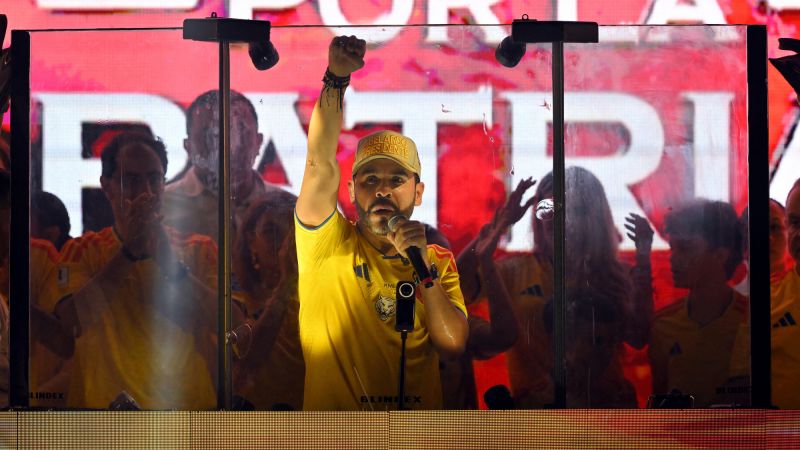
Why Colombia s pro Trump candidate – Colombia’s electoral authorities may need to take the soccer schedule into account when determining the next voting date. The recent controversy over a presidential candidate’s use of the national team jersey highlights how deeply intertwined sports and politics have become in the region. The nation’s first World Cup appearance since 2018 has sparked a frenzy, with the political spotlight shifting to the soccer pitch just days before a crucial runoff election on June 21. A local judge in Bogota, the capital, recently ruled against the popular right-wing contender Abelardo de la Espriella, ordering him to stop wearing the iconic yellow jersey of the Colombian national team during political campaigns.
The Jersey as a Political Tool
The decision came after weeks of de la Espriella and his supporters donning the jersey at rallies and social media posts, turning it into a visual rallying cry. As a conservative nationalist, de la Espriella has adopted a MAGA-style rhetoric, framing the jersey as a national emblem akin to the flag or the armed forces. He argued that the garment symbolizes collective pride and should be used to unify voters, a strategy that has proven effective in drawing attention to his candidacy.
“De la Espriella’s use of the jersey logically compromises the right to be equally used by the other presidential candidate and his supporters,” said Colombian Judge Aura Forero, whose ruling formalized the ban. “The improper use of said jersey is being skewed in favor of the candidacy of de la Espriella and his political party.”
The ruling, however, has drawn mixed reactions. Critics, including leftist rival Ivan Cepeda, accuse de la Espriella of exploiting the jersey to gain an unfair advantage, arguing it should remain a neutral symbol for all Colombians. Despite this, the political use of soccer attire is not a new phenomenon. In Latin America, where the sport holds cultural significance, leaders have long leveraged team colors to connect with the public.
From Brazil to Italy: A Soccer-Politics Nexus
Former Brazilian President Jair Bolsonaro popularized the green and yellow Brazilian jersey, transforming it into a visual shorthand for his nationalist agenda. Similarly, current president Luis Inácio Lula da Silva has used the same attire to project an image of accessibility, often appearing alongside football icons like Ronaldo Fenômeno. Even in Italy, the groundwork for this trend was laid by Silvio Berlusconi, who built his political empire in part on the success of AC Milan, a club he owned from 1986 to 2017.
De la Espriella’s strategy mirrors these examples, but his case has taken on a sharper edge due to the timing of the election. With the World Cup qualifiers against Uzbekistan and Congo scheduled around the runoff, the jersey has become a bridge between national pride and political ambition. The judge’s decision, however, has raised questions about the limits of symbolic representation in democracy. Will wearing a jersey be considered a form of political propaganda, or is it simply a gesture of solidarity?
Jerseys Beyond Borders: A Shared Political Language
Even countries without World Cup success, like Venezuela, have seen their national team jerseys used as political tools. Former President Nicolas Maduro and opposition leaders have both donned the Vinotinto shirt, each seeking to align themselves with the collective identity of the nation. This pattern suggests that in South America, the jersey is more than just clothing—it’s a language, a banner, and a battleground.
De la Espriella’s supporters have already pushed back against the ban, with some calling for a “flag-day” event on Saturday to continue wearing the jersey. The idea has gained traction, especially as 10 million Colombians voted for him in the first round. The timing of the runoff, which coincides with the World Cup, adds urgency to his campaign. Whether this symbolic defiance will sway voters or undermine the ruling remains to be seen.
The Cultural Weight of Soccer in Latin America
Soccer is more than a sport in Latin America—it’s a cultural touchstone. For many, the national team represents unity, resilience, and shared dreams. Politicians have long recognized this, using the jersey to evoke emotional connections. De la Espriella’s decision to incorporate it into his campaign reflects a broader trend: leveraging the power of sports to amplify political messages.
Yet, the controversy also underscores a tension between individual expression and collective symbolism. The judge’s ruling emphasizes that the jersey, while cherished, is a公共资源 that should not be monopolized. This debate has reignited discussions about the role of sports in politics, with some arguing that such moves dilute the spirit of the game. Others, however, see it as an inevitable part of the political landscape, where even the most mundane items can become powerful tools.
What’s at Stake for Colombia’s Election?
As the World Cup and the presidential runoff converge, the stakes have never been higher. De la Espriella claims the jersey ban is an attack on personal freedoms, but his opponents counter that it’s a necessary step to prevent bias. The ruling has sparked social media debates, with old videos of politicians in the past wearing the jersey resurfacing. These clips include Maria Jose Pizarro, a campaign chief for Cepeda, who donned the jersey during legislative elections on March 8, and even Colombian President Gustavo Petro, who wore it at a farewell event for the national team shortly after the judge’s decision.
Despite the ban, the jersey continues to dominate conversations. Its presence in public spaces, from political rallies to daily attire, has become a silent endorsement of the candidate’s movement. The challenge now lies in balancing this cultural symbolism with electoral fairness. If the ban is applied strictly, it could lead to a public backlash, especially as the World Cup matches are expected to draw massive crowds and media attention.
For now, de la Espriella remains defiant. His supporters argue that the jersey is a personal choice, not a political weapon. The judge, meanwhile, insists that its use in campaigns risks skewing public perception. As the runoff approaches, the clash between symbolism and regulation will be watched closely—not just by Colombians, but by observers across Latin America who recognize the same dynamics at play.
Whether this incident marks a turning point in the region’s political strategy or simply another chapter in the ongoing story of soccer as a political force, one thing is clear: the jersey has become an unavoidable element of the campaign. Its power to unite or divide, to inspire or mislead, reflects the complex relationship between sports and politics in South America. As the World Cup kicks off, the game may have entered a new phase—one where every player on the field and every supporter in the stands carries the weight of the political moment.
