His family long wondered what happened to the World War II veteran who vanished in 1965. Then the FBI knocked on the door

Daftar Isi
A Knock at the Door Reopens a Six-Decade-Old Mystery on Oregon’s Coast
Earthguardiansonline.com – In the wooded hills above Astoria, Oregon, an 85-year-old woman answered her front door expecting a door-to-door salesperson. Instead, she found an FBI agent in jeans and a sweatshirt asking whether any relatives had gone missing. The question, delivered on a spring afternoon, unraveled a mystery that had haunted one family for more than sixty years.
Sandra Kalander, who lives in the coastal community of Astoria, remembers her initial reaction with a wry laugh.
“Who wants to know?”
FBI Special Agent Meagan Sharp explained that a DNA sample from an ancestry test taken by Kalander’s late son, Robert, had produced a familial match to unidentified remains discovered in 1972 in the woods near Bandon, Oregon. The agency needed a closer genetic link to confirm the identity. Robert had died more than a decade before that spring visit, but his preserved sample became the thread that finally pulled the knot open.
The Man Behind the Remains
The body belonged to Armas Henry Lahti, a World War II Navy veteran who had spent his postwar years as a commercial fisherman along Oregon’s rugged coastline. Lahti was a second cousin of John Kalander, Sandra’s husband. He had sustained two bullet wounds to the head. His disappearance, which occurred sometime around 1965 when he was in his 50s, had never been formally reported as a missing-person case, leaving investigators without a conventional starting point.
Lahti’s wife had died years before he vanished, and he left no children behind. His solitary lifestyle made him difficult to track. He operated his own boat alone, moved constantly between fishing grounds, and kept to himself in ways that made his absence easy to overlook.
“(He) did a lot of stuff on his own. He ran his own boat by himself,” said Chancy Fabrizio, who volunteers as a special deputy at the Coos County Sheriff’s Office and took over the case in 2024.
Fabrizio noted that in the mid-1960s, families often assumed a relative had simply gone off to do their own thing rather than filing a formal report. That cultural norm, combined with Lahti’s itinerant work life, meant no missing-person file existed to match the decomposed body found decades later.
What Remained After Sixty Years
By the time investigators in 2024 examined the case file, the physical evidence had been subjected to an unknown period of exposure to rain, insects, scavenging animals, and the general decay of the outdoors, followed by roughly fifty years in storage. The Coos County Sheriff’s Office described the remains as bearing “marks indicative of homicidal violence.” A composite sketch was released to the public seeking tips, but it generated no leads.
For decades, detectives pursued every available avenue and hit dead ends. The victim’s identity remained unknown. Newspaper archives offered only fragments: a 1942 announcement of Lahti’s enlistment as a boatswain’s mate, a photograph of him and his wife at a wedding, and his mother’s obituary. Some records spelled his first name “Armes,” a phonetic adjustment to the Finnish form Armas that his family preferred.
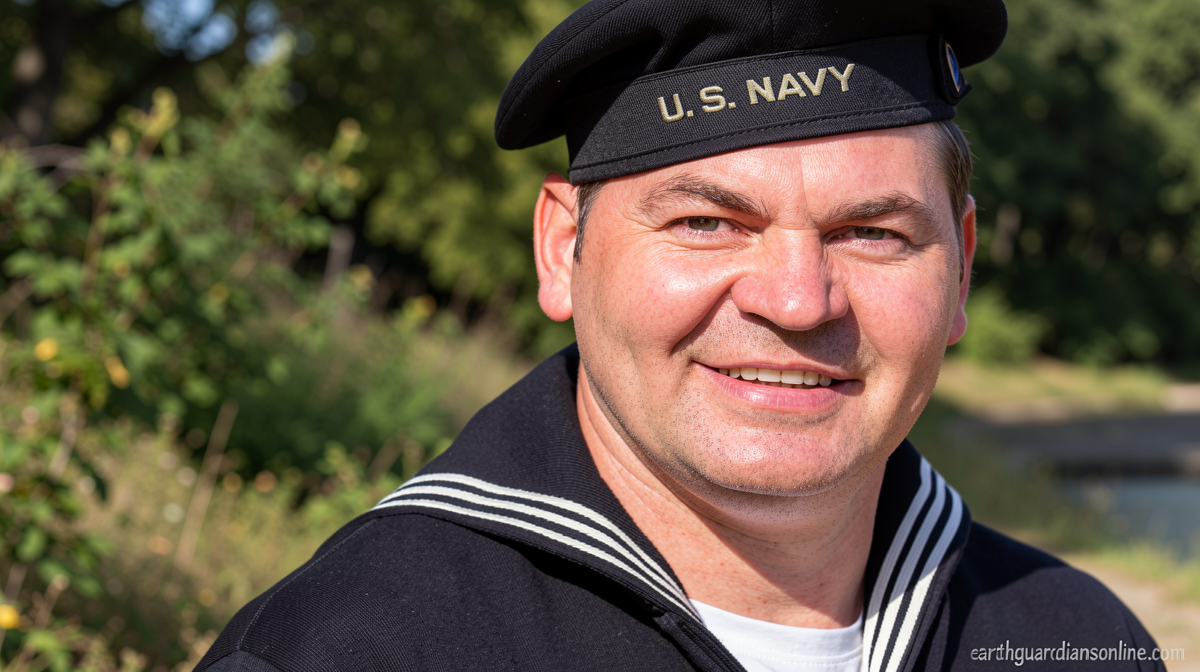
The single surviving personal artifact, according to Kalander, is a photograph of Lahti in his Navy uniform, wearing his regalia with evident pride.
Genetic Genealogy Closes the Loop
With conventional avenues exhausted, investigators were left with two realistic paths: cross-reference the serial code stamped on the victim’s denture plates, or persuade a potential relative to submit a DNA sample. It was the latter route, executed through commercial ancestry testing, that ultimately broke the case open. Robert Kalander’s sample, taken years before his death, carried enough shared genetic markers to flag a distant familial connection to the unidentified remains. The FBI then sought a closer match, which brought them to Sandra’s doorstep.
The identification confirmed that the remains were Lahti’s. The finding represented the culmination of work by multiple tenacious investigators across several decades, augmented by the relatively new discipline of genetic genealogy, which allows cold-case teams to trace lineage through consumer DNA databases.
Memories That Would Not Fade
Despite the passage of time, Kalander’s recollections of her late second cousin sharpened after the FBI visit. Lahti, nicknamed “Mousy” by family members despite being anything but timid, would drop by the house after the peak fishing season. He was described as jolly and outgoing, a family-oriented man who would lower himself to the floor to play cards with Kalander’s then-toddler Robert — the very child whose DNA sample, decades later, connected the family to the case.
John Kalander, now 87, recalls fishing alongside Lahti in his youth, gradually learning the man’s habits over successive seasons. Sandra Kalander summed up her late relative in a single phrase:
“Just a heck of a nice guy.”
Questions That Remain
Identifying Lahti answers who the victim was, but it does not yet answer how he died. Rumors have circulated for decades about a bar dispute from which Lahti allegedly walked away one evening, rifle in hand. With time eroding living memory, few witnesses remain to confirm or contextualize that story, and the probability that a perpetrator is still alive has diminished considerably.
Fabrizio and other volunteers continue pressing for answers, hoping to bring the family a measure of closure. The case underscores how genetic genealogy is reshaping cold-case work: where once an unidentified body might remain anonymous indefinitely, a single ancestry sample taken for curiosity or family history can now bridge a gap of more than sixty years, connecting a nameless set of remains to a living relative who finally learns what happened.
For the Kalander family, the knock on the door ended a long, quiet grief. What remains is the harder question — one investigators are still working to answer.
Related Reading
Frequently Asked Questions
What is His family long wondered what happened?
His family long wondered what happened is the main topic of this guide. The article explains the context, practical details, and next steps readers should understand.
Why does His family long wondered what happened matter?
His family long wondered what happened matters because readers are looking for a useful answer, not just a short summary. Good content should match search intent and help them decide what to do next.