Hurricane Simon skirts Mexico’s Pacific coast as beachside communities and tourist areas prepare for impact

Daftar Isi
Hurricane Simon Puts Mexico’s Pacific Coast on Alert
Earthguardiansonline.com – Coastal communities across western Mexico faced an escalating threat Sunday as Category 4 Hurricane Simon tracked offshore near major resort areas, bringing destructive winds, dangerous surf and heavy rainfall closer to land.
Authorities urged people in vulnerable areas to remain sheltered while the storm moved north-northwest at 7 mph. At 1 p.m. ET Sunday, Simon carried sustained winds of 140 mph and was positioned about 85 miles west-northwest of Manzanillo in Colima and roughly 65 miles south-southeast of Cabo Corrientes in Jalisco.
Its path had become less certain after earlier projections suggested a Sunday landfall. Forecast guidance now indicated that Simon could stay over water through Monday, though uncertainty remained over whether the hurricane might eventually cross onto land or continue offshore.
Tourist destinations halt normal activity
Puerto Vallarta, the resort city on Bahía de Banderas, prepared for worsening conditions by suspending operations at its international airport. The Pacific Airport Group said the facility would remain closed until 10 a.m. ET Monday. Flights at Manzanillo’s airport were also halted for the day.
Along Puerto Vallarta’s waterfront promenade, police told visitors that the area had been shut down and directed people to seek shelter. The closures underscored the potential impact on beach districts and tourism businesses even if Simon’s core does not make a direct landfall.
“We don’t know the extent of the danger yet. We’re just starting to see what’s going on.”
That reaction from visitor Brenda Villareal reflected the uncertainty confronting residents and travelers as the hurricane passed unusually close to the coastline.
Warnings extend across four states
Mexico’s Civil Protection Agency warned that the storm could produce exceptional rainfall and intense winds in Jalisco, Colima, Michoacán and Nayarit. President Claudia Sheinbaum called on residents in those states to stay in shelter until officials declare that the threat has ended.
Laura Velázquez Alzúa, national coordinator of the Civil Protection Agency, stressed that Simon remained dangerously near Mexico despite staying offshore. She said strong winds, high waves and storm surge were expected to continue through Monday, with northern Jalisco among the areas facing particular concern.
“We ask that you remain vigilant.”
Officials also cautioned against treating a temporary drop in wind or rain as a sign that the emergency is over. Such lulls can occur as a hurricane’s structure shifts, while hazardous conditions may quickly return.
Dr. Jorge Zavala, a climate scientist at the National Autonomous University of Mexico, said the projected track created several possible impact points across the region. The range of scenarios, rather than a single confirmed landfall location, was a central reason for concern.
Evacuations and emergency crews mobilized
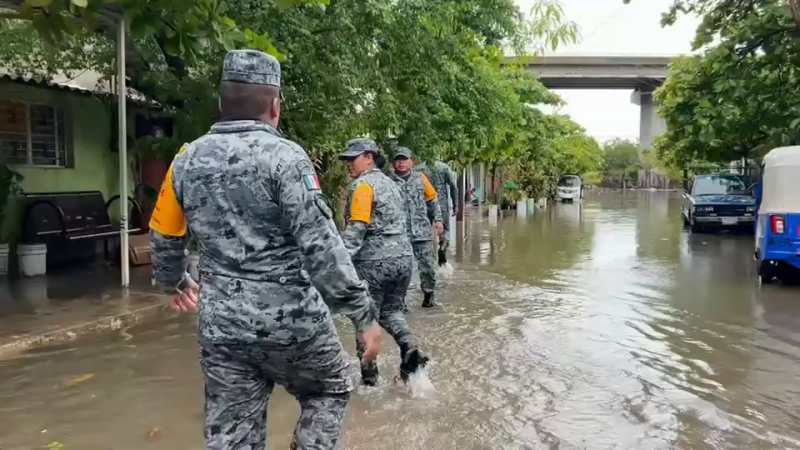
Nonessential activities were suspended in affected areas, while precautionary evacuations continued. Mexico’s Navy sent more than 4,600 personnel to support the emergency response. The deployment also included excavation equipment, heavy machinery and other resources intended to assist communities dealing with flooding, blocked access routes or storm damage.
Rainfall had already created serious problems before Simon reached its closest point to shore. In Manzanillo, naval personnel helped remove floodwater from homes. Resident Cecilia Palomar said water began entering her house around dawn and rose to a level she had not experienced before.
“It had risen before, but not like this. Beds, refrigerators, heaters, all the furniture got wet, the whole house is flooded.”
Federal teams were also working to restore electricity in locations including Acapulco, the Guerrero coastal city that suffered catastrophic damage three years earlier during Hurricane Otis. The response highlighted how heavy rain and coastal weather hazards can disrupt communities well beyond the area nearest a hurricane’s center.
Why offshore hurricanes can still be dangerous
A hurricane does not need to cross the shoreline to cause major impacts. Powerful winds circulating around Simon can push large waves toward beaches, while storm surge may raise water levels along exposed coastal areas. Heavy rain can overwhelm drainage systems, flood homes and create hazardous travel conditions, particularly in low-lying neighborhoods.
For residents, the key safety message was to follow local emergency instructions, avoid closed waterfront areas and remain indoors when officials advise sheltering. Travelers whose flights were disrupted were also likely to face continued schedule changes while airport authorities waited for conditions to improve.
With Simon’s route still difficult to pin down, officials emphasized vigilance through Monday. The storm’s changing forecast meant coastal communities from Jalisco to Nayarit, along with neighboring states already under warning, needed to remain prepared for rapidly shifting conditions.
Related Reading
Frequently Asked Questions
What is Hurricane Simon skirts Mexico s Pacific?
Hurricane Simon skirts Mexico s Pacific is the main topic of this guide. The article explains the context, practical details, and next steps readers should understand.
Why does Hurricane Simon skirts Mexico s Pacific matter?
Hurricane Simon skirts Mexico s Pacific matters because readers are looking for a useful answer, not just a short summary. Good content should match search intent and help them decide what to do next.