
Livestreamer known for racist content faces attempted murder charge with bond set at $1.25 million after courthouse shooting
Livestreamer Known for Racist Content Faces Attempted Murder Charge with $1.25 Million Bond Set
Livestreamer known for racist content faces – On Friday, a content creator infamous for sharing racially charged videos appeared in court, charged with attempted murder following a shooting incident at a Tennessee courthouse. Dalton Eatherly, who streams under the alias “Chud the Builder,” is accused of firing a weapon at a man outside the Montgomery County Courthouse in Clarksville on Wednesday. The case has sparked significant attention, with authorities citing the gravity of the incident and the potential for severe penalties.
Shooting at the Courthouse
According to an arrest warrant, Eatherly became involved in a dispute with another individual, identified as Joshua Fox, during an argument outside the courthouse. The conflict escalated when Eatherly, 28, positioned himself in a “bladed stance” and retrieved a firearm from his jacket. A physical altercation ensued, during which Eatherly discharged the weapon, striking Fox multiple times. The warrant details the event as a “dangerous felony” due to the use of a firearm and the resulting injuries.
The incident occurred around 1:20 p.m., a time when several bystanders were present in the area. Surveillance footage of the event reportedly shows a “ricocheting projectile hitting nearby walls,” suggesting the shooting’s intensity. Despite the footage being available, CNN has not yet reviewed it, leaving details of the exact sequence of events partially unclear.
Bond Hearing Details
During his arraignment and bond hearing, General Session Court Judge Reid Poland III set Eatherly’s bond at $1.25 million. The judge justified the high amount by emphasizing the number of people in the courthouse courtyard and the severity of the charges. “Attempted criminal homicide can result in a sentence of 15 to 60 years in a Tennessee state penitentiary,” the judge stated, underscoring the legal consequences of the act.
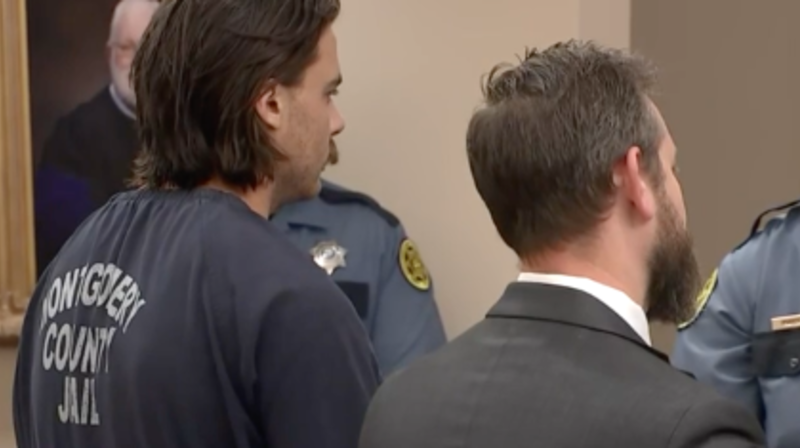
Eatherly, clad in a marked Montgomery County Jail jumpsuit, displayed a brief moment of contemplation when the bond was announced. The judge’s decision highlights the court’s perception of the case’s risk, particularly given the public nature of the altercation and Eatherly’s online presence. The bond is not only a financial requirement but also a symbolic measure to ensure his return for future proceedings.
Racist Content History
Eatherly’s social media activity reveals a pattern of racially inflammatory behavior. His videos frequently feature him using derogatory language toward Black individuals and other minorities, with one notable instance involving a physical confrontation. In his streams, he has been seen labeling Black people as “chimps,” a term critics argue perpetuates stereotypes and fosters racial hostility.
Following the shooting, Eatherly livestreamed himself speaking to first responders. In the video, he recounted the incident, describing how a group of people in the courtyard were “laughing” and “pointing at me.” He claimed one man in the group told him to “walk away” before approaching him and stating, “I have PTSD.” “He said, ‘You start saying all that chimp out s**t to me and ‘Imma hit you,’ and he hit me,” Eatherly explained, as captured in a
from the footage. “He started whaling on me, even after I had to defend myself by shooting him.”
Previous Arrest in Nashville
Before the courthouse shooting, Eatherly faced another incident that led to his arrest. On Saturday, he was kicked out of a restaurant in Nashville after continuing to livestream despite staff requests. The police affidavit notes that Eatherly was “disruptive and started making racial statements, yelling, screaming” while inside the establishment, causing a scene. When confronted about his actions, he allegedly refused to pay for a $371.55 meal, claiming, “I’m not paying if you are kicking me out.”
As a result, he was taken into custody and initially resisted being placed in handcuffs. However, the situation calmed down without further escalation, and he was later released on a $5,000 bond. This prior incident demonstrates a recurring pattern of behavior that has led to legal trouble, adding context to his recent charges.
Authorities have not yet provided a detailed description of Fox, though a witness who saw him being loaded into an ambulance described him as Black to The Associated Press. This detail has fueled speculation about the racial dynamics of the confrontation, with some noting the public’s reaction to the livestreamer’s actions. The case also raises questions about the role of social media in amplifying incidents of racial tension and how such content can influence real-world confrontations.
Legal Proceedings and Future Steps
A preliminary hearing for Eatherly is scheduled for May 26. The hearing will likely focus on the evidence against him, including the arrest warrant and testimonies from witnesses. Attorney Jake Fendley, who has previously represented Eatherly, will be defending him. His legal team may argue that the shooting was a defensive act, emphasizing the circumstances leading up to the incident.
Additionally, the case has prompted discussions about the broader implications of online behavior. Prosecutors have pointed out that Eatherly’s actions at the restaurant and the courthouse reflect a consistent approach to using livestreaming as a platform to assert his views, often disregarding the impact on others. The combination of his social media history and the recent shooting has positioned him as a defendant with a history of inciting racial conflict through digital content.
As the legal process unfolds, the public continues to monitor the case closely. The $1.25 million bond, while a substantial sum, is intended to ensure Eatherly’s presence for trial. The trial will not only determine his fate but also set a precedent for how racially charged online behavior is treated in the context of real-world violence. The witness account of Fox being Black adds another layer to the narrative, suggesting a possible intersection of racial identity and the conflict.
The incident has also sparked debates about the role of bystanders and the potential for escalation in public spaces. The presence of several innocent individuals during the shooting highlights the risks associated with such altercations, particularly when they occur in high-traffic areas. The use of a ricocheting projectile further underscores the chaotic nature of the event, with law enforcement and the public left to assess the circumstances that led to the confrontation.
While Eatherly’s defense may highlight his alleged self-defense, the prosecution will likely stress the premeditated nature of the attack. The livestreamed account of the shooting provides a unique perspective, blending real-time testimony with the public’s reaction to his actions. This combination of digital and physical evidence could play a critical role in shaping the jury’s perception of the case.
As the trial approaches, the legal team will need to prepare a compelling argument to address the charges. Eatherly’s case serves as a reminder of the growing influence of online content in real-life interactions, raising important questions about accountability and the potential consequences of repeated offenses. The outcome of this trial may also impact how similar incidents are handled in the future, particularly in communities where racial tensions are already high.
In summary, the shooting outside the Montgomery County Courthouse has brought to light both Eatherly’s history of racist behavior and the immediate consequences of his actions. The legal process, with its high bond and detailed charges, reflects the seriousness of the situation. As the case moves forward, it will be crucial to examine all facets of the incident, from the initial argument to the aftermath, to ensure a fair and thorough evaluation of the facts.
