
NATO members condemn Russia after drone slams into Romania apartment building, wounding two
NATO members condemn Russia after drone slams into Romania apartment building, wounding two
NATO members condemn Russia after drone – On the early hours of Friday, a Russian drone struck an apartment complex in Galati, Romania, leaving two individuals injured, according to reports from the Romanian government. The incident occurred as Russian forces simultaneously targeted a Ukrainian port in Izmail, situated just across the border. This dual assault has intensified scrutiny on Moscow’s escalating aggression, prompting swift denunciations from the European Union and NATO.
Immediate Reactions from Allies
The attack prompted immediate criticism from European Union and NATO officials, who emphasized the growing risk of Russian operations extending beyond Ukraine. Matthew Whitaker, the United States Ambassador to NATO, labeled the strike a “reckless incursion,” expressing concern over its implications for collective security. In a tweet, he asserted,
“We will defend every inch of NATO territory.”
The statement underscored the alliance’s commitment to safeguarding its members from external threats, even as the conflict in Ukraine continues to draw attention to the border regions.
Meanwhile, Romania’s Foreign Affairs Minister Oana-Silvia Toiu confirmed the drone’s Russian origin, stating via social media,
“We have confirmation from the Ministry of National Defence that the drone which crashed into a residential building in Galati was of Russian origin.”
The government has since urged NATO and EU partners to expedite the transfer of anti-drone technology, highlighting the country’s desire to bolster its defenses against such attacks.
Details of the Strike and Military Response
According to a spokesperson for the Romanian defense ministry, the drone entered national airspace at 1:54 a.m. and proceeded toward the eastern part of Galati before losing contact with radar south of the city. Colonel Cristian Popovici explained that the military had “no opportunity” to intercept the drone, but confirmed the situation was “under control.”
“We are not facing an attack on Romania, we are facing the effects of a conflict taking place right next to our border,”
said Brigadier General Gheorghe Maxim, Deputy Commander of the Joint Forces Command.
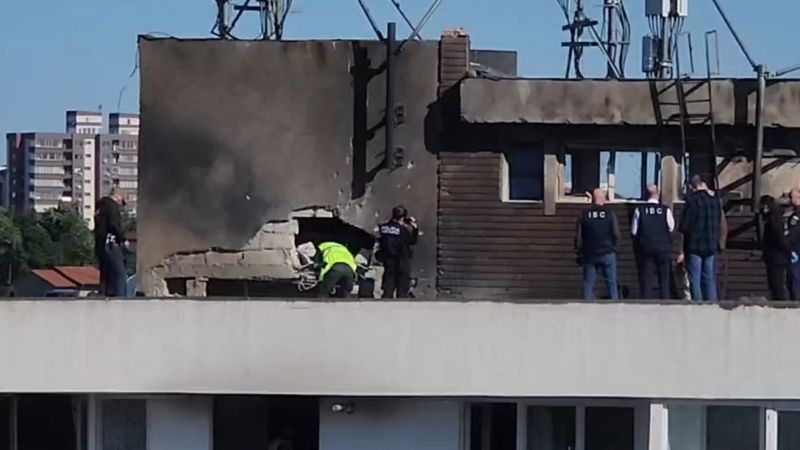
Footage released later that day showed the roof of the apartment block in Galati with visible signs of damage, including charred remnants. Response teams and investigators inspected the site on Friday morning, assessing the extent of the casualties and the drone’s trajectory. The incident has reignited debates about the vulnerability of NATO territories to Russian aerial assaults, particularly in regions close to the Ukraine front.
Strategic Context and Regional Concerns
Galati, located in Romania’s far southeast, sits directly on the border with Ukraine. Just across the Danube lies Izmail, home to the largest Ukrainian port in the region and a frequent target of Russian military actions. The simultaneous drone attacks on both locations have raised alarms about the potential for the conflict to spill further into Eastern Europe. Ukraine’s Foreign Minister, Andriy Sybiha, reiterated the threat, stating,
“This incident proved once again that Russian aggression poses a real threat to the Black Sea region and the entire Europe.”
American resident Stephen Evelyn, who spoke to Reuters from Galati, echoed similar sentiments, calling the attack “another provocation by the Russians” and urging NATO to take decisive action.
“NATO needs to do something about this,”
he remarked, emphasizing the urgency of the situation. The drone strikes have become a recurring feature of the war, with NATO members increasingly called upon to counter Russian aerial threats.
Broader Implications for NATO and the EU
Romania’s defense strategy has been a focal point of discussions within NATO. The country’s request for advanced anti-drone capabilities signals a broader concern about the alliance’s readiness to handle such incidents. The Romanian military’s statement about the drone’s trajectory and the lack of interception efforts highlights the challenges of defending against low-profile attacks in contested areas.
As part of its response, the European Commission has announced preparations for additional sanctions against Russia, citing the attack as another example of the country’s “aggression crossing yet another line.” President Ursula von der Leyen emphasized the need for stronger measures to deter Moscow, while NATO’s spokesperson, Allison Hart, reiterated the alliance’s resolve.
“We condemn Russia’s recklessness, and NATO will continue to strengthen our defences against all threats, including drones,”
Hart stated, reflecting the collective determination to counter Russian advancements.
France and Latvia have also taken steps to address the incident. Foreign Minister Jean-Noel Barrot summoned Russia’s ambassador in Bucharest, condemning the “irresponsible act” and accusing Moscow of targeting a “friendly country” within the EU and NATO. Latvian President Edgars Rinkevics added his voice to the chorus, calling the attack a clear escalation of hostilities. These actions underscore the unity among European nations in confronting Russian aggression, even as tensions persist.
Historical and Political Significance
Romania, once part of the communist Eastern Bloc, has emerged as a key player in NATO’s eastern flank. The country’s dual membership in both NATO and the European Union has positioned it as a strategic ally, particularly in light of the ongoing conflict. The recent drone attacks have not only tested the alliance’s collective defense mechanisms but also highlighted the evolving nature of modern warfare, where aerial threats can materialize with little warning.
As the conflict in Ukraine enters its third year, the proximity of Russian strikes to NATO territories has become a critical issue. The incident in Galati, combined with the simultaneous assault on Izmail, demonstrates the increasing reach of Moscow’s military operations. This has led to renewed calls for coordinated efforts among NATO members to enhance surveillance and defensive capabilities, ensuring that such incidents are less frequent and more contained.
Global Perspectives and Future Outlook
Analysts suggest that the drone attacks are part of a broader strategy by Russia to pressure NATO countries into greater involvement in the war. The use of unmanned aerial vehicles (UAVs) has proven effective in bypassing traditional defense lines, allowing for targeted strikes with minimal risk to Russian forces. This development has forced NATO to reconsider its approach to security, emphasizing the need for rapid response systems and improved intelligence-sharing.
Romania’s call for international support has also sparked discussions about the distribution of resources among allies. The country’s request for anti-drone capabilities from the EU and NATO reflects a growing awareness of the need for shared responsibility in countering hybrid warfare. As the conflict evolves, the line between Ukraine and Romania may become increasingly blurred, with both nations facing the consequences of Russia’s expansionist ambitions.
Despite the immediate threat, Romania has maintained a firm stance, vowing to “act with the utmost determination to increase international pressure on the Russian Federation.” This commitment aligns with NATO’s principle of collective defense, where an attack on one member is seen as an attack on all. The incident in Galati serves as a stark reminder of the vulnerabilities that exist in the face of relentless Russian operations, reinforcing the alliance’s need for vigilance and adaptability.
As the world watches the conflict unfold, the drone attacks in Romania and Ukraine highlight the global reach of Russia’s military strategy. The combination of territorial incursions and covert operations has kept NATO on high alert, with members preparing for the possibility of further attacks. The Romanian government’s actions, supported by its allies, signal a unified front against Russian aggression, even as the war continues to reshape the political and military landscape of Eastern Europe.
