
Planet found orbiting a dead star could preview what will happen to our solar system
Planet Found Orbiting a Dead Star Could Preview What Will Happen to Our Solar System
Planet found orbiting a dead star – Astronomers have uncovered a celestial mystery that may shed light on the future of our own solar system. A massive exoplanet, now locked in a tight orbit around a dying white dwarf star, challenges existing theories about planetary survival after a star’s demise. The discovery, made using cutting-edge technology, could provide a glimpse into how planets like Jupiter and Saturn might fare when the sun eventually becomes a red giant and collapses into a dense stellar remnant in approximately 5 billion years.
Unexpected Discovery Near a Fading Star
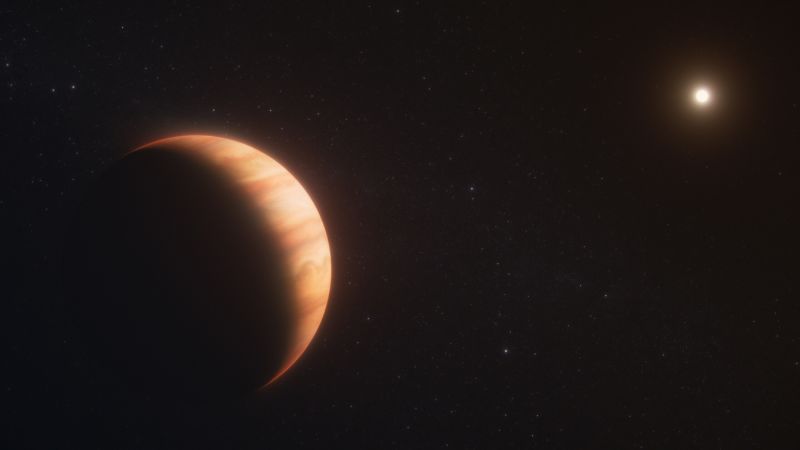
In a groundbreaking study, scientists identified a Jupiter-sized planet orbiting a white dwarf star located 80 light-years away. Dubbed WD 1856 b, the planet’s proximity to its host—just 50 times closer than Earth is to the sun—raises intriguing questions about how it endured the star’s violent transformation. The findings, published in the journal *Nature*, were led by Dr. Christopher O’Connor, a postdoctoral fellow at Northwestern University’s Center for Interdisciplinary Exploration and Research in Astrophysics. “This is one of the most bizarre planetary systems we know of,” O’Connor noted, emphasizing the planet’s unusual position in relation to its stellar remains.
WD 1856 b’s orbit is so close that it completes a full revolution around the white dwarf every 34 hours. This extreme nearness, combined with the planet’s size—seven times larger than its Earth-like star—suggests a dramatic history. When a star like the sun exhausts its hydrogen fuel, it expands into a red giant, engulfing nearby planets before collapsing into a white dwarf. Yet WD 1856 b appears to have survived this process, defying expectations. “For a theoretical astrophysicist, finding a strange object located where it ‘shouldn’t be’ feels a bit like an invitation from the universe to get creative in search of an explanation,” O’Connor wrote in an email, capturing the team’s curiosity.
Unlocking the Secrets of Planetary Survival
Researchers turned to the James Webb Space Telescope to investigate the planet’s origins. The instrument’s advanced capabilities allowed them to capture detailed data on WD 1856 b’s atmosphere, mass, and temperature, despite the challenges of observing a dim white dwarf. “To make things even harder, the planet’s transit only lasts 8 minutes, so it’s very much if you blink you miss it,” said Victoria Boehm, a graduate student at Cornell University and coauthor of the study. The team’s ability to analyze the spectrum of light passing through the planet’s atmosphere was critical to their findings, which revealed surprising insights into its history.
Measurements from Webb suggested that WD 1856 b has a mass between four and 11 times that of Jupiter. This mass, coupled with its high temperature of about 260 degrees Fahrenheit (127 degrees Celsius)—significantly warmer than anticipated—indicates the planet may have experienced a rapid inward migration after its star’s death. “That was really what started us on the track of figuring out the planet’s history from our data,” O’Connor explained, highlighting the importance of the temperature anomaly in shaping their conclusions.
By combining these observations with models of planetary cooling, the team traced the planet’s journey. They found that WD 1856 b likely originated in a more distant orbit, where it was shielded from the star’s violent expansion. However, its current position near the white dwarf suggests a dramatic shift. This discovery could reshape our understanding of how planets evolve after their host stars die, particularly for gas giants like Jupiter and Saturn, which may face similar fates in the distant future.
Theories Behind the Planet’s Unlikely Orbit
Two competing theories have emerged to explain how WD 1856 b ended up so close to its host. The first, known as the “engulfment model,” posits that the planet was partially consumed by the star as it swelled into a red giant but managed to escape its fate. “In this scenario, we would expect the migration and heating to occur as a byproduct of the violent process,” O’Connor said, noting that the planet’s high temperature supports this idea. The second theory, the “gravitational interaction model,” suggests the planet survived the star’s transformation but was later pulled closer by gravitational forces from other objects in the system. This model proposes that remnants of the star’s outer layers, or interactions with nearby planets, could have altered WD 1856 b’s trajectory over time.
Both theories highlight the dynamic forces at play in stellar systems as stars evolve. The engulfment model implies that the planet may have experienced intense friction and heat during its close encounter with the expanding star, while the gravitational model emphasizes the role of external influences in shaping planetary orbits. These hypotheses not only explain WD 1856 b’s current state but also offer a framework for understanding similar systems in the cosmos. “The planet’s tight orbit and the lopsided relative sizes of WD 1856 b and its host star motivated us to investigate further,” O’Connor added, underscoring the significance of the discovery.
Implications for Our Solar System
The implications of this finding extend beyond the study of distant exoplanets. As the sun ages, it will expand into a red giant, potentially engulfing Mercury, Venus, and even Earth. However, planets like Jupiter and Saturn may avoid this fate, depending on their orbital paths and the star’s evolution. WD 1856 b’s survival offers a preview of what could happen to our outer planets in 5 billion years, suggesting they might migrate inward or remain in stable orbits. “This system serves as a model for what may occur in our own solar system,” O’Connor said, emphasizing the relevance of their research to planetary science.
Further observations are needed to determine which theory best explains WD 1856 b’s journey. The team is also exploring how the planet’s atmosphere has changed over time, which could provide additional clues about its survival. “The data we collected is just the beginning,” Boehm stated, highlighting the potential for future discoveries. The James Webb Space Telescope’s role in this study underscores its importance for investigating the long-term evolution of planetary systems. Its ability to capture faint light from distant stars and analyze atmospheric composition has opened new avenues for understanding cosmic phenomena that were once thought impossible.
As researchers continue to study WD 1856 b, the findings may lead to revised models of planetary dynamics. The planet’s existence challenges the assumption that gas giants are doomed when their stars die, instead suggesting they can adapt to extreme conditions. This discovery also raises questions about the stability of planetary systems over billions of years, prompting scientists to rethink the role of gravitational forces and stellar evolution in shaping the cosmos. The study’s implications are vast, offering a unique window into the future of our own solar system and the resilience of planets in the face of cosmic upheaval.
With more data coming in, the scientific community is eager to unravel the full story of WD 1856 b. The planet’s journey from a distant orbit to its current position near a white dwarf may be a rare but crucial event in the life cycle of stellar systems. By studying such cases, astronomers can better predict the fate of planets in our galaxy, providing a roadmap for the sun’s eventual transformation. “This system is a cosmic puzzle that pushes the boundaries of our understanding,” O’Connor concluded, reflecting on the significance of the findings.
