
Protesters set vehicles and homes on fire as violence flares over knife attack in Northern Ireland
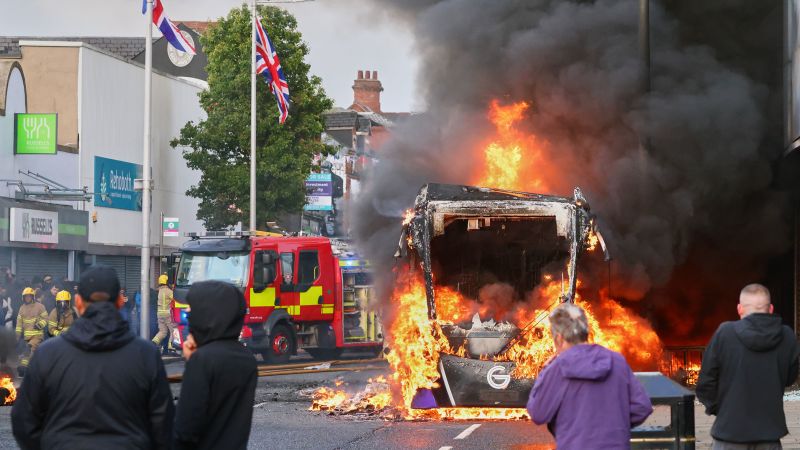
Protesters Light Fires in Belfast and Surrounding Areas
Protesters set vehicles and homes on fire – Following a knife attack in Northern Ireland that left a man hospitalized with serious injuries, tensions have escalated across the United Kingdom. A 30-year-old Sudanese resident was charged with attempted murder by local authorities, prompting widespread demonstrations. In Belfast, masked groups took to the streets on Tuesday evening, igniting a series of incidents that saw vehicles, homes, and barricades consumed by flames. Video footage, geolocated by CNN, captured the chaos as crowds gathered in various neighborhoods, some of whom targeted emergency vehicles and battled with firefighters. The unrest also spread to nearby areas such as Newtown Abbey and Kilkeel, where additional cars were set ablaze, underscoring the growing anger among protesters.
Violence Sparks Outrage and Political Criticism
Northern Ireland’s First Minister, Michelle O’Neill, described the scenes as “outright thuggery,” highlighting that groups of masked individuals were “burning families out of their homes.” She emphasized the disturbing nature of the protests, which she said were driven by a desire to intimidate and disrupt communities. “This is not just about anger; it’s about targeting the innocent,” O’Neill stated in a post on X, underscoring the need for accountability. The violence erupted after police confirmed the Sudanese suspect was legally authorized to live in the region, a detail that has fueled debates about the connection between the attack and broader social issues.
“The attack in North Belfast was heinous and wrong. But there are dangerous attempts to exploit that to target and attack innocent people who are simply trying to live, work and raise their families here,” said Michelle O’Neill.
Meanwhile, the UK Prime Minister, Keir Starmer, condemned the incident as “horrific” and “sickening,” expressing his disapproval of the escalating violence. “My thoughts are first and foremost with the victim, and I thank the first responders, including members of the public who intervened,” he added. The knife attack, which occurred on Monday night in northern Belfast, was captured on video by a witness and quickly became a viral sensation on social media platforms. In the footage, a man is seen overpowering another, whose head is covered in blood, before bystanders and police officers step in to stop the assault.
Protests Extend Beyond Belfast
While the majority of the unrest centered in Belfast, smaller demonstrations also emerged in other British cities. In Bangor, Glasgow, and London, far-right activists took to the streets, confronting police and chanting slogans against immigration. These protests, though less intense, reflected a broader national sentiment of frustration and division. Northern Ireland’s Assistant Chief Constable, Ryan Henderson, clarified that there was currently no evidence linking the attack to terrorism, though the investigation is ongoing. He noted that the suspect had the legal right to reside in the region, adding context to the debate over the incident’s motivations.
Police Chief Constable Jon Boutcher urged citizens to remain composed, emphasizing that the protests were still in their early stages. “Don’t let people who know nothing about Northern Ireland impact the behaviors of our people from afar through social media,” he warned. The force acknowledged that “sporadic pockets of disorder” had emerged across the area, with some vehicles and properties damaged. Officials called for calm, encouraging protesters to demonstrate peacefully and avoid unnecessary conflict.
Political Fallout and Rising Tensions
Amid the chaos, political figures have weighed in on the situation. Northern Ireland’s Justice Minister, Naomi Long, criticized the unrest, accusing some protesters of being “intent on wreaking destruction on the very communities they claim they are trying to protect.” She called the actions “simply disingenuous,” stressing that hate cannot be allowed to dominate public discourse. “While I recognize the concerns following the attack, it is vital to differentiate between legitimate anger and malicious intent,” Long said in a statement on Tuesday night.
“There is no place for masked thugs to take to the streets and threaten, intimidate, disrupt and cause wanton damage – it is simply disingenuous to claim this is being carried out for the good of Northern Ireland,” Justice Minister Naomi Long added.
The protests have also intensified political tensions in the UK. Last week, the release of bodycam footage showing the death of Henry Nowak, a White student, sparked national outrage. The video depicted Nowak being fatally stabbed in December while handcuffed by police, leading to accusations that officers were complicit in his death. Far-right leaders were criticized for using the incident to stoke racist sentiment, with some linking it to mass migration. Prime Minister Starmer recently addressed these claims, calling for people to focus on “interfering in our democracy” rather than spreading misinformation.
Historical Context of Racial Tensions
Similar unrest has occurred in Northern Ireland before. A year ago, Ballymena experienced several nights of racially motivated violence after two Romanian teenagers were accused of sexually assaulting a local girl. Although the charges were later dismissed, the incident left a lasting impact on community relations. The current situation echoes those past events, with activists accusing the Sudanese suspect of stirring racial animosity. However, there is no definitive evidence yet to support these claims, as per Ryan Henderson’s remarks.
As the investigation continues, the role of social media in amplifying the protests has come under scrutiny. Police have warned that online platforms can distort public perception, urging citizens to base their actions on facts rather than sensationalized narratives. The knife attack has become a focal point for political debate, with some using it to highlight issues of immigration and others emphasizing the need for unity in the face of violence.
Broader Implications for Northern Ireland
With tensions at a peak, the incident has raised questions about the future of stability in Northern Ireland. The First Minister and Justice Minister have called for a balance between addressing concerns and preventing the spread of hatred. “Racism, intimidation and violence are wrong wherever they occur,” O’Neill reiterated, while Long emphasized the importance of distinguishing between justified anger and deliberate harm. As the public watches the unfolding events, the challenge remains to ensure that the protests remain focused on the real issues at hand without descending into chaos.
The knife attack has not only ignited immediate unrest but also reignited discussions about the UK’s political climate. With the backdrop of recent controversies, the situation in Northern Ireland serves as a reminder of the fragile state of community relations and the potential for minor incidents to escalate into larger conflicts. As authorities work to restore order, the broader implications of this unrest will likely shape public discourse for weeks to come.
