
Taiwan test-fires rockets in China’s direction from US-supplied mobile launching system
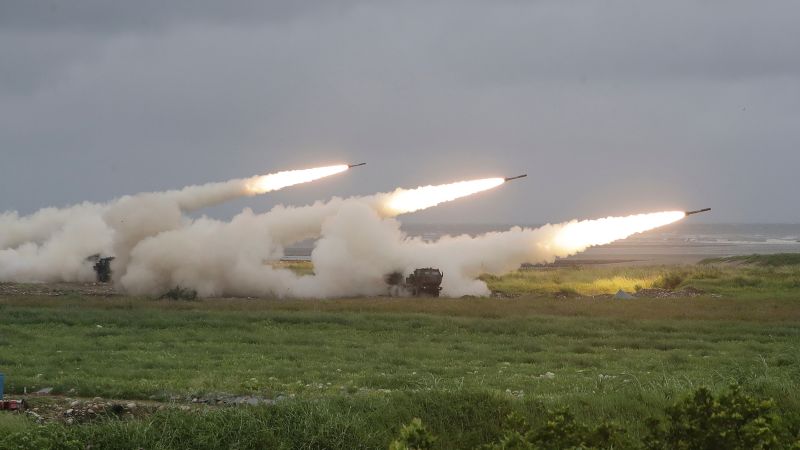
Taiwan Test-Fires Rockets in China’s Direction Using US-Supplied Mobile Launchers
Taiwan test fires rockets in China – On Wednesday, Taiwan’s military conducted a live-fire exercise, launching rockets toward China from portable, mobile launch systems. The demonstration aimed to showcase the island’s readiness to defend itself against a potential Chinese invasion, highlighting the tactical flexibility of its armed forces. This event marked the first time rockets from the US-supplied High Mobility Artillery Rocket System (HIMARS) were fired into the waters of the Taiwan Strait, a narrow body of water that separates the self-governing island from mainland China. The exercise underscored Taiwan’s reliance on advanced US technology to bolster its military capabilities in an increasingly tense regional environment.
Strategic Drills and Asymmetric Tactics
The test-firing took place during the second day of large-scale military drills on Taiwan’s western coast, a region directly exposed to Chinese naval and aerial threats. The drills included 155 mm howitzers, which are traditional artillery pieces, alongside the newer HIMARS systems. These combined efforts were designed to simulate a rapid response to a Chinese invasion, focusing on the speed and precision of Taiwan’s defense posture. The mobile launchers, capable of firing missiles from concealed positions and quickly relocating, exemplify an asymmetric strategy that prioritizes agility over sheer firepower.
The HIMARS, a truck-mounted pod of rockets, allows for rapid deployment and targeting. During the exercise, the systems received a firing order, maneuvered into position, and launched their rockets with bright flashes within three minutes. This efficiency is a key advantage in scenarios where speed can dictate the outcome. The drills emphasized the importance of mobility in modern warfare, a concept that aligns with the US’s broader approach to supporting Taiwan’s defense capabilities.
Taiwan’s military leadership has consistently emphasized the need for such exercises. Army Sgt. Wang Ming-hui, a spokesperson for the armed forces, stated,
“Due to the current enemy threat, we will continue HIMARS training with unwavering determination to protect Taiwan as the nation’s strongest force.”
This declaration reflects the growing urgency of the situation, as tensions between Taiwan and China escalate. The test-firing was part of a larger training initiative, which also involved the deployment of other weapons systems to evaluate their operational effectiveness.
US Support and the Shift in Strategy
The US has been a critical supplier of military equipment to Taiwan, providing advanced technology to counter China’s overwhelming military presence. The HIMARS system, which stands for High Mobility Artillery Rocket System, is emblematic of this strategic shift. Instead of relying on traditional heavy weaponry, Taiwan is adopting an asymmetric approach, which emphasizes speed, precision, and adaptability. This strategy is intended to deter China from launching a full-scale invasion by demonstrating the island’s capacity to strike swiftly and decisively.
Speaking to CNN’s Jim Sciutto on Wednesday, Taiwan’s representative to the US, Alexander Yui, confirmed the army’s use of the newly acquired HIMARS systems.
“We’re an island; we can only shoot east or west, so they chose west,”
he explained, referring to the direction of the rockets fired during the exercise. This statement highlights the geographical constraints of Taiwan’s military operations, as the island is surrounded by water on three sides. The west coast, facing mainland China, became the focal point of the drills, underscoring the strategic importance of this location.
The US has been a consistent partner in Taiwan’s defense efforts, with the latest arms deal announced in December promising the sale of 82 additional HIMARS systems. However, the package appears to have been temporarily delayed following President Donald Trump’s meeting with Chinese leader Xi Jinping in Beijing last month. The delay raises questions about the future of US support and the potential for diplomatic tensions to impact Taiwan’s military readiness. Despite this, the US has maintained its commitment to opposing any forced change to Taiwan’s status, as stated in its official stance.
China’s Response and Geopolitical Context
China views Taiwan as an inalienable part of its territory, a position rooted in historical claims and the One-China policy. The country has repeatedly conducted military exercises near the island, sending warships and planes into the skies and waters of the Taiwan Strait on a near-daily basis. These exercises serve as both a display of strength and a warning to Taiwan’s leaders, signaling China’s intent to unify the island through military means if necessary.
The recent rocket test-firing by Taiwan is seen as a direct challenge to China’s dominance in the region. By using the HIMARS system, which is designed for rapid, precise strikes, Taiwan aims to enhance its ability to counter Chinese advances. This move is part of a broader effort to modernize its military and adapt to evolving threats. The test-firing in the Taiwan Strait, a historically significant body of water, symbolizes the island’s resolve to assert its independence and defend its sovereignty against encroachment.
While the US does not formally recognize Taiwan as a country, it has long supported the island’s self-defense. This support includes not only military equipment but also diplomatic backing and economic ties. The HIMARS system, with its capacity for quick deployment and targeted strikes, is a testament to this collaboration. By integrating such systems into its military framework, Taiwan is building a more resilient defense network, one that can operate independently and efficiently in a crisis.
Implications for Regional Security
The exercise has drawn attention to the delicate balance of power in the Asia-Pacific region. Analysts note that the use of HIMARS represents a shift in Taiwan’s military strategy, focusing on precision and mobility rather than brute force. This approach is designed to counter China’s numerical superiority and its reliance on conventional weapons, such as aircraft carriers and heavy artillery. The drills also tested the integration of different weapon systems, ensuring that Taiwan’s forces can coordinate effectively in a real-world scenario.
Additionally, the test-firing highlighted the importance of training with advanced technology. The military used reduced-range practice rockets for the exercise, which are designed to minimize the risk of hitting land targets while still simulating real combat conditions. This method allows for extensive training without the potential for significant collateral damage, making it ideal for demonstrating capabilities in a controlled environment.
With the ongoing tensions between Taiwan and China, the US remains a pivotal player in maintaining the island’s security. The potential resumption of the HIMARS arms deal could provide Taiwan with a significant boost to its defense capabilities, enabling it to maintain a credible deterrent. However, the current geopolitical climate, marked by frequent military exercises and diplomatic maneuvering, means that Taiwan’s ability to project power is closely watched by both allies and adversaries.
The test-firing event also serves as a reminder of the complex interplay between military strategy and international politics. While the US has consistently opposed any forced unification of Taiwan, its support is conditional on maintaining a balance of power in the region. The demonstration of HIMARS capabilities reinforces this position, signaling to China that Taiwan is prepared to defend itself with modern, versatile technology. As the situation evolves, the military’s ability to adapt and respond to threats will remain a key factor in shaping the future of Taiwan’s security.
With additional reporting from CNN, the exercise has been widely covered as a symbol of Taiwan’s determination. The combination of mobile launchers, artillery, and rapid response tactics highlights a multi-layered defense strategy. This approach not only enhances Taiwan’s military preparedness but also sends a message to China about the island’s commitment to its independence. As the drills continue, the focus remains on testing the effectiveness of these systems in a real-world setting, ensuring that Taiwan is ready to defend its people and territory at a moment’s notice.
