
The website where crypto promoters pay people to tattoo ads on themselves
The Website Where Crypto Promoters Pay for Body Art Featuring Their Ads
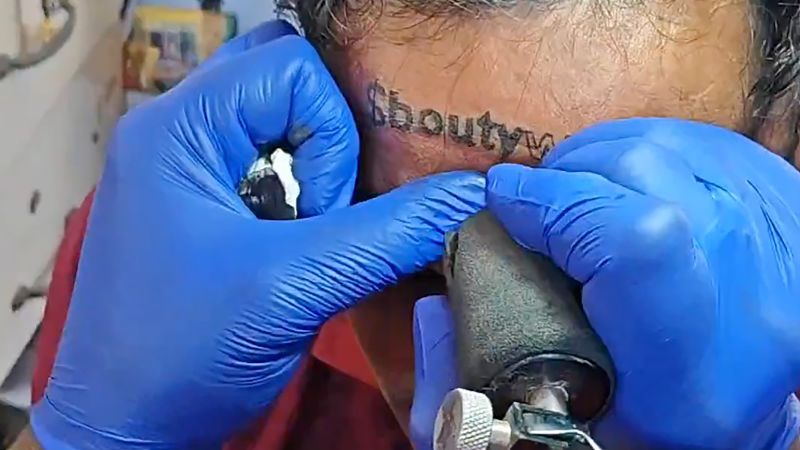
The website where crypto promoters pay people – On June 6, a man in Chennai, India, made a bold decision to transform his forehead into a canvas for a cryptocurrency message. With a slightly receding hairline, he approached a local tattoo artist, presented a message on his phone, and agreed to have it permanently inked onto his skin. The transaction, recorded on video, was part of a growing trend on Pump.fun, a platform that has become infamous for its role in the memecoin economy. The man, identified as Arivu, received payment in cryptocurrency worth approximately $3,000 for the task, as instructed by Ayush, a 21-year-old based in Florida.
Pump.fun: A Gateway to Memecoin Frenzy
Pump.fun is a digital hub designed to foster the creation and trading of memecoins—cryptocurrencies with no intrinsic value, often named after internet memes or jokes. These coins thrive on attention, relying on viral marketing to attract investors. Last week, the platform launched a new initiative called Pump.fun GO, allowing users to set public bounties for tasks completed by others. The feature was introduced with the promise of connecting people globally through the power of money and human effort.
“Pay ANYONE to do ANYTHING. Create & complete bounties for ANY task and leverage the power of humans & money across the globe,”
—Pump.fun’s statement on X.
The concept is simple: users post bounties in cryptocurrency, and others accept them to perform specific actions. In this case, the action involved altering one’s appearance with a tattoo promoting a crypto-related venture. Ayush, who remained anonymous due to privacy concerns, described the arrangement as a way to “get attention” for his coin. “That $3,000 is him working for five years,” he remarked in a direct message on X, highlighting the disparity between the reward and the labor involved.
From Beachside Tattoos to Bounties for Suicides
Meanwhile, in Toronto, a 27-year-old artist named Jordan—using a pseudonym to protect his identity—accepted a $3,000 bounty for tattooing a cryptocurrency casino logo on his leg. “I’m struggling financially, and my girlfriend is a tattoo artist, so it was a little easier for me,” he explained. The task, though seemingly trivial, underscores the platform’s ability to turn everyday activities into currency exchanges. However, the scope of bounties has expanded far beyond such benign transactions.
According to the cryptocurrency news outlet BeIn Crypto, some bounties have taken on more extreme or controversial forms. On the platform’s debut day, a user offered 10,000 Solana—valued at around $690,000 at the time—to someone willing to film their own suicide. The listing, now removed, exemplifies the lengths to which individuals might go to secure rewards. “The greater the precarity and vulnerability of a given population, the higher the predatory instincts there are towards them,” said Nicholas Vrousalis, a philosophy professor at Erasmus University in Rotterdam, who has written extensively on economic exploitation.
While some bounties appear harmless, such as a user earning $300 to be the first to post proof of visiting a McDonald’s, others reveal a darker side. In one instance, a participant paid $35 in bail for a 70-year-old homeless man named Dickie Schultz in Lincoln, Nebraska, while also providing him with transportation and food. These acts of kindness contrast sharply with the platform’s more provocative offerings, demonstrating how its incentive model can both uplift and exploit.
The Legal Gray Area and Moderation Challenges
Despite its popularity, Pump.fun’s bounty system operates in a legal limbo. The anonymity of cryptocurrency transactions complicates regulation, making it easier for users to enter agreements without scrutiny. Vetle Lunde, head of research at the crypto analysis firm K33, noted that the site has long existed at the edge of the internet’s attention-driven economy. “Pump.fun has always operated at the controversial edge of the internet’s attention economy,” Lunde said. During the 2024 memecoin boom, the platform’s livestreams became synonymous with chaotic behavior, including threats of self-harm and animal abuse.
After facing backlash, Pump.fun temporarily suspended its live streaming feature, citing the need for improved moderation. The company later reintroduced the functionality with updated policies banning violent, harassing, or sexually explicit content. Yet, the bounty platform quickly evolved into a space for more extreme incentives. “It was all too predictable,” Vrousalis added. “The bounty system turns people into disposable labor, especially in regions where daily wages are minimal.”
Voices from the Crypto Community
Ayush, who orchestrated the forehead tattoo deal, emphasized the appeal of quick financial gains. “People are desperate for money, and this is a way to get it without much effort,” he stated. The platform’s ability to connect individuals from diverse backgrounds has fueled its growth, but critics argue it creates a hierarchy of power. “It’s not just about earning money—it’s about leveraging the vulnerability of others to gain visibility,” said Lunde.
Meanwhile, Pump.fun’s co-founder, Alon Cohen, has remained silent on the controversy. Despite multiple attempts to reach out via email and social media, the company has not provided public comments. Stephen D. Palley, Cohen’s lawyer, stated during a phone call that “I’m not able to talk” about the current situation, leaving the debate to continue in the public eye.
As the memecoin market evolves, so too does the culture surrounding it. What began as a casual exchange of tattoos for crypto has transformed into a global marketplace where tasks range from mundane to macabre. The platform’s users, driven by the desire for attention and profit, continue to push boundaries. Whether these actions are seen as creative or exploitative depends on perspective, but one thing remains clear: Pump.fun has become a catalyst for redefining the role of human effort in the digital economy.
With its bounty system, the platform has opened a Pandora’s box of possibilities. From incentivizing daily labor to encouraging acts of self-sacrifice, the rewards are as varied as the participants. As more people seek financial stability through crypto, the line between innovation and manipulation continues to blur. The future of Pump.fun may depend on how it balances the thrill of the bounty system with the ethical responsibilities it entails.
