
Using the stars and paddles, indigenous Taiwanese recreate risky sea journey of Great Pacific Migration
Recreating the Perilous Voyage: Indigenous Taiwanese Navigators Honor Ancient Pacific Migration
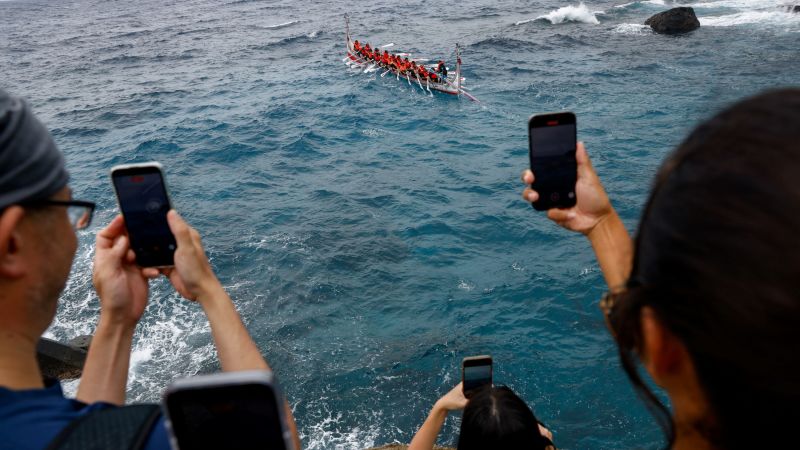
Using the stars and paddles indigenous – On a sunlit morning in June 2026, a team of indigenous seafarers from Taiwan embarked on a remarkable expedition, retracing the footsteps of their ancestors who once crossed the vast Pacific Ocean in primitive canoes. Using the stars as their guide and paddling a traditional wooden vessel, the group from Orchid Island reached the Philippines after a 111-mile journey, symbolizing the enduring legacy of one of humanity’s most extraordinary maritime migrations. This effort, led by the Tao people, not only celebrates their ancestral seafaring prowess but also reinforces a theory that traces the origins of Austronesian cultures to Taiwan.
Ancient Connections and Genetic Threads
Historians and geneticists have long debated the roots of Austronesian civilizations, which span from the Pacific islands of Hawaii and Easter Island to the shores of Madagascar. According to experts, Taiwan’s indigenous communities are believed to be the progenitors of these widespread groups, sharing linguistic and genetic ties that suggest a common heritage. The navigational skills of these early voyagers—traveling thousands of miles in rudimentary boats—have been hailed as a pivotal chapter in human history. Their ability to locate distant landmasses without modern tools or maps remains a subject of awe and study.
The recent voyage by 60 Tao individuals marks a tangible effort to revive this lost tradition. By replicating a journey thought to have occurred over 4,000 years ago, the group demonstrated the practicality of ancient methods. The Tao, who historically inhabited Orchid Island, are part of Taiwan’s smaller indigenous groups, with a population of just 5,120 as per government records. Despite their relatively small numbers, their role in shaping the Great Pacific Migration is immense, as they were instrumental in spreading Austronesian culture across the globe.
Building a Canoe from the Past
Before setting sail, the Tao people collaborated with artisans to construct a canoe named “Ovayan,” or “Golden Friendship,” using techniques passed down through generations. Over 200 participants from six tribal communities contributed to the project, meticulously binding specially cut wood with natural materials rather than nails. This hands-on process was not just a feat of craftsmanship but also a way to reconnect with their ancestral practices.
“The surface must be smooth to minimize resistance from the sea,” explained Hsieh Chen-Hsiung, a shipbuilder, in a promotional video. “Even minor irregularities can increase the effort required to navigate these waters.” His comments underscored the precision needed in building vessels capable of enduring long ocean crossings. The canoe, a symbol of cultural pride, was designed to mirror the small, open boats used by early navigators, which allowed them to traverse the Pacific with remarkable success.
The expedition was backed by the Taiwanese government, which sees it as a way to highlight the island’s historical contributions to global exploration. While indigenous peoples now make up only 3% of Taiwan’s 23 million population, their influence on the region’s cultural and linguistic identity remains profound. The journey to the Philippines, which took two days, was not just a physical test but a cultural milestone, with the participants being greeted by vibrant drum and dance performances upon arrival.
The “Out of Taiwan” Theory and Its Critics
Although the “Out of Taiwan” hypothesis is widely accepted in academic circles, it has faced recent challenges from mainland Chinese scholars. These researchers argue that the origins of Austronesian peoples may instead lie in southern China, a claim they say supports Beijing’s claim over Taiwan. Despite this, the Tao people’s voyage serves as a powerful reminder of the island’s historical significance.
Emeritus Professor Peter Bellwood of Australian National University, a leading advocate for the “Out of Taiwan” theory, asserts that the migration likely began in Taiwan around 5,000 years ago. “From there, it spread to the Philippines and beyond,” he told CNN. Bellwood emphasizes that archaeological evidence and DNA analysis provide strong support for this narrative, highlighting the presence of shared genetic markers and linguistic patterns across Austronesian communities.
Victoria Chen, a senior lecturer at Victoria University of Wellington in New Zealand, adds that the journey’s impact extends beyond migration. She notes that the Austronesian languages, which are now spoken in diverse regions like Indonesia, the Pacific Islands, and East Africa, still retain similar roots. For example, the word for “five” is “lima” in Bahasa Indonesian, “rima” in Māori, and “ʻelima” in Hawaiian. Yet, Taiwan’s linguistic diversity is unmatched, with more intricate grammatical structures and expansive vocabularies offering clues to the migration’s complexity.
Bellwood also points to the practical knowledge that enabled these ancient voyagers to survive. “They carried yams and taro as food, along with domesticated animals,” he explained. “Without these, their survival on small islands would have been impossible.” Women, too, played a critical role, as they were often on board to help maintain the vessels and record navigational routes. “Their understanding of the stars allowed them to chart both their course and their return,” he added, underscoring the communal effort behind these historic expeditions.
Reviving a Forgotten Route
The 111-mile voyage to Batan Island, home to the Ivatan people, was intended to reconnect with a sea route that had been dormant for over three centuries. At the time of the first migration, navigators relied on crude vessels and limited tools, yet they managed to traverse vast distances with astonishing accuracy. This modern replication of the journey not only honors their legacy but also provides insight into the challenges they faced.
Maraos, chairperson of Taiwan’s Indigenous Peoples Cultural Foundation (IPCF), described the event as a moment of global importance. “This is not only a significant day for the Pacific Ocean but also a day of commemoration for the Austronesian people,” he said, reflecting on the cultural and historical significance of the voyage. Like many Tao individuals, Maraos uses a single name, a tradition that highlights the deep-rooted customs of the community.
While the “Out of Taiwan” theory remains a subject of debate, the Tao people’s effort to revive the ancient route demonstrates their commitment to preserving their heritage. The voyage, though a small scale recreation, carries the weight of centuries of exploration and adaptation. As the canoe cut through the waves, its participants became living embodiments of a past that continues to shape the present.
In an era where modern technology often overshadows traditional methods, this expedition serves as a reminder of the ingenuity of early navigators. The Tao’s journey, coupled with the growing body of evidence supporting their role in the Great Pacific Migration, strengthens the argument that Taiwan was the cradle of Austronesian expansion. As Victoria Chen noted, the linguistic and cultural diversity observed today can be traced back to this original dispersal, offering a glimpse into the interconnectedness of human history across the world’s oceans.
Despite the challenges posed by critics, the event stands as a testament to the resilience and achievements of Taiwan’s indigenous peoples. Their ability to navigate the Pacific, sustain life on distant shores, and pass down knowledge through generations remains a powerful narrative. The Ovayan canoe, now a symbol of unity and heritage, represents not only the physical journey of the past but also the cultural and historical legacy that continues to inspire today.
