What we know — and don’t know — about what caused the Nepal flood wave

Daftar Isi
The Geological Mystery Behind Nepal’s Catastrophic Flood Wave
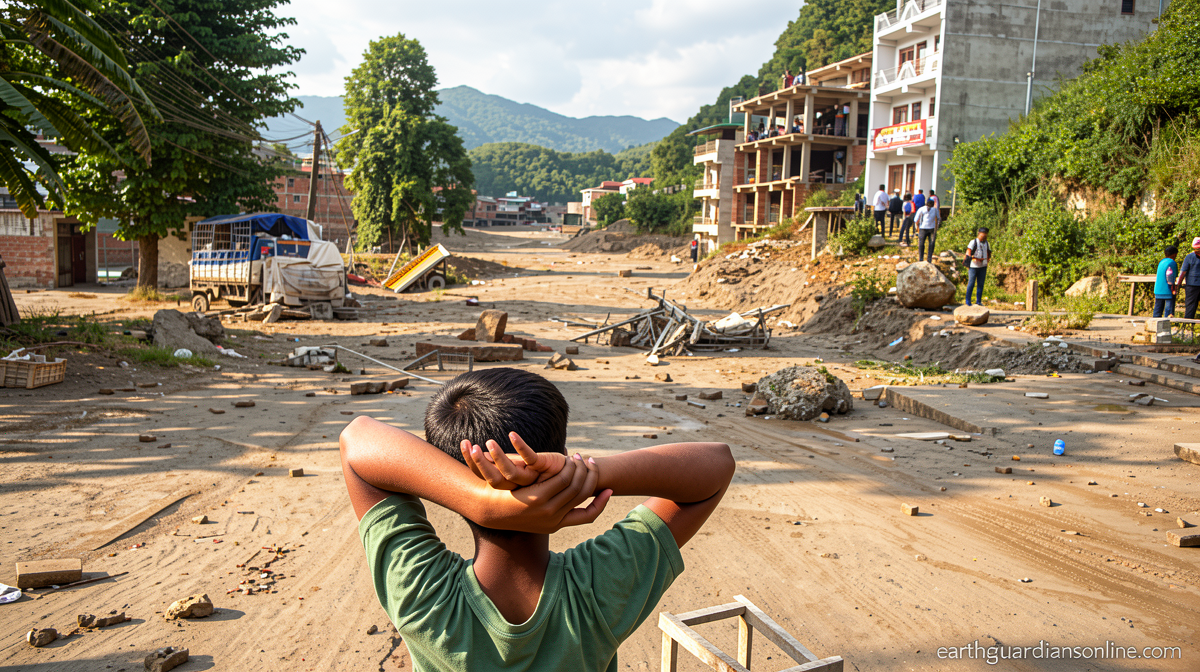
Earthguardiansonline.com – When the ground shook along the Nepal-China border on a summer morning in 2026, the first assumption was straightforward: an earthquake had struck. Within minutes, however, that assumption collapsed. What actually set the earth trembling was not tectonic movement but something far stranger — a colossal landslide of ice and rock so violent that it registered on seismometers as the equivalent of a magnitude 5.2 quake. The resulting flood wave tore through towns, obliterated roads and bridges, and carved a path of destruction through Nepal and Tibet. Weeks later, the precise chain of events remains under investigation by an international team of scientists, though the broad strokes of what happened are becoming clearer.
What the Seismometers Actually Recorded
At 8:37 a.m. local time, the US Geological Survey flagged shaking along the Nepal-China border, north of Kathmandu, initially catalogued as a 4.4-magnitude earthquake. Almost simultaneously, a massive cascade of ice and rock — functionally a landslide rather than a true avalanche — ripped down a mountainside and plunged into the Lhende Khola River, a tributary of the Bhote Koshi. The Bhote Koshi itself drains from the Tibetan plateau into Nepal, threading through deep gorges where even modest debris can generate torrential surges.
USGS subsequently corrected its initial classification. The seismic signal was not produced by fault rupture. It was generated by the landslide itself, whose kinetic energy translated into ground motion equivalent to a magnitude 5.2 event. In other words, the causality ran in reverse of what most observers expected: the earthquake did not trigger the slide. The slide produced the earthquake.
The Glacier-Shear Hypothesis
A multinational scientific team working to reconstruct the event believes a substantial portion of a glacier sheared free and dropped into the valley below. The sheer volume of water visible in footage from the disaster, however, presents a puzzle that a simple ice fall cannot fully explain.
“What is hard to reconcile is the gargantuan volumes of water that we see in these absolutely horrific videos,” said Daniel Shugar, a geologist at the University of California and a member of the investigation group.
The working theory now combines two simultaneous failures: a rock landslide occurring alongside the glacier collapse, producing a fast-moving slurry of ice, rock, and water that cascaded down the slope. As it descended, the mass entrained already-saturated sediment — a consequence of monsoon-season rainfall that had soaked the hillsides in preceding weeks. The resulting torrent carried far more water than a dry rockslide or a pure ice calving event would have produced.
A Warming Himalaya Under Pressure
Nepal sits at the heart of the Hindu Kush Himalaya, a mountain belt home to thousands of glaciers that are retreating at accelerating rates. Recent research indicates that ice-loss rates across this region have doubled since the year 2000, placing nearly two million downstream residents at growing risk from meltwater surges, debris flows, and lake failures. Warmer air temperatures allow meltwater to percolate into fractures within glacier ice and bedrock, progressively weakening the structural integrity of both. Shugar noted that this thermal weakening may have hastened the collapse that ultimately produced the flood.
The broader climate trajectory compounds the danger. As glaciers retreat, they leave behind vast proglacial lakes dammed by residual ice or moraine deposits. When those dams fail — whether through ice collapse, overtopping, or seismic jostling — the stored water releases in a matter of minutes, sending catastrophic flood waves down steep valleys. Tom Robinson, a senior lecturer at the University of Canterbury in New Zealand, has drawn a direct analogy to engineered infrastructure:
“These glacial dams are no different to constructed dams. If you take the Hoover Dam, for instance, you’ve got a massive lake behind it, but if you suddenly remove the Hoover Dam, that water has to go somewhere, and it’s going to come cascading down a valley in massive flood waves.”
Ruling Out Other Triggers
Investigators have also examined whether a glacial lake outburst contributed to this particular disaster. A comparable flood in the same corridor last year was traced to such an outburst in neighboring Tibet, raising the question of recurrence. Satellite imagery reviewed by geomorphologist Wolfgang Schwanghart, a professor at Freie Universität Berlin in Germany, has so far failed to identify major lakes upstream of the flood path.
“So far, satellite imagery suggests that no major lakes are upstream of the flood path, indicating that a glacial lake outburst can be excluded,” Schwanghart stated.
Weather conditions in the days preceding the event likewise do not appear to have been a primary trigger. Analysis of satellite imagery and ground-station data showed no widespread intense rainfall in the immediate vicinity during the week before the disaster. That said, summer remains the wettest season in the region owing to monsoon-driven storms, and scattered rain events did reach the area. Combined with months of accumulated snowmelt, those seasonal inputs would have left rivers running at elevated levels, amplifying the downstream impact of whatever volume the landslide released.
What Remains Unknown
Pinpointing the exact sequence — which ice mass failed first, how much rock contributed, whether multiple slides merged into a single torrent — will require weeks, possibly months, of fieldwork, remote sensing, and hydrological modeling. Until then, the event stands as a stark illustration of how a rapidly warming Himalaya is converting ancient ice into present-day hazard, and how the communities living in the valleys below carry the consequences of that transformation.
Related Reading
Frequently Asked Questions
What is What we know?
What we know is the main topic of this guide. The article explains the context, practical details, and next steps readers should understand.
Why does What we know matter?
What we know matters because readers are looking for a useful answer, not just a short summary. Good content should match search intent and help them decide what to do next.