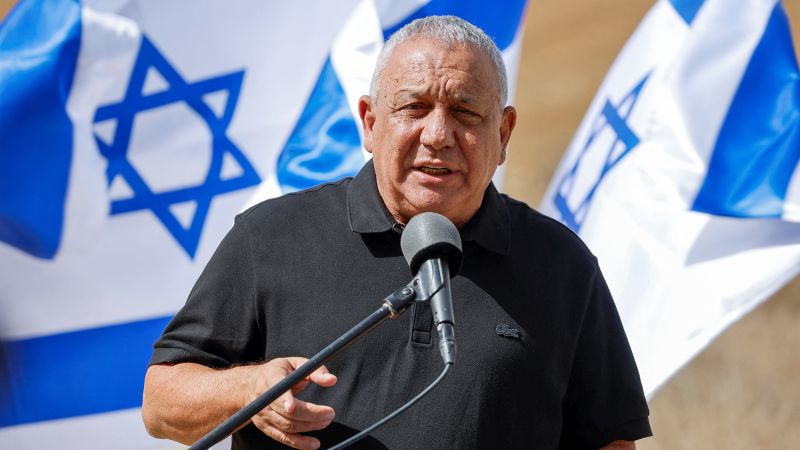
Who is Gadi Eisenkot, Netanyahu’s main challenger in Israel’s elections?

Daftar Isi
Gadi Eisenkot’s Rise Puts Israel’s Political Divide in Focus
Earthguardiansonline.com – Gadi Eisenkot has become the leading opposition figure seeking to end Benjamin Netanyahu’s long dominance of Israeli politics in the October 27 election. His strongest political credential may be straightforward: he offers voters a clear alternative to the prime minister at a moment when Israel faces deep divisions over war, security and the country’s future direction.
But Eisenkot’s candidacy has also brought renewed attention to a longstanding social divide. The 66-year-old former military chief is the son of Moroccan immigrants, and his possible ascent would carry historic significance. Israel has never elected a Mizrahi prime minister, despite the large role Jews with roots in the Middle East and North Africa have played in the country’s society and politics.
Ethnicity becomes a campaign issue
The debate intensified after Yinon Magal, a prominent television host often viewed as close to Netanyahu, made remarks about Eisenkot that triggered widespread outrage. Magal described him with a racist slur and referred to his “Mizrahi-Moroccan” background while suggesting that “Ashkenazi elites” were directing him behind the scenes.
The comments reopened discussion about inequalities between Jews of European heritage and those whose families came from the Middle East. Magal later said he had not intended to ridicule Eisenkot’s background, arguing that he had used an underworld expression for a frontman controlled by others. Netanyahu condemned the remarks as well.
Eisenkot does not often make his ethnicity central to his public identity. Still, it forms part of a biography that differs sharply from Netanyahu’s. He was raised in Tiberias and Eilat, away from Israel’s central political establishment, while Netanyahu grew up in Jerusalem amid influential circles. Mizrahi voters have long been an important constituency for Netanyahu’s Likud party, making Eisenkot’s appeal across those communities a potentially consequential feature of the race.
From military command to national politics
Eisenkot is the second of nine children and the father of five. Before entering electoral politics, he spent four decades in the Israel Defense Forces. He joined the Golani Brigade in 1978 and rose through the ranks to become IDF chief of staff, serving from 2015 through 2019 during Netanyahu’s tenure as prime minister.
His time as military chief included one of the most divisive incidents in Israel’s recent military history. In 2016, Sgt. Elor Azaria shot and killed a wounded Palestinian attacker in Hebron. Right-wing politicians, including Netanyahu, pressed against the military’s handling of the case. Eisenkot supported an investigation and trial, framing his position as a defense of military discipline and ethical standards.
He moved into politics in 2022 with Benny Gantz, another former IDF chief of staff. The two later entered Netanyahu’s emergency war cabinet after the Hamas-led October 7, 2023 attack on Israel. Their participation did not last: Eisenkot and Gantz left in June 2024, citing the lack of a defined strategy for the period after the war.
Personal loss and a political mission
The Gaza war imposed a profound personal cost on Eisenkot’s family. His youngest son, Gal, was 25 when he was killed in combat in Gaza in December 2023, two months after the war began. Two of Eisenkot’s nephews were also killed while fighting.
In an April 2026 newspaper article, Eisenkot linked that loss directly to his reasons for remaining in public life.
“Over Gal’s grave, I swore that the price he paid, he and his friends, those he knew and those he didn’t, would not be in vain,” Eisenkot wrote in Yedioth Ahronoth.
He has presented that commitment as central to his political purpose, connecting questions of military sacrifice with his argument for a different national course.
Strong polling, difficult coalition arithmetic
Eisenkot entered the final campaign period as the opposition’s best-positioned challenger. Polls have put his Yashar party at roughly 20 to 23 of the Knesset’s 120 seats, ahead of Likud in those surveys. He has also led Netanyahu in measures asking voters who is most suited to serve as prime minister.
Those numbers do not guarantee that he will take office. Israel’s parliamentary system is governed by coalition building, rather than simply by which party wins the most seats. After an election, the president assigns the task of forming a government to the lawmaker judged most likely to assemble a governing majority.
That leaves Eisenkot facing a complicated path. Surveys indicate that neither Netanyahu’s bloc—made up of Likud, far-right parties and ultra-Orthodox allies—nor the parties opposed to Netanyahu are clearly on course for the 61 seats needed for a majority. A prolonged stalemate remains possible.
To construct a governing coalition, Eisenkot would need support from parties spanning the center, left and right. In some scenarios, Arab parties could also prove important. Netanyahu has spent years seeking to discredit cooperation with Arab parties, while some opposition figures have already ruled out working with them.
Eisenkot has said he would seek to form a government even without a 61-seat majority, an approach that could involve a minority administration supported externally by Arab parties. Whether the political forces needed for such an arrangement would accept it remains one of the election’s central unanswered questions.
The contest therefore represents more than a personal rivalry between a former general and a longtime prime minister. It is a test of whether an opposition fragmented by ideology can unite around Eisenkot, and whether his military record, personal story and promise of change can overcome the political mathematics that have repeatedly protected Netanyahu’s hold on power.
Related Reading
Frequently Asked Questions
What is Who is Gadi Eisenkot Netanyahu s main?
Who is Gadi Eisenkot Netanyahu s main is the main topic of this guide. The article explains the context, practical details, and next steps readers should understand.
Why does Who is Gadi Eisenkot Netanyahu s main matter?
Who is Gadi Eisenkot Netanyahu s main matters because readers are looking for a useful answer, not just a short summary. Good content should match search intent and help them decide what to do next.