
Zelensky needles Putin in personal letter calling for face-to-face peace talks
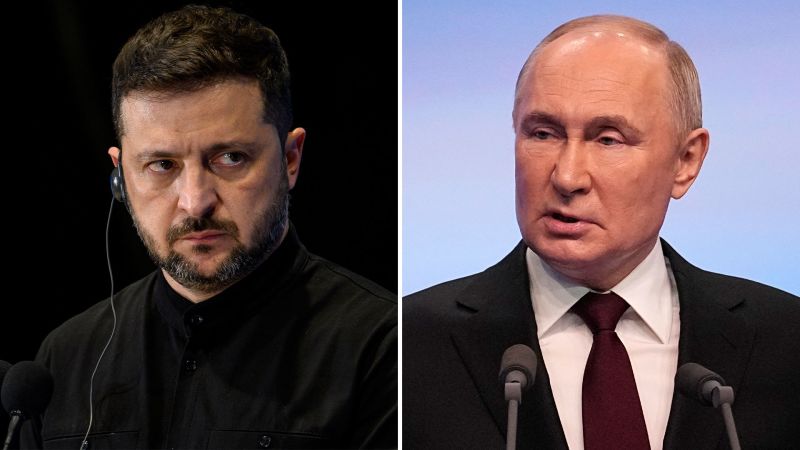
Zelensky Urges Direct Talks with Putin Amid Economic Strain on Russia
Zelensky needles Putin in personal letter – As Russian President Vladimir Putin engaged in discussions at the St. Petersburg International Economic Forum, Ukrainian President Volodymyr Zelensky sent a pointed message through an open letter. The document, published alongside the event, called for an end to the four-year war and emphasized the need for face-to-face negotiations. Zelensky’s timing was deliberate, targeting a gathering where Russian billionaires and political leaders exchanged ideas on economic strategy. The choice of venue underscored a strategic intent: to leverage growing unease among the business elite about the war’s toll on Russia.
“We can all see that Russians are finally becoming less comfortable with this reality—how the war is bringing more and more negative consequences to Russia,” Zelensky wrote. “They do not like the fact that there is no end in sight to your war.” The letter reflected a shift in tone, blending diplomatic appeals with a personal challenge to Putin. Zelensky highlighted the Russian leader’s repeated delays in capturing key regions, particularly Donetsk, and warned that the conflict might continue into the next year. “And you will not capture it this year either,” he added, emphasizing the urgency of a resolution.
Zelensky’s Direct Appeal
In a departure from formal diplomatic channels, Zelensky addressed Putin directly, framing the war as a choice that could define Russia’s future. “(You) will have to fight much harder for your own existence—not Russia’s, but your own,” he wrote. “This is not a threat from me or from Ukraine. It is a fact of Russian history that you know well: when Russia grows tired, change comes.” The message was clear—Putin’s grip on the war is weakening, and the time for decisive action is approaching.
Zelensky also stressed the need for immediate steps to reduce the conflict’s intensity. “We can work toward that fatigue. You can stop your war,” he said, suggesting that the prolonged engagement could erode public support for the war effort. This sentiment aligns with broader concerns from Western analysts, who have long argued that Russia’s war strategy is unsustainable. The International Institute for Strategic Studies recently noted that the Kremlin faces a critical decision: either increase pressure on the economy and society or adjust its war goals.
Russian Economic Concerns Emerge
While the letter was public, the Kremlin’s response remained measured. Spokesperson Dmitry Peskov confirmed that the letter had been reviewed and that Putin was aware of its contents. “He can come to Moscow,” Peskov said, hinting at a willingness to engage but also reinforcing the idea that the meeting would take place on Russian soil. However, Zelensky dismissed the notion of traveling to Moscow, citing the threat of assassination attempts attributed to Russian-backed groups. Ukrainian security services had reportedly foiled several such plots, making a visit to the capital a high-risk proposition.
Meanwhile, internal Russian voices have begun to question the economic viability of the war. German Gref, head of Sberbank, Russia’s largest financial institution, described continued growth as “already a miracle” in the current climate. His remarks echoed those of other economists who have warned about the strain on Russia’s resources. Deputy Prime Minister Alexander Novak, on the other hand, described the economy as “in a state of controlled cooling,” a more optimistic assessment that contrasts with Zelensky’s message.
Zelensky’s letter also touched on the broader geopolitical context. He pointed out that the United States was increasingly focused on Iran, creating an opportunity for Ukraine to push for peace without waiting for American attention to shift back to the war in Europe. “We see that the United States is fully focused on the issue of Iran, and it would be wrong to simply wait until the war in Europe returns to the center of its attention,” he said. This argument aimed to position Ukraine as a proactive force in negotiations, rather than a passive victim of Russian aggression.
Strategic Strikes and Military Momentum
Despite the war’s economic challenges, Ukraine has demonstrated military resilience. Recent operations have allowed Kyiv to strike deep into Russian territory, targeting energy infrastructure and other critical assets far from the front lines. These actions have heightened the stakes for Russia, as the war’s impact extends beyond the battlefield. “War is coming home to Russia’s biggest cities,” Zelensky noted, a statement that underscores the growing domestic pressure on the Kremlin.
The letter’s emphasis on direct engagement with Putin also reflected a broader strategy to break through diplomatic stalemates. Zelensky proposed a meeting in a third country, suggesting a neutral setting would foster more productive discussions. He argued that a clear timeline for the talks was essential to avoid further delays. “An attempt to establish real silence is the best way to begin talking to one another,” he wrote, highlighting the importance of mutual understanding in achieving peace.
Putin, in turn, acknowledged the possibility of compromise. During the forum, he mentioned Donald Trump’s proposals as a potential foundation for peace. “We generally agreed to these compromises. We just need to convince the Ukrainian side of this, and that’s it,” he said. However, the Russian leader’s remarks left room for interpretation, suggesting that the path to peace requires Ukraine to make concessions. This aligns with Putin’s ongoing demands, including the cession of territory currently under Ukrainian control.
The letter’s timing—just as attendees of the forum, often referred to as “Russia’s Davos,” gathered in St. Petersburg—was no accident. Zelensky’s message coincided with a moment of vulnerability for Russia, as its leaders grappled with both economic and political challenges. The open letter served as a reminder that the war’s consequences are no longer confined to Ukraine; they are reverberating within Russia itself. “Russia is facing a spring of discontent,” Zelensky noted, a phrase that captures the growing dissatisfaction among the population and the business class.
While Ukraine has not yet secured a decisive victory, it appears to have gained a strategic advantage in certain regions. The ability to strike deep into Russian territory has forced the Kremlin to reassess its military objectives and resource allocation. Zelensky’s letter, therefore, is not only a call for peace but also a reflection of Ukraine’s evolving position in the conflict. As the war continues to test Russia’s endurance, the message from Kyiv grows louder: the time for negotiation is now, and the cost of prolonging the conflict is rising.
Analysts suggest that Zelensky’s approach could pressure Putin into a more conciliatory stance. The combination of military progress, economic strain, and domestic unrest creates a unique opportunity for dialogue. However, the success of these efforts will depend on the willingness of both sides to find common ground. For now, the letter stands as a symbol of Ukraine’s determination to end the war, even as the path to peace remains uncertain.
