Iran’s latest warning to the US signals the hardliners are just getting started

Daftar Isi
Tehran’s Pivot to the Offensive: Iran’s Hardliners Signal a New Phase of Confrontation
Earthguardiansonline.com – With the United States still mired in a conflict it launched nearly six months ago, President Donald Trump finds himself caught between two contradictory postures: insisting that Tehran is “begging” for a negotiated settlement while simultaneously threatening to resume kinetic strikes. Into that vacuum of American indecision, Iran’s hardline establishment is now inserting its own agenda — one built not on waiting for Washington to blink, but on projecting sustained military pressure until terms favorable to Tehran are extracted.
The diplomatic framework that was supposed to end the fighting, a Memorandum of Understanding negotiated between the two capitals, is set to expire. Control of the Strait of Hormuz, the narrow waterway through which roughly a fifth of global oil shipments pass, remains unresolved. That unresolved status gives Iran’s military leadership a sense of leverage it did not possess at the war’s outset. Analysts note that Tehran’s commanders believe they can close the capability gap with more powerful adversaries through continued adaptation of their weapons systems, and that the current stalemate actually strengthens their bargaining position rather than weakening it.
Leadership Shuffles and the Language of Attack
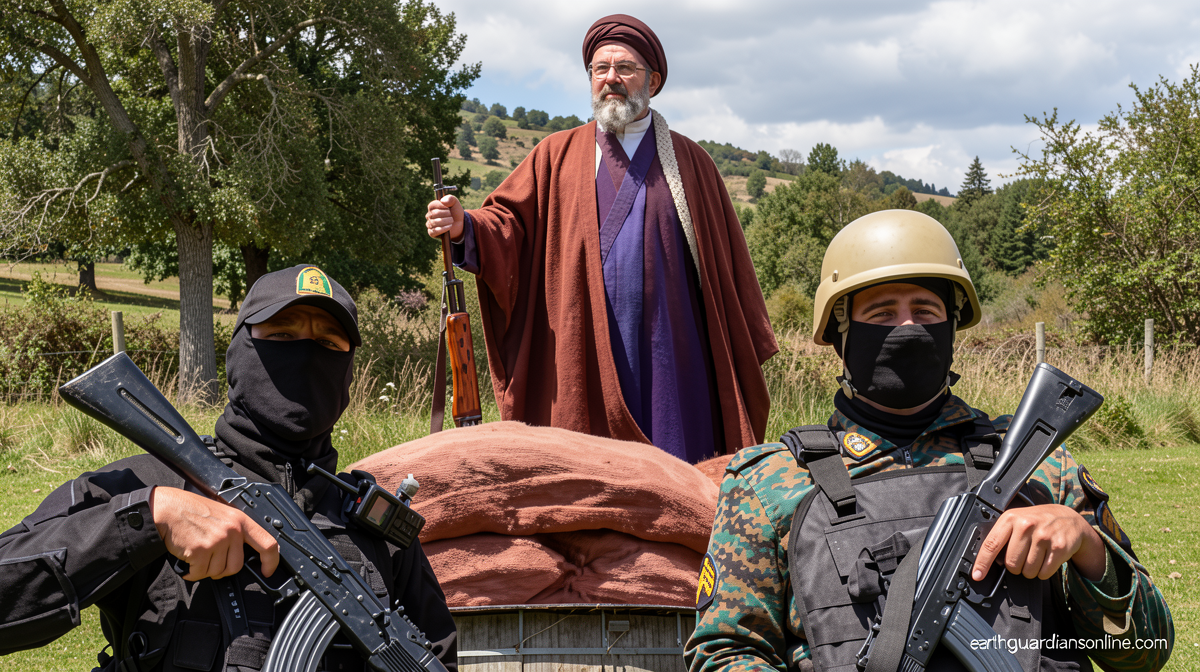
The institutional machinery for this new posture was set in motion last week through a series of decrees issued in the name of Supreme Leader Mojtaba Khamenei, reorganizing Iran’s security command structure. Among the most consequential appointments was the confirmation of Ahmad Vahidi as head of the Islamic Revolutionary Guards Corps. The decree accompanying his elevation explicitly called for heightened readiness for “strong offensive operations against the enemy” — language that departs sharply from the defensive vocabulary that dominated Iranian military discourse during the earlier phase of the war.
Hamidreza Azizi of the Clingendael Institute in the Netherlands read the appointment as a clear signal: Vahidi’s mandate was to recalibrate Iranian military strategy toward a more assertive, forward-leaning orientation. Days after the decree, Brig. Gen. Yadollah Javani, the IRGC’s political deputy, told the semi-official Fars news agency that Iran’s actions remain defensive in character, though they “may also take on an offensive aspect in the future.” The distinction matters in Tehran’s domestic political economy, where framing operations as defensive preserves popular legitimacy even as the operational tempo escalates.
Mohammad Reza Naqdi, an adviser to Vahidi, went further in remarks to state broadcaster IRIB, stating that the IRGC is developing the capacity to conduct operations “on enemy soil.” He emphasized the need to be able to “move the operations to the enemy’s soil, whenever this is needed and ordered.” The corps has been tasked with launching strikes in what Naqdi described as an “intelligent, selective, and targeted manner” — a formulation that, in practical terms, points toward renewed targeting of American military installations across the Gulf region.
From Resilience to Initiative
The strategic logic behind the shift is articulated most plainly by Mohammad Mokhber, an adviser to Khamenei, who declared that the “strategy of shifting the war to an offensive posture if Iran’s conditions are not met will undoubtedly transform the balance of power in the world.” The claim is bold, but it rests on a factual premise: Iran has absorbed a sustained barrage of American and Israeli strikes, along with retaliatory pressure from Gulf Arab states, and has remained structurally intact.
“The regime has withstood the US/Israeli barrage and retaliation from the Gulf Arab states, and they are still standing. Now they seek to transform this resilience into permanent political advantage in the region as opposed to letting the initiative waste away over time.” — H.A. Hellyer, senior associate fellow, Royal United Services Institute, London
Trita Parsi of the Quincy Institute for Responsible Statecraft frames the pivot in operational terms: Tehran believes it holds the military edge and is openly discussing going on the offensive rather than merely reacting to American strikes. In doing so, Iran would wrest control not only of the war’s scope and geography but also of its timing — a shift from reactive to proactive that fundamentally alters the calculus for Washington.
Regional Proxies and the Widening Front
The new doctrine does not operate in isolation from Iran’s network of allied forces. In recent weeks, Houthi fighters in Yemen have threatened Saudi commercial shipping and struck Saudi oil refineries, while Iranian-backed militias in Iraq have targeted Saudi petroleum infrastructure. Greater mobilization of these partners is a near-certain corollary of Tehran’s offensive turn. For Gulf states already bearing the economic cost of disrupted energy flows, the prospect of a sustained Iranian offensive posture raises the stakes considerably and complicates any attempt to mediate a ceasefire.
The Escalation Calculus
Behind the military posturing lies a cold economic arithmetic. Iran faces deepening domestic economic strain compounded by the continued naval blockade and the weight of international sanctions. Azizi argues that the current no-war-no-peace limbo, with its slow attrition of capability under dual pressure, may push the leadership toward deliberate escalation — either to force Trump to lift the blockade or to extract a settlement on terms more favorable to Tehran.
“The Iranian leadership may conclude that the costs of entering another war are lower than the costs of the gradual erosion of its capabilities under the dual pressure of sanctions and the blockade.” — Hamidreza Azizi, Clingendael Institute
On the tactical side, Iran has adapted rapidly over recent months. A new generation of more maneuverable ballistic missiles fitted with cluster warheads, combined with innovative drone employment, signals that the force structure is being rebuilt around precision strike rather than volume saturation. Sina Azodi, assistant professor of Middle East politics at George Washington University, notes that the faction now dominating the Supreme National Security Council under Mohsen Rezaie holds that “the only way to get concessions from the US is the continuation of fighting, exerting pressure on the US and a steady dose of pain on Donald Trump.”
For Washington, the implications are straightforward: the window for a negotiated exit from the conflict is narrowing. Each week that passes without resolution hardens Tehran’s institutional commitment to the offensive path, entrenches the role of proxy forces along the Gulf littoral, and narrows the set of options available to a president already struggling to define what victory looks like in a war he started.
Related Reading
Frequently Asked Questions
What is Iran s latest warning to the US?
Iran s latest warning to the US is the main topic of this guide. The article explains the context, practical details, and next steps readers should understand.
Why does Iran s latest warning to the US matter?
Iran s latest warning to the US matters because readers are looking for a useful answer, not just a short summary. Good content should match search intent and help them decide what to do next.