North Korea boosts support for Russia to include drone operators, Ukraine says

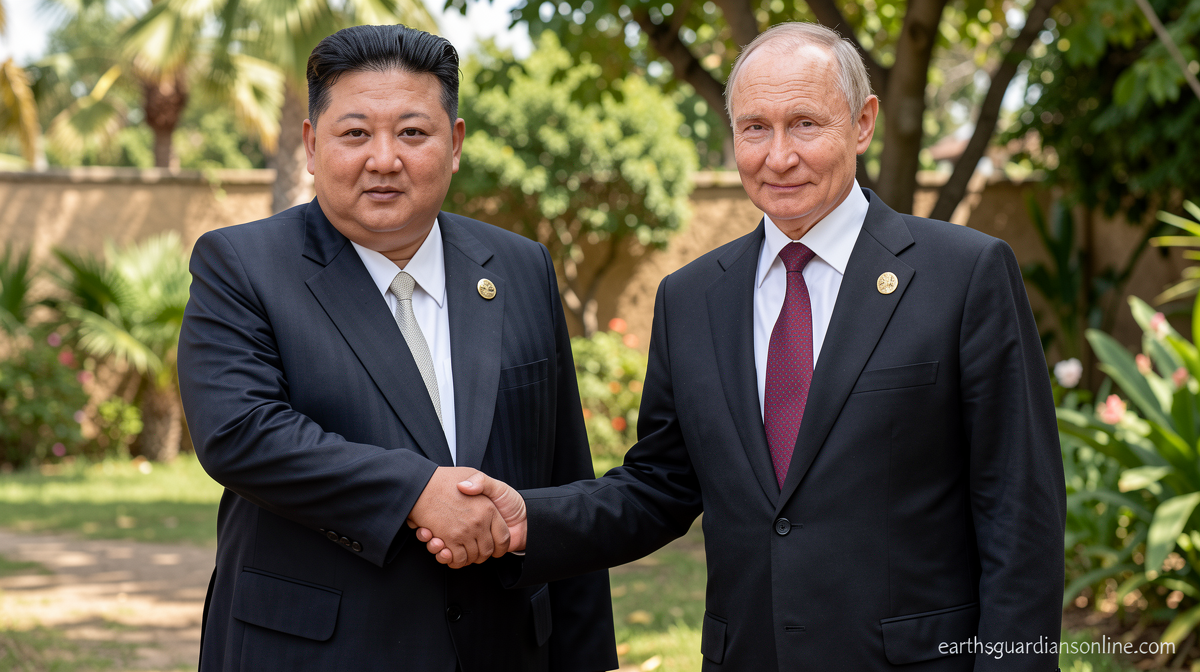
North Korea Boosts Russia Support with Drone Units
Earthguardiansonline.com – Ukrainian intelligence has confirmed that the newest batch of Pyongyang soldiers arriving in Moscow’s operational theater carries a dedicated drone component capable of hitting targets deep inside Ukrainian territory. North Korea boosts support for Russia at a level that now extends well beyond raw manpower, and the roughly 8,500 personnel in this latest wave represent a qualitative escalation in how the two regimes coordinate their war efforts. Kyiv’s air-defense network, already stretched thin, faces added pressure from aircraft tasked with both reconnaissance and precision strikes.
Composition and Operational Role of the New Wave
Major General Vadym Skibitskiy, Deputy Head of Ukrainian Defense Intelligence, broke down the unit’s makeup: approximately 1,000 engineers and deminers assigned to clear and fortify positions, plus 400 drone operators whose experience was sharpened during earlier rotations. Those operators will fly aircraft serving a dual mission—overhead surveillance of Ukrainian lines and targeted kinetic strikes—marking the first confirmed instance of an organized drone cell embedded within the larger deployment structure rather than operating as a scattered, ad-hoc capability.
A September Summit Could Multiply the Footprint
The current arrival is not an isolated gesture. Two years ago the two governments formalized a mutual-defense compact modeled on NATO’s Article 5, and Pyongyang has been funneling soldiers into the Russian theater since late 2024. Skibitskiy indicated that President Vladimir Putin may ask Kim Jong Un for as many as 50,000 additional troops when the two leaders meet in September. Should that figure materialize, the scale of cooperation would dwarf anything seen since the Cold War’s final decades—and it would land at a moment when Ukraine’s interceptor stocks are running dangerously low. North Korea boosts support for Russia at a pace that Kremlin public messaging has not fully acknowledged, supplementing Moscow’s proclaimed industrial resilience with foreign manpower and technology.
Where the Troops Sit and What They Do
Most of the newly arrived personnel are concentrated in Russia’s Kursk region, the same area where the first deployment landed in October 2024 to blunt a Ukrainian incursion—the first foreign military crossing onto Russian soil since World War II. Ukrainian intelligence assesses that these soldiers will not engage directly on Ukrainian territory. Instead, they will shore up rear-area positions, freeing Russian regulars to press forward in offensive operations inside Ukraine.
Ukraine first detected North Korean use of attack drones over its own territory last October. The present wave, however, is distinct: it embeds an organized drone unit within the broader force structure, a step that changes the tempo and precision of the threat.
Alliance Friction and Diplomatic Reactions
The deepening military entanglement between Moscow and Pyongyang has unsettled NATO members, who see a non-NATO power effectively absorbing the costs of a major conventional war on their eastern flank. Unease sharpened after President Donald Trump announced that joint military exercises with South Korea would be scaled back, a move framed as a courtesy to Kim Jong Un, whom Trump has expressed a desire to meet again. Kim’s sister and senior political figure Kim Yo Jong pushed back against Western reporting that tens of thousands more North Koreans were imminent, dismissing the figures as a
“groundless self-fabricated scenario.”
Ukrainian intelligence nonetheless places the cumulative number of North Koreans deployed or rotated through Russian military units at approximately 25,000 to date, a figure that predates the current 8,500-strong wave. In effect, North Korea boosts support for Russia through sustained, rotating deployments rather than a single static garrison.
Lessons Carried from the First Wave
The initial October 2024 deployment of an estimated 10,000 soldiers into Kursk produced heavy casualties. North Korean units reportedly employed mass-assault tactics against entrenched Ukrainian positions, absorbing losses that would be politically untenable in most other militaries. Pyongyang remained publicly silent about the deployment for months, finally confirming its soldiers were engaged against Ukraine only in April 2025. Wounded veterans returned home carrying firsthand knowledge of drone-dominated combat, and that experience now feeds directly into the training of the new drone operators heading back east.
Frequently Asked Questions
How many North Korean troops are in the latest deployment? Roughly 8,500 personnel, including about 1,000 engineers and deminers and 400 drone operators, according to Ukrainian Defense Intelligence.
Where are the troops stationed? Most are concentrated in Russia’s Kursk region, the same area that received the first wave in October 2024.
Will the new drone operators fight on Ukrainian soil? Ukrainian intelligence assesses that the broader deployment will hold rear-area positions in Russia, freeing Russian regulars for offensive operations inside Ukraine. The drones themselves, however, are expected to fly over Ukrainian territory for reconnaissance and strikes.
Could the deployment scale up further? Skibitskiy indicated Putin may request up to 50,000 additional North Korean troops at a September summit with Kim Jong Un. Kim Yo Jong has publicly dismissed Western estimates of that magnitude.
What is the cumulative number of North Koreans rotated through Russian units? Ukrainian intelligence estimates approximately 25,000 to date, a figure that predates the current 8,500-strong wave.